



Ulstein delivers another X-bow PSV
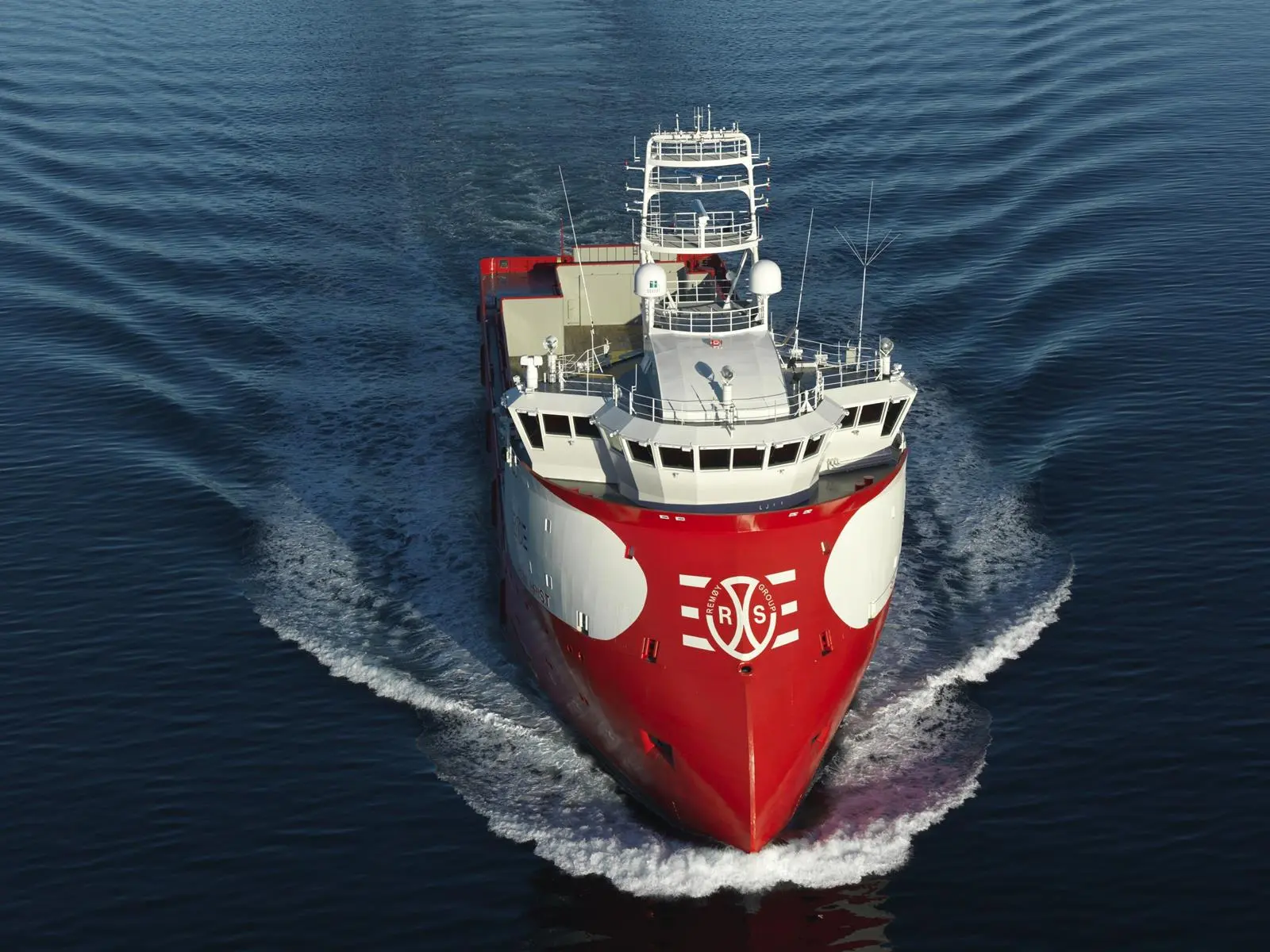
Ordered by Remøy Shipping, the Rem Hrist is the first vessel from the Ulstein Verft to be delivered to the Fosnavåg-based company and will be followed by a sister vessel, Rem Mist, yard number 289, which is under construction and scheduled for delivery later this spring.
Both X-bow vessels have been built together, starting with their keel laying on 1 September 2009 at the JSC Shipyard Zaliv in Kerch, Ukraine. Both have been outfitted at the Ulstein Verft shipyard in Ulsteinvik on the west coast of Norway. The vessels were built, equipped, and painted (tanks and exterior) in dry-dock inside a covered dock-hall, ensuring controlled atmosphere which the company hoped would result in high-quality workmanship and good surface protection.
Based on the PX105 design by Ulstein Design & Solutions, the Rem Hrist is a large PSV and is fitted with a well equipped and spacious bridge affording an uninterrupted 360° view thanks to the unusual exhaust system which is led through the ship’s side and emerges at the water surface instead of going through the wheelhouse deck-head.
The 4,258 dwt newbuilding measures 88.8m long, 19m wide, has about 1,000m2 of cargo deck space with a maximum deck-load of 2,430 tonnes. She equipped with some 136,000m of cable, 14-15,000m of piping and has a complicated cargo system with multi-cargo tanks for liquids and solid materials
The diesel electric power and propulsion plant comprises two Caterpillar 3516C engines, each of MCR 2,188kW (2,100 kWe/2,333 kVA) at 1,800 rpm, and two Caterpillar 3512C engines, each of MCR 1,790kW (1,700 kWe/1,888 kVA) at 1,800 rpm. Each of these main high speed engines is coupled to an AVK 690V – 60Hz electrical generator. An emergency genset is provided in the shape of a Caterpillar C9 diesel generator with an output of 200 kWe – 250 kVA at 1,800 rpm.
The main propulsion system consists of two Schottel SRP 2020 FP azimuth thrusters, each driven by a vertically mounted VEM frequency controlled variable speed electric propulsion motor. The two 2,600mm diameter three-bladed fixed pitch azimuthing rudder-propellers each deliver an output of 2,500kW at 800 rpm and give the vessel a maximum speed of 15.4 knots at a 5m draught.
For enhanced manoeuvrability, the vessel is fitted with a frequency controlled 850kW retractable Brunvoll controllable pitch propeller azimuthing thruster forward and two super silent frequency controlled 1,200kW Brunvoll controllable pitch propeller tunnel bow thrusters. This propulsion system means that the newbuilding is built and certified according to DNV’s AUTR, IMO Class II for dynamic positioning providing excellent station keeping capabilities with ERN (99,99,98). The US-based Marine Technologies provided the DP system incorporating a position reference system of two DGPS, laser reference system, radius reference system and pitch and roll sensor.
Rem Hrist is environmental-friendly and is certified by Det Norske Veritas according to the latest rules for class Clean Design. To reduce air pollution, each of the vessel’s four diesel engines is equipped with an exhaust gas system with controlled sea water injection and with SCR catalysts based on urea. Exhaust gas is cooled to 60-65° C and is led overboard through the ship’s hull-side above sea level. A ‘green passport’ complying with IMO ship recycling recommendations has been issued.
To meet the general demands of the offshore industry for cargo carriage, the newbuilding is fitted with six multi-application tanks arranged for carrying dry bulk and liquid cargoes with maximum specific gravity of 2.8 t/m3. This includes the carriage of 708m3 of fresh water, 1,650m3 of fuel oil, 1,804m3 of ballast/drill water, 1,315m3 of liquid mud, 734m3 of cement and 1,350m3 of brine. Various liquid cargo handling pumps are installed and these include four Danfoss multi-purpose hydraulic cargo pumps, two electrically-driven fresh water pumps, several fuel oil pumps and a couple of electrically-driven mud agitators. In addition, the 916m2 cargo deck will be able to accommodate pipes and other general cargo. Alfa Laval provided the ballast water treatment filter system.
Deck winches consist of an Odim double anchor windlass/mooring winch (three drums), two 10t pull tugger winches, two 10t pull capstans aft and six 4.6t pull lashing winches. A single 2t knuckle boom shipboard crane from TTS Marine Cranes is installed to handle stores.
Oil recovery is another important function and, to meet this requirement, the newbuilding is equipped with a 1,600kW electric Parat Halvorsen steam boiler to provide heating for the 2,265m3 oil recovery tanks in compliance with NOFO 2005. She also has an oil recovery skimmer, an oil recovery boom winch aft, a long range Securus IR camera for oil spill monitoring and search/rescue. The OSV is certified as a standby vessel for 250 persons and has appropriate flood lights with three 2,000W halogen searchlights in accordance with NMD/OLF regulations for standby vessels.
The Ulstein Group supplied a variety of electrical equipment including the main 440V and 230V switchboards, the emergency switchboard, communications including common distribution of IP automatic telephone, data network, and satellite TV antenna signal to all offices and cabins, mains telephone system and separate PA system (Ulstein COM), the integrated automation system (Ulstein IAS), the integrated navigation system (Ulstein NAV) and the bridge alarm system.
Accommodation for the 24 crew members is of a high standard with a floating floor on all accommodation decks providing low noise and vibration levels. In addition to the 14 single and five two-bed cabins, there is a hospital, a 20-seat dining area, a day room and a gym. For added crew comfort, there are three roll damping stabiliser tanks. The sanitary supply and discharge system is based on a Jets vacuum sewage toilet plant which is USCG approved.
The Ulsteinvik-based Mare Safety AS provided the lifesaving and rescue equipment in the shape of four 25-person life rafts and a 7.18m Mare Safety GTC 700-2 VD MOB boat with inboard twin diesel engines/waterjet propulsion and a top speed of 40 knots. For rescue duties, the ship is fitted with a rescue basket RB300 and two 10m x 6m scrambling nets.
There is a stand-alone addressable fire detection system with a Marioff water mist fire fighting system for the engine room, and a local water mist protection system.
The hull form, with the Ulstein X-bow combined with the diesel electric propulsion system, is designed to offer optimum performance with regard to fuel consumption, sea keeping, station keeping and speed. Remøy Shipping regards the Norwegian flagged Rem Hrist as a valuable addition to the offshore fleet thanks to its multi-functionality and environmental credentials. Both Rem Hrist and Rem Mist will work on eight-year contracts for Statoil in the North Sea.
Principal dimensions:
Length oa 88.80m
Length bp 82.00m
Breadth moulded 19.00m
Depth to main deck 8.00m
Maximum draught 6.60m
Design draught 6.00m
Dead weight (approx.) 4,258 dwt
Gross tonnage 3,969 gt
Max deck load approx. 2,430 tonnes
Cargo main deck area 916m2
Cargo deck load bearing 10 t/m2
Main propulsion 2 x 2,188 kWCaterpillar 3516C high speed gensets
2 x 1,790 kWCaterpillar 3512C high speed gensets
Propulsors 2 x Schottel SRP 2020 FP azimuth thrusters
1 x 850kW retractable Brunvoll CPP azimuth thruster
2 x 1,200kW Brunvoll CPP tunnel bow thrusters.
Speed (maximum) 15.4 knots
Related Articles
 PROPULSION
 GENERAL NEWS
 HYDROGEN