



The future of the ultra large container ship
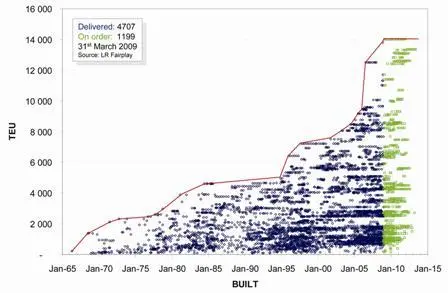
The graph shows how the size of container ships has grown over the years. Large ships are green ships by virtue of the fact that the fuel consumption per TEU transported is lower as a result of economies of scale. Two decades ago, studies were published comparing two 4,000 TEU ships to one 8,000 TEU ship and showed a reduced total cost per unit. Today, a comparison between two 8,000 TEU ships and one 16,000 TEU shows the same trend. The capital cost for the bigger ship is in the order of 20% less and the fuel cost around 40% less, the exact numbers depend on the building price and fuel price.
So bigger ships going at lower speed are what the world may be looking for in the years to come. But we all know that big ships need to a full payload to be able to reap the benefits and, in times of fluctuating transport volumes, it is prudent to ask if big units provide the best solution for adjusting the transportation service supply to the demand. What about the technical limitations?
A 16,000 TEU design has been developed in Korea and preliminary data give some indication of the steel dimensions and quality required. The length and beam are close to those of the Emma Maersk series, namely 399m x 57m. The material dimensions in the upper hatch coaming would have to be in the order of 75–85mm using HT47 steel. The highest grade currently in wide use is HT40 and the utilisation factor for this quality is not yet fully standardised in IACS.
A 22,000 TEU design as indicated by STX would have a length of about 470m. This is an increase of 17% compared to the 16,000 TEU. The bending moment is proportional to the square of the length leading to a corresponding increase in the section modulus and steel dimensions. So new detail designs and solutions have to be developed to allow for such a significant increase.
So why not increase the beam and reduce the length? The crane outreach, draught, lifting capacity and NPX restrictions are limiting factors. However, design considerations like resistance and fuel consumption, will also have a significant influence. The total resistance is made up of friction and wave-making resistance. At lower speeds, the friction resistance dominates while at higher speeds the wave making resistance dominates. The friction resistance is proportional to the wetted surface and a longer ship will have a larger wetted surface than a shorter one with the same beam, draught and deadweight. So when the speed drops, a shorter, beamier ship will have more economical fuel consumption.
What about the engine power needed for such a big ship, is it available? So far, what we have seen is the single screw with an up to 14-cylinder max-bore slow-speed engine that propels the big current designs at speeds of 24 -25 knots or more. This has been the solution for all container ships designed up to now.
For the 22,000 TEU design, the twin propeller solution with two smaller slow-speed engines and a skeg design could be an alternative. The higher capital expenditure (some 10% or $10 to $15 million) has ruled, up to now, out this as an alternative. However, the solution has been studied (Sulzer, some years ago), and, contrary to popular belief, the indications are that better propeller efficiency will outweigh the other losses to an extent that increases the overall efficiency by some 3%. So there is a fuel efficiency gain there that will partly offset the increased capital expenditure.
Can we learn from history? We know from the development of the VLCC in the 1960s and 1970s how the ship size increased driven by economies of scale and increasing global demand for crude oil. Are there any similarities with what has happened to container ships today? Wijnholst et al wrote about this in the Malaccamax report years ago. They suggested that the 21m allowable draught in the Malacca Strait would be the limiting factor for the biggest container ship that could be built. They also presented a graph showing tanker development in which the ship size increased rapidly to about 550,000 dwt before decreasing and settling at a common size of 300,000 dwt which is the going size for a VLCC these days.
From a technical point of view, building the 22,000 TEU design is possible, but time is needed to solve the outstanding issues. Maybe the leap from the present maximum to 22,000 TEU is too much in one go, and some intermediate size designs may need to be tested out first. That is not likely to happen in the foreseeable future due to the current market situation.
The typical big container ship of the future would most likely predominantly be the NPX (about 12,500 TEU), able to pass through the new Panama Canal (366m x 49m) and under the Bayonne bridge. It combines economy of scale with flexibility and versatility, and that is likely to make it a winner.
(Article based on a paper written by Knut A. Dohlie and first published in the DNV Container Ship Update No. 3 2009)
Related Articles
 PROPULSION
 GENERAL NEWS
 HYDROGEN