



Sinking a ship in a good cause
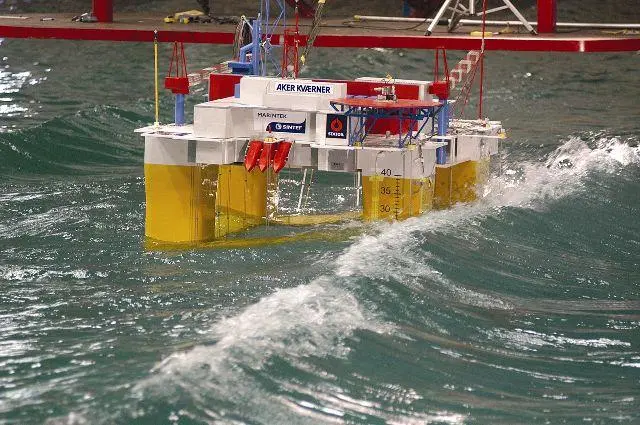
The Norwegian Marine Technology Research Institute in Trondheim – Marintek for short – claims to have long been in the forefront of ensuring safer designs for the massive variety of structures used in the global maritime industry.
And the marine industry is said to be one of the most demanding. The sea is an interface between air and water that is constantly changed by a mixture of forces shaped by meteorological, oceanographical and topographical conditions. These forces give rise to a wide variety of bending, twisting, and racking stresses both in compression and tension and often in a very short space of time.
Different designs of ships – ranging from small coasters through to the largest oil tankers – ply their trade on this flexible surface. Oil rigs, docks and other support structures are either fixed in place or have some limited form of movement as they resist the combination of wind and waves.
To ensure that structures are safe, Marintek undertakes research using models, usually to a 1:50 scale, designed as exact replicas of the proposed design. And then the elements are unleashed.
Marintek uses a range of equipment to ensure it creates authentic tests. These include a 50m x 80m wave tank with variable depth. Storm machines and wave generators are used to produce multi-dimensional waves. The machines can simulate anything from a light breeze to a wave that will only theoretically happen once every 10,000 years. There is also a 260m long x 10m deep towing tank, so that models can be subjected to different wave patterns to study how they respond at varying scale speeds of up to 8m/s and wave heights of up to 0.9m.
All of these tests examine the seaworthiness and manoeuverability of fixed and floating structures. Marintek can test anchoring systems, sea-based energy systems, offshore loading systems, marine drive systems, and underwater systems such as operations and pipelines. It can also examine the potential for structures to resist collision.
The aim of every test undertaken at Marintek is to measure the forces to determine whether a proposed design is safe or can be improved. This means using a wide variety of sensors to measure every possible parameter. Every scale model tested is equipped with sensors; up to 200 sensors have been used in some very special cases.
These sensors determine variables such as rudder angle, water pressure, wave height, roll, pitch and yaw, and movement along the six degrees of freedom. If the model is fitted with an engine, then the engine speed and propeller functionality can be measured. Equally any wave pattern generated for a set of tests has to be measured.
Capturing all of the data that is generated during a test sequence requires equipment that is accurate and reliable. For the past 25 years Marintek has been using equipment supplied by HBM, a multi-national instrumentation company headquartered in Germany. Throughout the testing halls there are racks of measuring amplifiers and logging equipment from HBM, all busy collecting, digitising and logging the data.
This trust was recently extended when Marintek needed a new data logging system to replace its 15-year-old predecessor. Although a number of different products were tested, Marintek choose HBM’s MGCplus combined with catmanEnterprise. One reason for this selection was that it can acquire three different simultaneous sampling frequencies during the same test. Marintek comments, “No-one else can do that”.
Marintek also felt that a major benefit is that catman can be run without an MGCplus being connected. This means that the test engineers can create lists of measuring channels in advance that are then imported into the measuring equipment, with no delays in starting taking measurements.
Marintek has arranged its MGCplus cabinets as a number of plug-in units residing on the same voltage bus. This is powered by an internal UPS. All measuring data is collected by a central controller, where it is logged and made available by Ethernet. Any number of rack cabinets can be used in a measuring system and a central host computer runs the control program catmanEnterprise.
For Marintek’s work, the MGCplus can be used in any configuration, with 8 or 16 add-on cards for functions including analog I/O, digital I/O, frequency output, wire strain gauge measurement with power to bridge, Pt-100, thermoelement, limit switches, CAN bus, Profibus, RS-232, RS-485, inductive sensors, piezoelectric sensors and potentiometers.
The system also allows a number of MGCplus cabinets to be synchronised. This is important if the tests demand sampling a large amount of data simultaneously.
Marintek has found a number of advantages in standardising on a single maker’s equipment. For example, a model might first be tested in the towing tank and then in the ocean tank. It is easier to disconnect the model from one set of measuring equipment, take the model and its channel list and simply connect everything to the measuring rack in the next tank. The measurements are the same regardless of where they take place.
A major advantage claimed for catman is its ability to subdivide a complex test involving numerous measuring channels into several sub-projects. This allows different technicians to work on their own subset of channels and save the result as a separate project which is much faster than trying to work with all the 50 to 200 or so channels required by a major ocean project.
The system can sample values with a number of different sampling frequencies at the same time. Sampling all channels with the maximum necessary frequency would otherwise produce data files of an unreasonable size. The files can now be brought down to an optimum size, shortening transmission times.
Marintek uses its MGCplus equipment for more than just importing test values. The output card is used to send start pulses to begin video recording of the process and to synchronize the clock shown on the video images while the wave and wind machines receive start and stop pulses from MGCplus although they are actually operated by a dedicated PC.
Related Articles
 PROPULSION
 GENERAL NEWS
 HYDROGEN