



Wind energy proves a bonus for shipping and shipyards
The offshore wind farms that are being created are in turn creating a bonanza for hard-pressed shipyards. A whole new range of speciality ship and boat designs has been developed to work on these offshore wind farms, which is bringing new investment and new work, mainly to speciality shipyards.
There are three main areas where these wind farm ships and boats are and will operate. All of the current wind farms are in relatively shallow inshore waters where the sea conditions are moderate and the scale of the construction relatively small. So this has allowed the construction work to be handled largely by existing offshore construction vessels. A combination of floating cranes and jack-up platforms, some of them moving inshore from offshore oil construction work, has been used to place the foundations and erect the pylons and blades.
Servicing of these inshore structures is being carried out by small workboats, mainly catamarans, which are designed to nudge up to the base of the pylon and allow direct transfer of personnel and stores to the access ladder. South Boats on the UK’s Isle of Wight is one of the main builders of these service craft.
As the scale of the wind farm structures increases to encompass the latest generation of 5MW and 6MW turbines that have been designed for offshore sites, a new generation of specialised installation vessels is under construction. Rather than adapting the technology used for the construction of offshore oil structures, where the emphasis is usually on lifting heavy unit weights, these new wind farm vessels have the emphasis on lifting and placing very tall structures. The largest of the proposed offshore turbine pylons will have a hub height of around 120m, so the cranes used for the installation need an emphasis on reach rather than lifting capacity.
To provide a stable platform for operating such cranes virtually all of the building and proposed installation vessels are based on jack-up platforms. These are feasible because most of the wind farms currently proposed in the North Sea, the Irish Sea and offshore in the USA and China, i.e. in relatively shallow water, with water depths perhaps up to 50m. The advantage of using a jack-up vessel is that it will have a relatively low down-time as a result of unfavourable sea conditions, and it will only be high winds that could restrict lifting operations. It is anticipated that the latest generation of jack-up vessels will be able to continue operations for up to 300 days per year.
Typical of vessels under construction is the Windcarrier for Fred Olsen. This vessel is a four-leg jack-up with a ship-shaped hull and is capable of transit speeds up to 12 knots from its Wärtsilä engines. With the first of two 130m vessels scheduled for delivery in 2012, it will have a full dynamic positioning capability and be fitted with an 800 tonne crane capable of installing turbines up to 100m in diameter.
Wärtsilä has designed complete ships for this market with a 135m vessel building at the Crist Werf yard in Poland for Beluga Hochtief. In addition to having a crane with a lifting capacity of 1500 tonnes, this vessel will be able to carry 8000 tonnes of cargo on deck, equivalent to about 12 turbines. It is anticipated that this vessel will be able to install up to 80 turbines complete with foundations in a year.
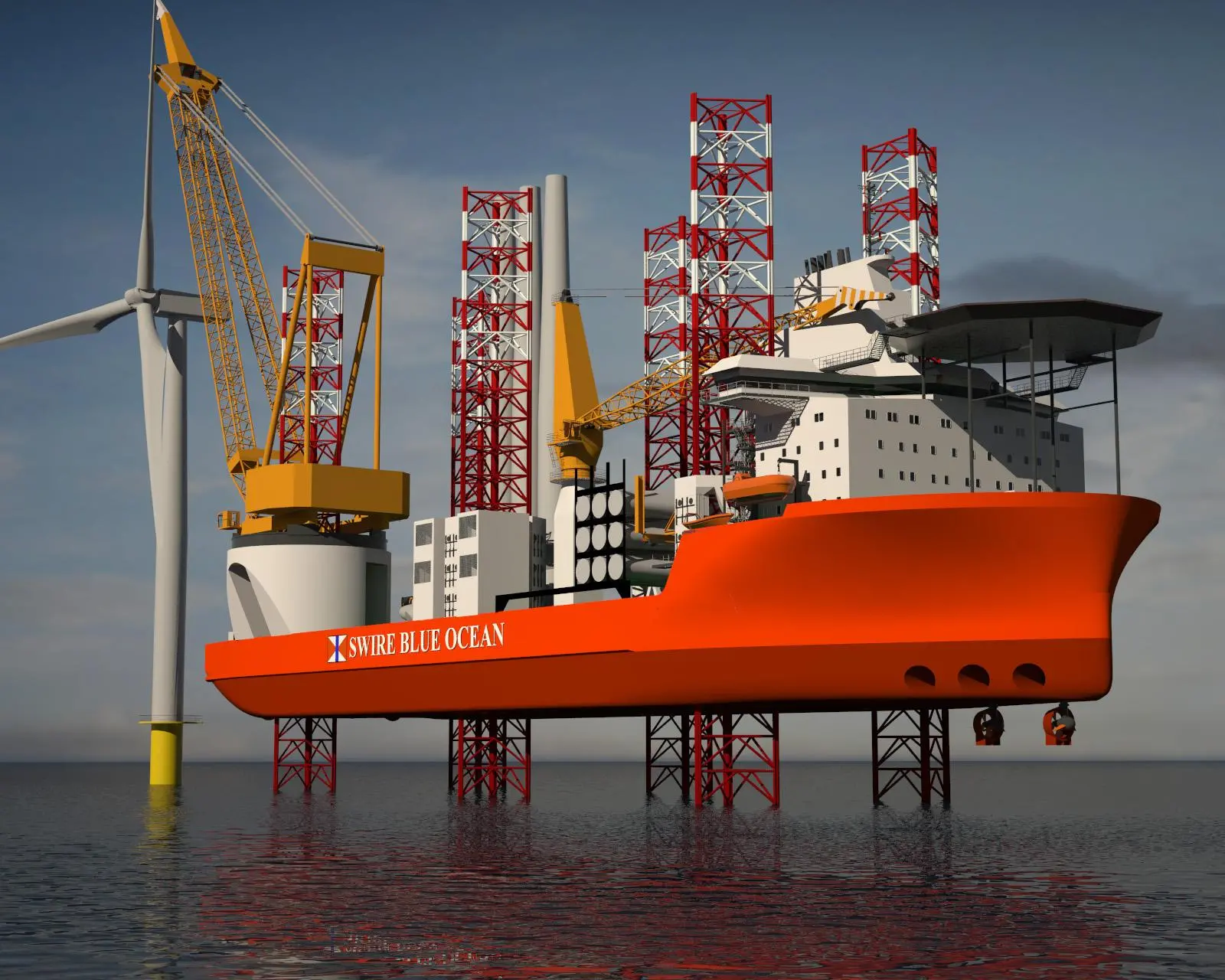
One of the largest wind farm vessels under construction is the 155m vessel building in Korea for Swire Blue Ocean. This vessel has six jack-up legs that will enable it to operate in water depths up to 75m and it will also have full dynamic positioning to enable it to hold position whilst jacking up. The main crane will have a capacity of 1200 tonnes at an outreach of 31m.
It is anticipated that with current planned wind farms around the world, up to 30 installation vessels will be required;with this number possibly increasing as floating pylon structures are introduced. Once these offshore wind farms have been established they will need regular servicing, and because of their distance offshore and the exposed locations, a new generation of service and maintenance vessels will be required.
There have been various proposals for these vessels ranging from large fast catamarans developed by Austal in Australia based on high speed ferry experience, through to huge vessels that can stay on station year round. The challenge here is to transfer the personnel and equipment required for servicing and maintenance in adverse conditions. The current range of small catamarans will probably prove too small to operate offshore so the Austal proposal for larger versions is one route to follow, but it still leaves the actual transfer operation to be solved.
One proposal for this is to use a Swath (small waterplane area twin hull) vessel and Aberking & Rasmussen delivered a 26m Swath to service a wind farm off the German coast in 2010. It is planned that the Natalia Bekker will be stationed offshore with service teams on board to be ready for work. The stable Swath platform is expected to enable transfers to be made safety in waves up to 2.5m high.
Probably the most extreme wind farm vessel proposed is the 187m Seawind developed by Offshore Ship Designers in The Netherlands. This vessel is DP equipped and has a flooding dock incorporated into the hull, from which small service vessels can be deployed. There is accommodation for up to 200 service personnel on board and the vessel also has cranes and a helicopter pad.
Such a large vessel may seem extreme but such is the rapid development of offshore wind farms, aided by government subsidies and the desire for renewable energy, that this is a market where there is considerable investment and scope for exciting new developments. The market is open to innovation and the challenges involved are leading to a new generation of construction and service vessels.
Related Articles
 PROPULSION
 GENERAL NEWS
 HYDROGEN