



Continuous slow steaming with two-stroke engines
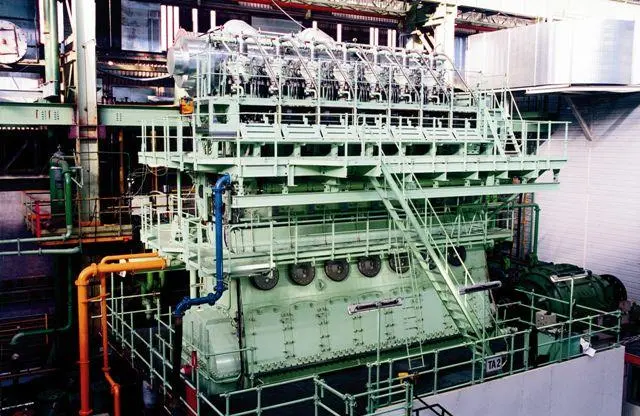
Driven by over-capacity in the market and by the necessity to cut overall fuel consumption, during recent months charterers have been adjusting both their services and the speed of their ships. Slow steaming has become an established way to operate vessels, particularly in the container segment. The benefits for the charterers are obvious, as slow steaming provides substantial reductions of fuel consumption and results in substantial savings in overall operating costs.
The reduction in ship speed signifies that the two-stroke main engines are continuously running at low load. This can present certain challenges and means that operational measures have to be followed.
Although Wärtsilä two-stroke engines are optimised for operation in a load range of above about 60% CMCR (contract maximum continuous revolution), continuous running at lower loads down to 10% CMCR is possible without any engine modification. However, Wärtsilä recommends that in order to secure reliable engine operation, operators take certain precautions when operating the engine continuously at loads below 60%.
The various concerns associated with low load and ultra low load operation are detailed in Wärtsilä documentation and bulletins. By adhering to recommendations outlined in operating manuals and service bulletins, any risks inherent with continuous low load operation can be mitigated, thus making such operation feasible.
Additional service packages offered by Wärtsilä can further aid low load operation, as improved air flows and engine operating temperatures are seen over a significant load range. Although guidelines and retrofit packages are offered, a degree of risk is still presented in very low load operation (super slow steaming). Decisions concerning such operation should be based on careful study, for which Wärtsilä offers specific onboard assessment, technical advice, and possible adjustments, if found necessary.
Unmodified engines
To varying degrees across the low load range, different engine conditions can be observed. The possible consequences of continuous operation at reduced load without taking precautions include:
· lower air flows;
· dangerous region after auxiliary blowers cut out / before cut in;
· possibility of very high exhaust, thus affecting component temperatures;
· poor combustion;
· poor atomization;
· higher sac volume: injected volume ratio, increased likelihood of dripping;
· increased fouling and carbon deposits likely;
· cold corrosion;
· through condensation of corrosive vapours;
· possible when observing very low engine temperatures during very low load operation.
Wärtsilä RT-flex engines are better suited than the Wärtsilä RTA engines for operating at continuous load down to 10%, due to their electronically controlled common rail injection system. Selective fuel injector cut-off at low load enables improved injection characteristics, resulting in reduced carbon deposits and thus less fouling of both the exhaust gas boiler and turbocharger.
In March 2009, Wärtsilä released instructions to its two-stroke engine customers in the form of service bulletins on the recommended precautions to be taken when operating the engine continuously at loads below 60%. By implementing these recommended measures, Wärtsilä two-stroke engines can in principle be operated continuously in the full load range between 10% and 100% MCR.
In short, the recommended precautions are as follows:
· Ensure correct injector nozzle condition. This is standard engineering practice but should be given more attention than during normal operation
· Maintain higher fuel temperatures – aim to achieve lower viscosities, 12/13 cSt
· Keep the LT cooling water temperature at 36°C in order to maintain the optimum scavenge air temperature, and the jacket cooling water temperature at the upper limit (85 – 95°C). High cooling water temperature will reduce condensation and thermal stresses. By-passing of the fresh water generator will most likely be necessary to maintain the cooling water temperatures.
Usually the cylinder oil feed rate is load dependant, and no adjustment is needed. However, frequent piston underside inspections are recommended to monitor piston running conditions and signs of over- or under-lubrication.
It is important that the exhaust gas temperature after the cylinders is kept above 250ºC in order to reduce cold corrosion.
High exhaust gas temperatures, above 450ºC after the cylinders should be avoided in the region after auxiliary blower cut out or before cut in. Hot corrosion and burning of exhaust valve seats may be a consequence.
Another concern during continuous low load operation is the accumulation of unburned fuel and lubricating oil in the exhaust manifold, as such deposits can ignite after the engine load is increased again. This may result in severe damage to the turbocharger due to sudden over-speeding. Wärtsilä therefore recommends periodically (twice a week) increasing the engine load as high as possible (to at least 70%) for a minimum of one hour in order to blow through accumulated carbon deposits. While at the increased loads, turbocharger washing and the blowing of economiser soot should be undertaken to reduce fouling
Optimised low load
Different trades can have different requirements for the operation of a ship. For some routes, charterers operate the vessels continuously at reduced speeds, while on other routes the full speed range is opted for. For this reason, flexibility for the full main engine load range is required. Wärtsilä offers upgrade solutions for ships in service, meeting all these requirements. Such upgrades enable maximisation of fuel efficiency and of main engine reliability, as well as further reductions in CO2 emissions. Four solutions are offered:
Automated cut-out
The automated flexible turbocharger cut-out solution – known as the Wärtsilä slow steaming upgrade kit– extends the optimised and reliable load range of the engine for continuous low load operation, and gives a major reduction in the BSFC (brake specific fuel consumption) in the low load range. Fuel savings are achieved by cutting-off one of the turbochargers, which leads to increased scavenge air and thus firing pressures. This cut-off is done in a controlled and fully automated way. The level of fuel savings, as well as the load at which the turbocharger can be cut-off, depends on the number of turbochargers. For example, for a Wärtsilä RT-flex96 engine with three turbochargers, the load range with cut-off turbocharger is about 10-60%.
In addition to the major reduction in BSFC in the low-load range, this solution provides full flexibility (the engine can be operated from 10 to 100%) and decreases the risk of engine fouling and excessive component temperatures. Therefore, this solution is most suited to a long-term scenario, where both slow steaming and nominal speeds are, or might be, required. This is because the engine can operate at any time up to its full installed power to allow full sea speed.
This retrofit is available for ships with Wärtsilä RTA and RT-flex low-speed engines with more than one turbocharger. One example of a Slow Steaming Upgrade Kit installation, which took place in October 2009 onboard a vessel with a 12-cylinder Wärtsilä RT-flex96C main engine with three turbochargers, measured fuel savings of 8-12 g/kWh in the optimal load range.
Turbocharger blinding
If the operational profile of a vessel is changed to slow steaming for a longer period, and engine loads above 60-70% are not required, the blinding of one of the turbochargers is the most cost effective solution, as it achieves the same BSFC reductions as the flexible solution slow steaming upgrade kit. However, it clearly limits the engine’s load range (10-60%, upper limit depending on the amount of turbochargers), and the vessel has no possibility to achieve full sea speed, if required. Nevertheless, the solution can be re-built to the original within a reasonable time and cost.
Permanent derating
If the operational profile of a vessel is changed for a long-term to one of a reduced speed and lower engine load (e.g. 5-15% reduction), a derating of the engine might be the best solution, considering fuel consumption, reliability, and operational flexibility. The scope of the solution depends on the required derating.
Propeller modification
When the engine is derated or continuously running at low-load, a modified propeller might better suit the engine’s performance and achieve an additional fuel efficiency optimisation. The optimal specification can be offered as a combined package between Wärtsilä’s two-stroke engine services and propulsion services.
Related Articles
 ALTERNATIVE FUELS & LUBRICANTS
 FUELS & LUBRICANTS