



Nissan goes greener with new car carrier
With large cargo ships being a major source of CO2 emissions worldwide it has been encouraging to see various efforts to make such vessels more efficient. In recent years we have seen the development of the world’s largest container ship (the Maersk Triple-E) to cut CO2 emissions per container moved, air lubrication system used to cut hull friction and even plans to return to the use of sails (e.g. Skysails) to cut fuel use.
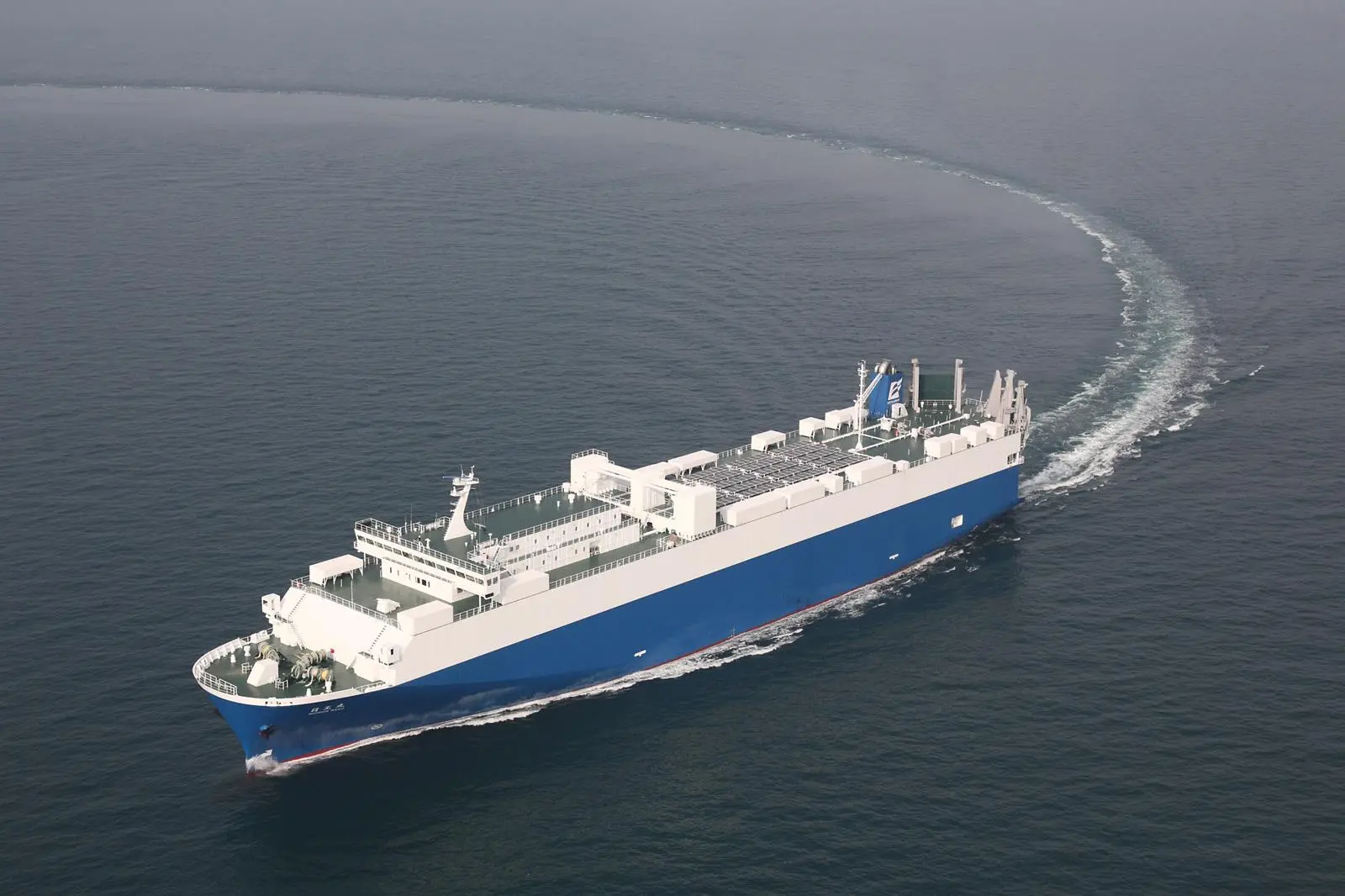
Coinciding with launching the first mass-produced electric car, the Leaf, Nissan says it has “gone even greener” with the introduction of the first of its newly-built energy-efficient coastal car carriers. The Nichio Maru is 169.95m long and 26m wide, and is fitted with 281 photovoltaic solar panels producing 50kW, LED lighting, a low friction hull coating and an electronically controlled diesel engine to cut fuel consumption.
The solar panels, which are installed on the vessel’s upper deck and power the LED lights that illuminate the ship’s hold and crew quarters, are a first in a Japanese coastal vessel says Tomohiko Uchiyama, president of Nitto Kaiun Corporation, the ship’s operator. “In terms of the logistical distribution we thought there should be a way for us to contribute using state-of-the-art technologies,” said Uchiyama.
A single 13,280kW MAN B&W 8S50ME-C8 two-stroke diesel engine provides the power to drive the 5-bladed K³ FP propeller (K-cubic propeller), an advanced GA design high-performance propeller manufactured by the shipbuilder, for a service speed of 21.2 knots.
With a carrying capacity of up to 1,380 cars on four decks, the 11,514gt Nichioh Maru joins two other car carriers in a daily service of a 1,800km domestic round trip route from Yokohama to Kobe and then to the southern island of Kyushu, making two round trips per week. Nitto Kaiun Corporation usually operates four sailings per week on this route but this has increased to six per week since the addition of the new vessel.
Each roundtrip uses roughly 13 tonnes less fuel equating to a reduction in CO2 emissions of 18% compared with a standard vessel. On an annual basis, the newbuilding can achieve a fuel reduction of up to 1,400 tonnes which amounts to an annual CO2 reduction of 4,200 tonnes over existing car carriers of similar capacity.
The Nichioh Maru follows in the wake of the eco-car carrier City of St. Petersburg which Nissan began using in 2010 for its international routes to Europe. That vessel boasts a sleek semi-spherical bow to cut wind resistance by up to 50%, resulting in an estimated fuel reduction of 800 tonnes and 2,500 tonnes reduction in CO2 emissions annually.
Aiming for a leading low corporate carbon footprint is a key objective of the Nissan Green Program 2016, the company’s new mid-term environmental action plan. Under this plan, Nissan is engaged in the development of zero-emission and environmentally-friendly vehicles, as well as CO2 reduction efforts during vehicle production, logistics activities, and in its offices and sales points. The new energy efficient car carrier will help to significantly reduce CO2 emissions in the company’s distribution chain.
Principal dimensions
Length: 169.95m
Width: 26.00m
Draught: 6.50m
Deadweight: 7,200dwt
Gross tonnage: 11,514gt
Load capacity: Completed vehicles: 880 units (without truck trailers: 1,380 units; with trailers: 115 units)
Service speed: 21.2 knots
Related Articles
 PROPULSION
 GENERAL NEWS
 HYDROGEN