



Chinese bulker class aims for high efficiency
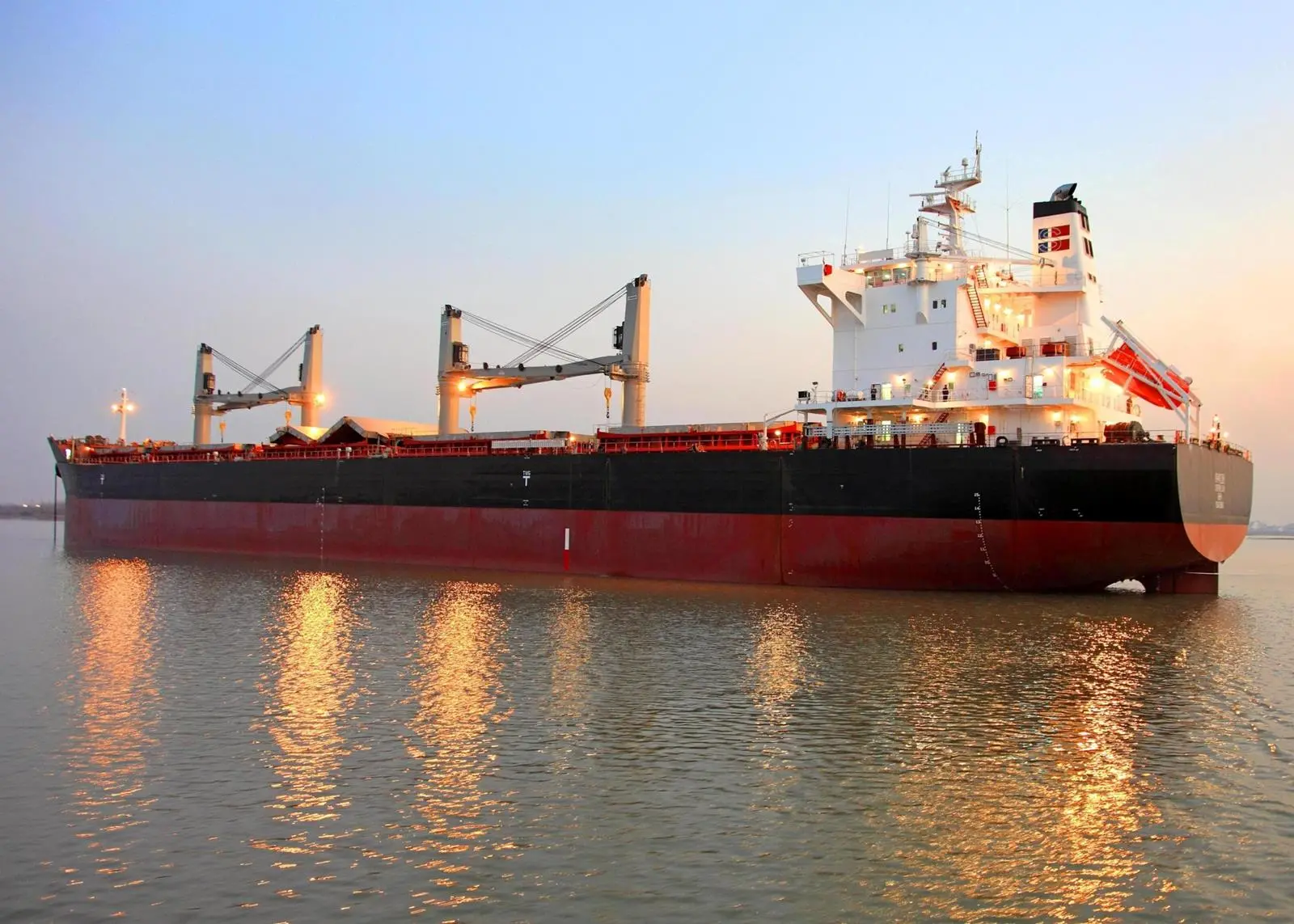
The image is still true in many cases, but could be changed forever by Sinopacific Shipbuilding, a shipbuilding group that seems keen to chase European orders by applying the standards of quality, efficiency and timeliness that are increasingly important to Western owners and operators. The group has invested in modern facilities and business practices, and has successfully diversified out of the traditional low-technology bulk carrier market into more challenging areas including offshore support vessels, container ships and LNG carriers, last year establishing a presence in Norway to enhance its OSV activities. Bulkers still form the core market for the group, and the latest products of the group’s Dayang shipyard in Yangzhou seem set to enhance its market position.
The first example of the group’s Crown63 design was delivered at the end of February 2012. The JS Amazon is lead ship of a new Ultramax geared bulker class, designed to offer high fuel efficiency and environmental friendliness. As well as being the first Crown63, JS Amazon is the 100th bulk carrier to be delivered by Dayang Shipyard.
The ship design came from Sinopacific’s in-house design company Greenseas, which worked closely with French bulk shipping expert Setaf-Saget. The Crown63, of 63,000dwt, is basically an upgraded version of Sinopacific Shipbuilding Group’s Crown58 bulk carrier design. But to describe it as an upgrade does its creators something of a disservice – the design process involved over three years of optimisation, including five tank testing campaigns at HSVA in Hamburg, resulting in enhancements to wake distribution and flow lines. These developments have led to improved carrying efficiency, environmental protection, operation & maintenance convenience, lower noise and vibration and other important improvements. As a result, although the first two ships have only recently reached completion, the market has accepted the vessel and Sinopacific claims a market-leading position for the Crown63, which is said to hold the highest share of the emerging Ultramax bulk carrier order book.
The ship is designed for the carriage of bulk cargoes, including coal, iron ore, grain and cement, as well as a range of dangerous cargoes. The loading capacity has been increased over that of the previous design by some 9%, but at the same time the fuel consumption, for the same ship speed, has been cut by an estimated 13%. This, according to the yard, relates to a fuel cost saving of typically $800,000 a year at current bunker rates. The improved performance is as a result of electronically-controlled low speed engine technology combined with optimised hull lines and a large-diameter high-efficiency Nakashima propeller. As well as being more efficient, the new hull design is lighter in weight, though it still promises high safety levels, being designed according to the latest common structural rules (CSR). The yard claims the maximum possible deadweight – 63,200dwt at summer draught – compatible with CSR requirements and within the length and draught, has been achieved thanks to refined steel structure calculations. Further potential savings for the owner have been achieved through the installation of four 35t cranes, said to represent a great improvement in discharge capability.
For the next deliveries, known as the ‘B’ version and scheduled for completion post-April 2012, the yard has promised further optimisation of the design, with further improvements in performance expected.
According to the yard, the first two ships in the series are owned by European shipowner Turner, which has ordered 16 similar ships in total. Turner operates several other Dayang-built bulkers in the 53,100dwt and 58,000dwt series.
As a result of the high fuel efficiency, the JS Amazon exceeds the energy efficiency design index (EEDI) standards stipulated under the forthcoming MARPOL regulations, and has received the first EEDI certificate to be awarded by class society Bureau Veritas. BV points out that the ships greenhouse gas (GHG) performance when measured in accordance with IMO’s EEDI is some 20% cent better than the MARPOL Annex VI minimum standard and already reaches the Phase II requirement normally set for the years 2020/2024.
Bernard Anne, managing director of BV’s Marine Division, says: “This vessel marks the start of a new series of ships which will be exemplary contributors to a greener and cleaner world, shaping the image of shipping for the future. It also represents a celebration of the achievement of outstanding new design concepts and the re-enforcement of strong and successful, long-established levels of co-operation. Bureau Veritas, Sinopacific Shipbuilding Group and bulk carrier expert Setaf-Saget have been working together for many years in the best kind of partnership – one built on trust and a long-term commitment to shipbuilding quality and innovation. BV has been delighted to work with Greenseas, the in-house design office of the Sinopacific Group, which has a proven ability to deliver high-quality designs for energy-efficient ships. EEDI is aimed at producing ships which are ahead of industry standards, with optimised fuel consumption and the highest standards of quality and safety to meet the demanding criteria for bulk carriers engaged in worldwide service today. The Crown63 series demonstrates to the world that the shipping and shipbuilding industries can bring to the market an exemplary generation of new ships which are safeguarding the future of our planet.”
BV’s long-standing partnership with Sinopacific and various owners is underlined by the fact that 42 vessels of the Crown58 series of Supramax bulk carriers either delivered or under construction are to BV class, while BV says it is also responsible for the classification of 32 vessels on order in the Crown63 series, and anticipates more to come.
In addition, the Crown63 class is prepared for the installation of ballast water treatment systems meeting the latest IMO specifications, and which will become mandatory following the soon-anticipated ratification of the IMO Ballast Water Convention. As a result, JS Amazon holds a ‘green ship’ certificate issued by BV.
Another recognition of current pressures on shipping is that the Crown63 has been designed with a ‘citadel’ providing security for the crew in the event of piracy attacks.
Although some Chinese shipyards seem to have problems with delivery dates, time for completion of the first two Crown63 ships has been remarkably short. The ‘keel laying’ ceremony for the first two was held in late November 2011, and the first of the two had completed sea trials just two months later. Admittedly, with modern shipbuilding methods ‘keel laying’ often means joining the first two completed modules together, but even so this seems a very short time scale, particularly as we understand the first steel was cut in March 2011.
Sinopacific stresses that it is a technology-driven group, which is intensifying efforts to provide high level products and technical services, seeking an optimal balance between technical solutions and construction cost. In this endeavour it benefits from its long-standing co-operation with Setaf-Saget, and its STCO (Setaf technical control organisation) division, which takes advantage of its parent’s long experience in dry bulk ship operation.
Paris-based STCO says that the combined strengths and mutual expertise of Sinopacific and STCO have resulted in a ship design offering numerous competitive advantages, including a particularly low fuel consumption, significant reduction in CO2 emissions, and the largest deadweight compatible with the existing Panama Canal locks.
The main engine is to the MAN 5S60ME-C8 design, rated 8,300kW at 91rpm, manufactured by Doosan in the case of JS Amazon, though the yard also offers similar engines from fellow licensees Hyundai and Hudong. Auxiliary power is provided by three 600kWe gensets, of either MAN/CME or Daihatsu/Anqing design, and a 120kWe emergency diesel genset. All engines are to IMO Tier II standard with regard to NOx emissions. The engines are equipped to run on multiple fuel grades, HFO, MDO or LSMGO, compliant for operation in ECAs and other low-emissions zones such as the Californian coast.
The ME electronically controlled engine was selected because of its lower specific fuel consumption over a wider range of operating parameters (recording 161.6g/kW on the test bed at normal operating speed); low NOx emissions and absence of visible smoke; its easy change of operating mode during operation; the possibility of operation at lower rpm for manoeuvring; and good acceleration, astern and crash stop performance.
The main engine drives a Nakashima high-efficiency four-bladed FP propeller; the combination of low engine revs and large propeller diameter is said to contribute significantly to the low fuel consumption, and low CO2 emissions, claimed to be 18 % lower than the 57/58 generation of bulkers, based on EEDI calculations as per MEPC.1/Circ.681. Normal service speed is achieved at 80% MCR, i.e. 84.5rpm, at which speed the engine develops 6,640kW. This, says the designers, gives a good reserve of power to cope with difficult sea conditions. Additional energy savings are said to result from the use of an advanced HSVA rudder profile, and a propeller boss cap in combination with a rudder bulb.
Main engine controls are from Nabtesco of Japan, with the main switchboard from Terasaki of Singapore. Shafts, bearings and seals came from Blohm & Voss of Germany. Saacke of Germany provided the boiler equipment, with fuel supply from Alfa Laval and purifiers from Westfalia. Rolls-Royce supplied the steering gear and mooring winches. Cargo cranes and hatch covers are from MacGregor, with a Napa loading computer. Pumps by Naniwa of Japan with valve control and tank level gauging from Besi of Germany completes the machinery line-up. Radio and Navigation equipment was supplied by JRC of Japan.
All fuel oil storage tanks are double-skinned for safety, with enclosed overflow and venting to prevent oil spills. There are double settling and service tanks, with separate piping arrangement, designed to ensure fast and safe fuel change over. Capacity for storing up to 450m³ of LSMGO allows long-range operation in ECAs.
The cargo holds are suitable for various bulk cargoes including coal, iron ore, grain and cement. All cargo holds are fitted with a CO2 fire-fighting system in all cargo holds, which, with adapted deck fire fighting system and an insulated front bulkhead to the engine room, means the ship can carry practically all dangerous cargoes listed in IMSBC Appendix B. With padeyes fitted inside the cargo holds, and structural allowance in the design for carrying deck cargo, lengthy and heavy cargoes such as steel pipes, steel products and hot coils can be transported.
Special attention has been paid to paints and coatings, using paint supplied by Jotun, offering a five- year design life for the anti-fouling system, ballast tanks painting with 400μm, pure epoxy system, in excess of PSPC rules, 250μm Jotaguard 660 paint in cargo holds and 250μm paint thickness on weather decks.
The accommodation has been designed with the latest ILO 2006 requirements in mind, and focused on crew well-being, with 25 crew cabins, none on the upper deck. Security has also been considered; as well as arranging the machinery room to double-up as a citadel as recommended in anti-piracy guidelines, extra cabins and lifeboat capacity has been included so that a ‘flying squad’ can be accommodated.
Following this successful co-operation exercise, Sinopacific says that it intends in the near future to join with Mitsubishi Heavy Industries in optimising the design of the 82,000dwt Kamsarmax bulk carrier, which will help the group mantain its current market position.
Principal particulars – Crown63
Length oa: 199.99m
Breadth: 32.26m
Depth: 18.50m
Scantling draught: 13.30m
Deadweight: 63,500tonnes
Service speed: 14.50 knots
Class notations: BV + CSR Bulk carrier ESP, BC-A, GRAB[20], unrestricted navigation, VeriSTAR-Hull, Inwatersurvey, AUT-UMS, Mon-Shaft, Green Passport
Related Articles
 PROPULSION
 GENERAL NEWS
 HYDROGEN