



Dutch tank barge sets new standard for ’clean’ inland shipping
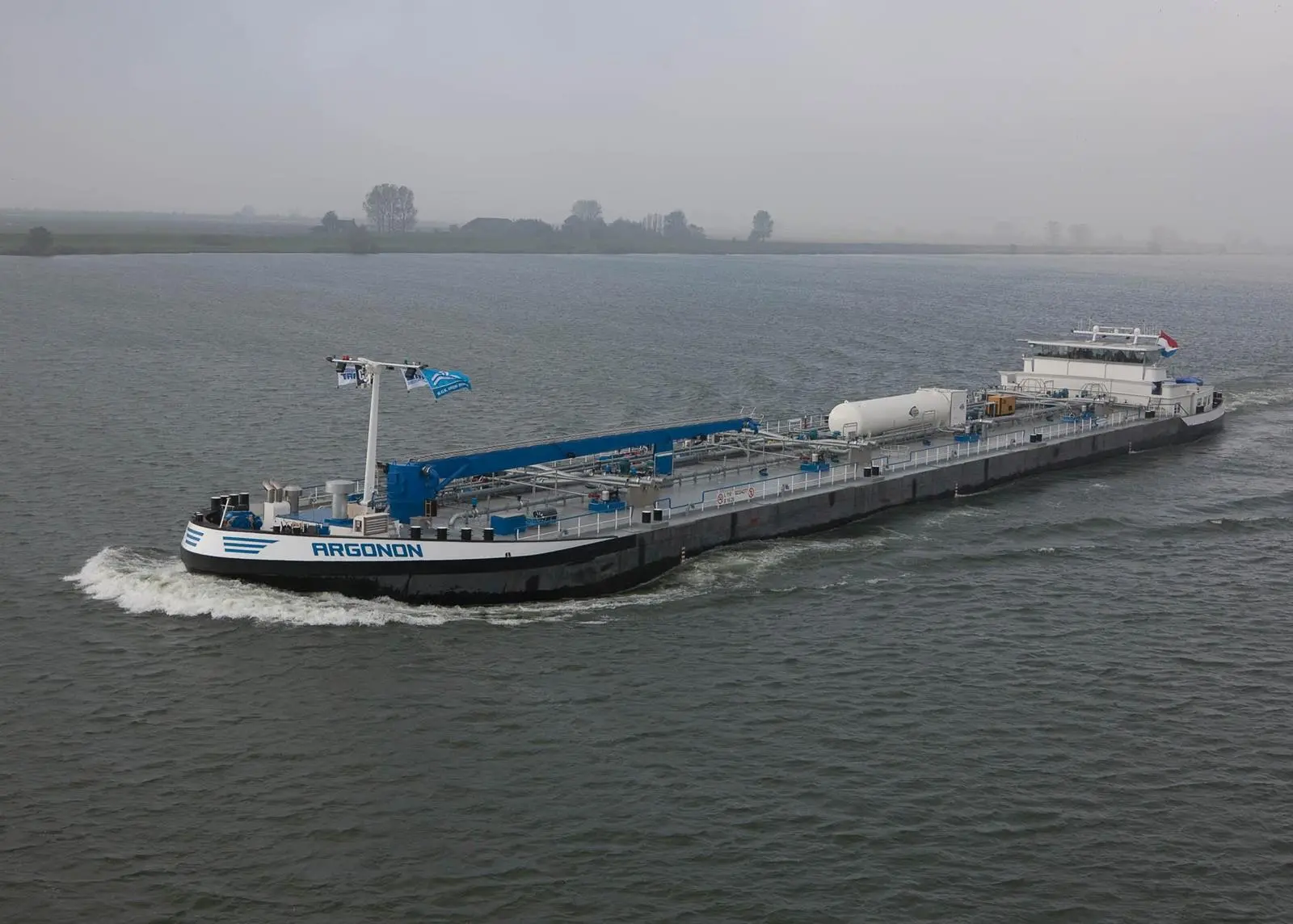
The predominant use of natural gas in the high-speed engine plant powering the 6,100dwt chemical and products tank barge Argonon will not only drastically cut pollutant emissions per unit of fuel consumed, but is also expected to substantially decrease running costs.
One of the biggest challenges has been in addressing the regulatory regime, given the stringent safety requirements governing navigation on European waterways. In essence, the vessel’s Dutch owner has had to demonstrate that the use, handling and storage of LNG is no more hazardous than conventional diesel fuel arrangements. Argonon is claimed to be the first new vessel on the inland system to run on dual-fuel main machinery.
Delivered from the Rotterdam premises of main contractor Shipyard Trico, and based on a bare steel hull constructed in China, the 110m tank barge is one of five inland vessels owned by the Deen Shipping subsidiary Argonon Shipping, which also manages a sixth unit from the Deen fleet. The company’s operations span the supply of bunker fuel to ships in the ports of Rotterdam, Amsterdam and Antwerp, and the transportation of mineral oils and distillates from refineries to storage depots in the Netherlands, Belgium, Germany and Switzerland.
A young and entrepreneurial company, Shipyard Trico has shown its mettle in the Argonon project in meeting the particular demands posed in integrating the disparate technical elements which in combination make for an innovative vessel.
The tank barge’s two main engines are dual-fuel adaptations of standard Caterpillar 3512-type high-speed diesels, burning a mixture of 80% natural gas and 20% diesel oil, and producing 1,115kW apiece. Natural gas is used as the main fuel and diesel as the ignition fuel.
Bunkered and stored as LNG at -162°C, since it occupies 600 times less volume as a liquid, the LNG is drawn through a vaporiser in preparation for delivery into the engines in gaseous form. Two carburettors are fitted between the air inlet and compressors so as to ensure an optimum gas/air mixture, and the gas flow is controlled through a metering valve. The dual fuel management system’s processor calculates gas requirements in accordance with the power output of the engine, rpm, temperature and pressure in the engine manifold, having been designed to ensure rapid engine response under changing load demands.
Each engine is started on diesel oil, and once engine running is stable, a homogeneous mix of natural gas and air is introduced to every cylinder, with ignition of the mix maintained by approximately 20% diesel fuel. The diesel accordingly acts akin to a spark plug, and a ratio of 20/80 is intended to guarantee stability, responsiveness and power delivery in all conditions, including manoeuvring. The engines can also run entirely on diesel, but not entirely on natural gas.
The extent of reduction of NOx, particulate matter and carbon emissions achieved by the dual-fuel system will be measured over time, but a highly positive result is not in doubt. In addition to its ‘cleaner’ properties relative to other hydrocarbon fuels, combustion of natural gas generates only about half as much carbon dioxide, lessening greenhouse gas emissions.
The auxiliary power outfit departs from the norm but complements the dual-fuel plant and the whole rationale behind the Argonon‘s design and engineering. Two 30kW Capstone micro-turbines, fed purely by natural gas, provide electrical power and heat, and apply cogeneration technology. Exhaust gases from the microturbines pass through a heat exchanger. The resulting hot water is diverted to heat the LNG vaporiser, providing fuel to the Capstone units and the main engines. In addition, the hot water produces heat for the boiler, serves the domestic central heating and hot water system and is also fed to the absorption chiller for the air conditioning system.
The gas micro-turbine produces minimal NOx and negligible particulate matter (PM), and is virtually maintenance-free and quiet in operation. Caterpillar dealer Pon Power supplied the Capstone generators as well as the DF main engines. Argonon has provided a platform for a drive to promote the environmental and efficiency benefits of the micro-turbines’ CHP (combined heat and power) capabilities in the inland shipping market. Such an installation can meet strict emission regulations without exhaust after-treatment measures.
The arrangements on are such that the inevitable boil-off of stored LNG fuel is not lost to the atmosphere, at both monetary and pollutant cost, but is effectively tapped to ultimately generate onboard electrical power.
The double-wall, vacuum-insulated, stainless steel storage tank, incorporating vaporiser, is mounted on deck and provides a 40,000-litre (40m³) capacity. Storage volume and fuel consumption rate are such that Argonon has an endurance factor that allows a return passage between Rotterdam and the Swiss Rhine port of Basel without bunkering. Amsterdam-based Cryonorm Projects manufactured the cryogenic fuel tank and also supplied vacuum-insulated bunker connections on both sides of the barge.
Technical support and regulatory guidance was provided throughout the design and build project by Lloyd’s Register, which has classed Argonon. Shipowner Gerard Deen observed that LR adopted a very pragmatic approach to finding solutions to adapt seagoing regulations into inland shipping rules regarding dual-fuel.
The vessel has an exceptionally high ratio of length to beam, and offers a 6,400m³ cargo volume in a total of eight relatively large tanks. The patented Y-shaped hull construction has been adopted so as to limit environmental impact in the event of a collision. Two grades of oil can be carried separately, and the tanker has been equipped for bunkering duties as well as for inland trading.
Argonon – Principal Particulars
Length oa 110m
Breadth 16.20m
Draught 4.95m
Deadweight 6,100dwt
Cargo tanks 8
Cargo capacity 6,400m³
Main engines 2 x Cat 3512DF
Main engine power 2 x 1,115kW
Generators(gas) 2 x Capstone microturbines
Generator output 2 x 30kW
Class Lloyd’s Register
Related Articles
 PROPULSION
 GENERAL NEWS
 HYDROGEN