



Automation, longevity and early ro-ros
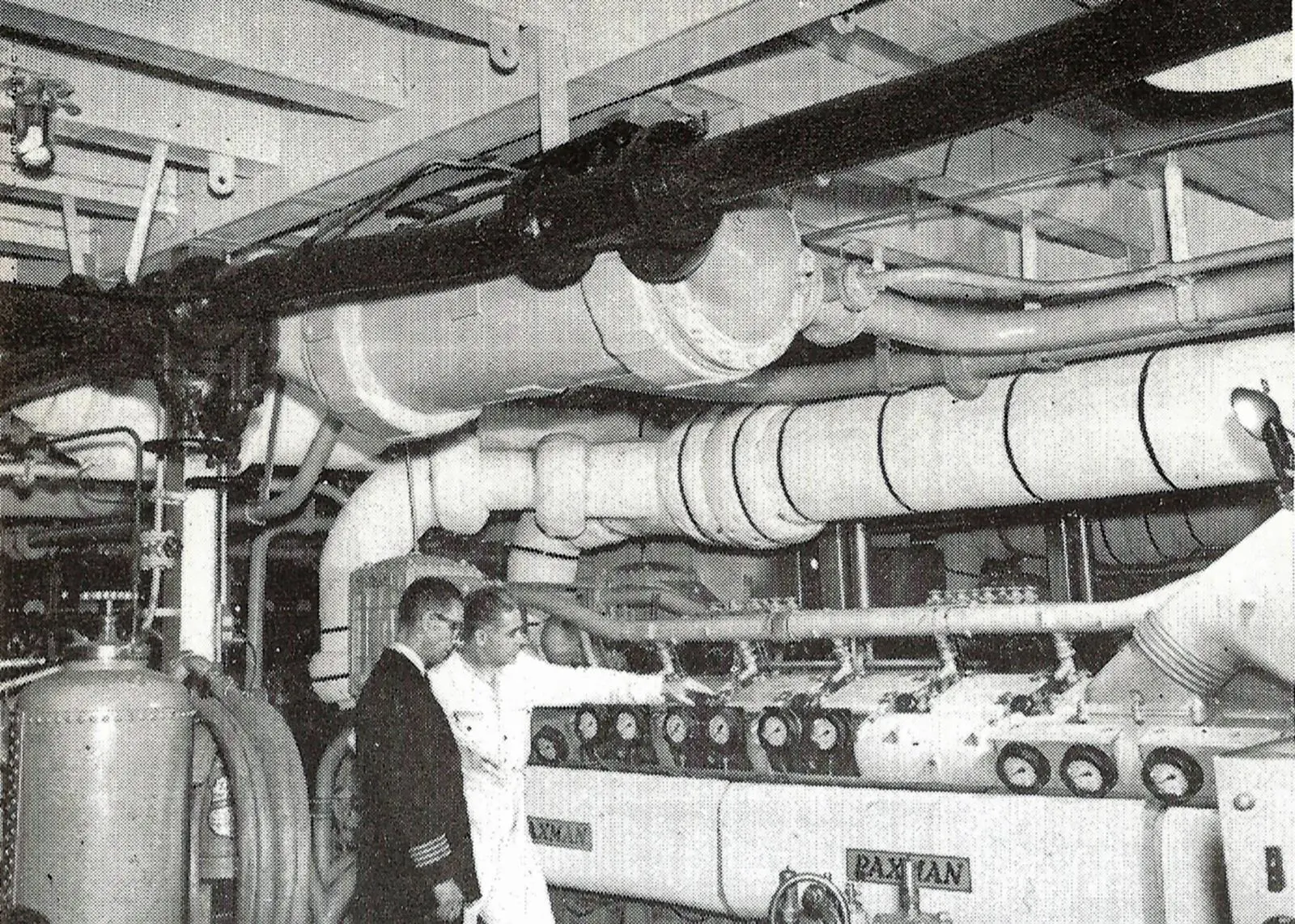
There was a good reason; US labour and manning costs were very high, and US shipowners felt that a larger crew was needed on a motor ship than on a steam-powered vessel, offsetting the lower fuel costs.
There was hope for the future though; machinery automation was seen as the way forward. The USA seemed slow to take this up either; it was left to the Japanese to blaze the automation trail. One Japanese ship had managed to achieve engine starting, stopping and change of direction from the wheelhouse and our editorial predecessors looked forward to the prospect of fast Diesel-powered cargo liners with a total complement of a mere 20 men.
But such a degree of remote operation would only be possible, it was felt, if engine manufacturers paid more attention to simpler maintenance, and extending service intervals so that major overhaul would coincide with drydocking. It was noted that some engines had managed to run for over 7,000 hours without being opened up. However the conclusion was that most engineers would consider such practices too radical and fraught with problems.
The May 1962 issue went on to summarise a number of papers on the use of high speed Diesel engines for ship propulsion, namely for deep-sea fishing vessels, though it was considered that the same principles could be applied to other ship types. Such engines, thanks to volume production, enjoyed a significant advantage in initial cost, overhaul and maintenance was simple and cheap, with good wear rates. A number of problems were highlighted in one installation, admittedly an experimental prototype, mainly related to corrosion, and piston and liner failures. These were attributed to unsuitable materials, and over-cooling and poor combustion when running at light load – all were solved by minor redesign work. Despite the stated benefits, one of the papers regretted that most shipowners regarded revolutions in excess of 1,000rpm as “flying in the face of nature”. Shipping was then, and remains now, a highly conservative industry.
The perennial problem of liner wear was discussed: though 50 years ago fuel sulphur content seemed not to enter into the equation. An article outlined research by Castrol, which suggested problems occurred to some extent with cheap residual fuels of high viscosity, but more so with blended fuels, which many British owners specified because of their insistence on ordering fuel of a particular viscosity. Correct heating of the fuel oil was thought to overcome these problems, and Castrol was able to guarantee wear rates would be contained in the range 0.006-0.010in/1,000h when using the company’s lubricant.
Ships reported on were mainly ferry-type vessels; including a novel class of ‘drive on drive off’ ships for carrying trailers between Tilbury and Antwerp/Rotterdam and on the Irish Sea. Trailers were loaded, in reverse, via a stern ramp, and unloading was achieved by driving off in a forward direction. The ships were powered by twin Paxman 16-cylinder four-stroke engines of 1,680bhp at 750rpm, chosen for their low height. Such advanced loading arrangements had still to come to car ferries; a new cross-Channel ship for Townsend Bros, the Free Enterprise, used a complicated arrangement of MacGregor-supplied ramps and a turntable to get vehicles into the garage decks. Despite the complex loading arrangements, the operator still wanted a quick turn-round in port, so the ship featured novel transverse thrusters and a bow rudder to speed up berthing.
Later ships adopted the now-familiar bow and stern doors and ramps – we can’t help thinking that in view of what happened to one of the Free Enterprise’s successors in Zeebrugge in 1987 this may have been a retrograde step.
Related Articles
 50 YEARS AGO
 50 YEARS AGO
 50 YEARS AGO