



Short stays on the slipway
Mr Rasmussen explains that although costs may seem to present themselves as cheaper elsewhere, the innovative builds that the company specialise in are not so easy to control – or remediate if challenges arise – if the builds are away from the home base. So activities are centred largely on Kleven Maritime’s two yards, Kleven Verft AS and Myklebust Verft AS along with a yard in Poland.
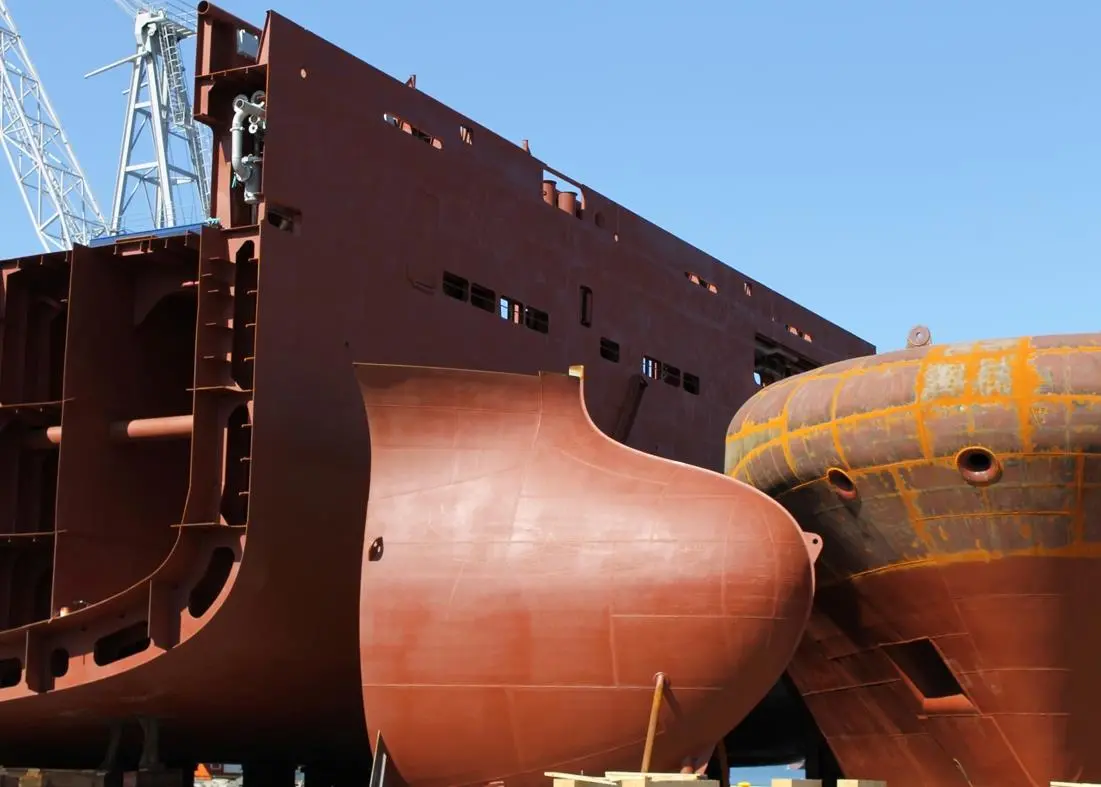
Therefore the company has set about a ‘modular’ approach, and by modular, Mr Rasmussen means that each part is as fully prepared and kitted out as it’s possible to get before assembly on the slipway. This cuts down time – and it gets around the bottleneck that can all too easily occur on the quay.
Further, it gives the builders an easy access into the build, as the vessels are layered – a lot almost in cross sections. “You don’t have to cut big holes in the walls to get the equipment in,” says Mr Rasmussen. “It also helps that we can, for example, work on the engine module indoors, in a controllable environment, before assembly.”
Everything is helped along a little by this approach. He points out: “What people sometimes forget is that walking is logistics. A lot of people walking around a large hull just to get to their working area adds to the total logistical sum.”
Although some of the hull modules come in from the company’s Polish facility, “even then it is not a complete hull, its just sections that are barged in”, explains Mr Rasmussen. This approach, along with automated, robotised processing means savings, he adds.
Proof of the pudding is in the time that the Olympic Taurus spent on the slipway. After all the sections were readied, the vessel only spent a total of 54 days being put together before being launched in June. Its sister too, the 93.8m Olympic Orion, is making good headway on the slip. Like the Taurus and the Commander (delivered in January) it also has some subsea capabilities on board: there’s a large platform running across the front section of the cargo deck capable of holding a large ROV which can be retracted to lie flush to the bulkhead behind, giving more cargo room across the 1,060m² deck, and further, the vessel can take on light construction work. The main engines are four 2,230kWe CAT 3516-Cs, while the props, tunnel thrusters and swing up thrusters are all from Rolls-Royce. The Orion will be delivered in November, just five months after the Taurus, with two other ships – Evita and Viking Princess being delivered between… certainly a result for this modular approach.
Another of the builds that would otherwise take up a lot of slipway hours is a recent contract for a SALT 301 OCV, a large offshore subsea construction vessel by Salt Ship Design, destined for owner Eidesvik.
Kleven is unusual in that it doesn’t have its own designers, but collaborates with whatever an owner brings to the table. Mr Rasmussen adds: “I think the independence that we have from particular designs possibly helps, ship owners come to us with what they’d like to have built.”
Eidesvik and Kleven Maritime have a history of working together on large, complex projects as they were pioneers in building the world’s first LNG powered offshore supply vessel, Viking Energy, in 2003. Further, in March 2012, Kleven Maritime delivered the LNG powered vessel Viking Prince, and at time of writing Eidesvik is about to take delivery of its sister vessel Viking Princess.
This particular vessel however will be the largest in Eidesvik’s history and is to be built for arctic deployment.
Weighing in around 13,500dwt the new OCV will have a length of 145m and a width of 31m. It will also have accommodation for 150 people. Two large offshore cranes, one with a 400 tonne capability and one 100 tonne crane will be installed on board. Set for delivery in the second quarter of 2014, the total contract value is around NOK1.1 billion – and it also includes an option for a further vessel of the same type.
However, in June Kleven expanded its working area with the recent acquisition of a large floating dock. It has an overall length is 180m with a maximum inside beam capacity of 28m and the lifting capacity is a hefty 15,000 tonnes. The new facility will deal with dry dock services taking on propulsion equipment, conversions, painting and so on – so while not involved directly in builds, it will help expand Kleven’s overall capacity.
By Stevie Knight
Related Articles
 PROPULSION
 GENERAL NEWS
 HYDROGEN