



Innovative multipurpose class for old China hand
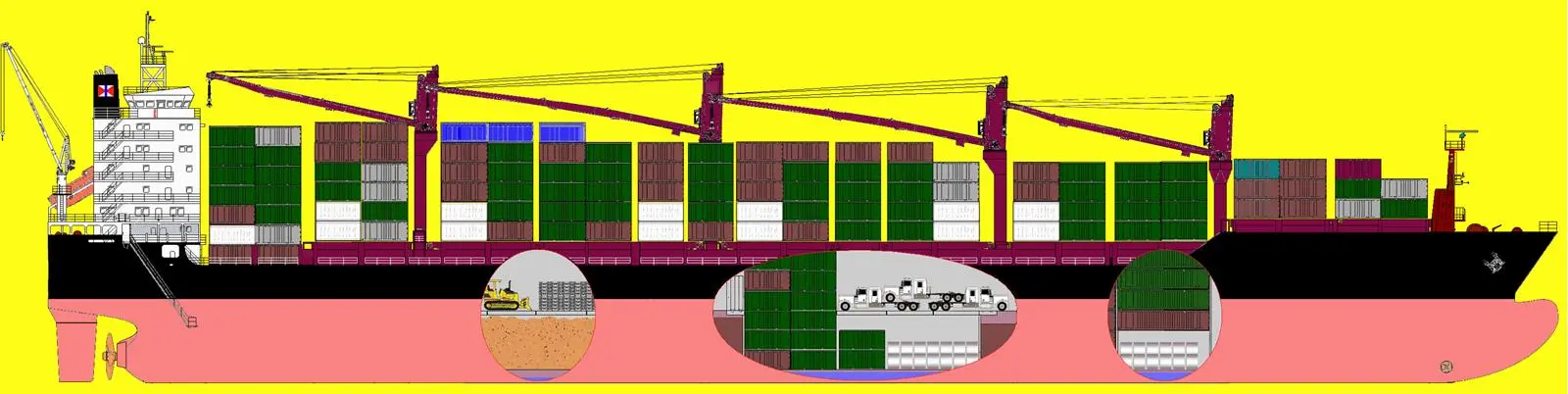
Designed and fitted to meet the scheduling and turnaround demands of liner trades, the self-sustaining S-class is distinguished by its configuration and scope for mixed payloads of containers, steel products, breakbulk goods, project cargo and bulk commodities, in combination with exceptional efficiency at normal operating speeds. A major advance in energy saving has also been assured through the adoption of fully-electric, high capacity deck cranes. The new class will be operated by the China Navigation Company (CNCo) under the Swire Shipping, Tasman Orient, New Guinea Pacific Line, and Greater Bali Hai brands.
CNCo, the deepsea shipping arm of the Swire Group, awarded the $300million contract for the construction of eight vessels of the 31,000dwt S-type to Zhejiang Ouhua Shipbuilding on China’s Zhoushan Island towards the end of 2010. Deliveries are due between January and August 2013, and the owner holds options on eight further ships in continuation.
Founded in 1872 by John Swire to run a fleet of steamers on the Yangtze River, CNCo’s pioneering disposition and trading verve expressed through its many phases of organic growth and expansion into other fields of shipping has been augmented in the past decade by acquisitions of Andrew Weir’s Bank Line and Oldendorff’s Indotrans Service. The accumulated know-how reflects directly in the nascent breed of vessels from China. In tailoring the ships to the evolving, multifarious transport needs of a wide range of eastern Asian and southern Pacific economies, the closest attention has been paid to every aspect of technical design and operating performance in a bid to ensure long-term efficiency and competitiveness.
The S-class embodies five holds, three of which are fitted with cell guides for 40ft containers, while offering added utility by incorporating stoppers at the top of the second tier, allowing emplacement of pontoon hatch covers. By such means, breakbulk cargo or steel coils can be loaded on the tank top, with containers carried above. The two other, largest, holds, Nos 3 and 4, are designed as flush-sided, multipurpose cargo spaces, with a centreline girder and a tweendeck. They are conducive to block-stowed containers and bale goods, breakbulk shipments, including heavy cargoes such as steel products, as well as to agricultural bulks and other dry bulk consignments. Tanktop strengthening to 24t/m² has been applied in holds 2,3,4 and 5, while No 1 has been specified for 14t/m².
While the weatherdeck hatch covers for the cellular holds 1, 2 and 5 are lift-away pontoons, handled non-sequentially by crane, the weather deck openings to holds 3 and 4 are served by folding, high-stowing covers, actuated by hydraulic cylinders. The tweendecks in holds 3 and 4 are equipped with a tailored design of high-stowing, Foldtite-type covers to maximise available cargo space, and are hydraulic cylinder-operated. As one of the key factors influencing ship performance, flexibility and productivity, the MacGregor hatch cover system was discussed at a very early stage in the project with supplier Cargotec.
Interposed between each hatchway are high-stooled, centreline-located deck cranes, conferring complete self-reliance in handling the gamut of cargoes. The four cranes can each cope with 60t at 26m outreach, and up to 40t at 36m, and can work in pairs to provide tandem lifts of 120t. The decision to opt for the electrically-driven MacGregor GLE design followed a rigorous and extensive onboard, in-service evaluation programme conducted by CNCo, looking to replace existing electro-hydraulic cranes with all-electric equipment offering operating benefits as well as 30% less power requirement. The GLE cranes encapsulate fewer moving parts than their electro-hydraulic predecessors.
‘Sustainable development’ is becoming a rather hackneyed term today, used by marketeers everywhere, but CNCo is one of the organisations for whom it is actually part of the culture, integral to business objectives. The S-class has been designed to yield the lowest possible energy usage across the operating profile, with all main aspects of the hull, propulsion, auxiliary, and cargo handling systems yielding environmentally-beneficial characteristics.
Although rated for a maximum output of 13,560kW, the electronically-controlled Wärtsilä 6RT-flex58T main engine has been optimised for maximum fuel efficiency at 60% MCR, and utilises low load tuning and high efficiency turbocharging with a controllable exhaust gas waste gate. At 10.5m scantling draught, and with consideration of a practical rather than wishful sea margin allowance, the S-class is expected to be able to make 15.5 knots at 8,136kW power, 60% of maximum output. Power availability, however, allows for schedule recovery or faster transits when needed, as indicated by the capability for 19 knots on a draught equivalent to 20,000dwt, about two-thirds of the full deadweight.
Energy-saving measures also encompass a refined hull form, plus the use of a flap rudder, Mewis wake improvement duct, promising an efficiency gain of around 4%, and low-resistance antifouling. Supplied to CNCo’s specific requirements, the Aalborg composite boiler makes heat from both main engine and auxiliary machinery exhaust streams. Other prospective contributors to reduced energy usage are variable speed cooling pumps, low wattage lighting and improved thermal insulation.
The Cargotec GLE6028-type fully-electric cargo cranes require 30% less power than corresponding, electro-hydraulic units, and confer added efficiency through a system whereby power is fed back to the generators when lowering. The power control arrangements are such that all four cranes can be operated in port with only one generator running, instead of two, potentially saving about 1.5t to 2t of fuel per day during cargo handling.
Fully-electric mooring winches have also been nominated for the new ships. The overall choice of deck gear will obviate the pollution and cleaning costs arising from hydraulic oil seepage common to electro-hydraulic equipment. Environmental legislation bearing on fuel usage in emission control areas has determined the adoption of triple service and settling tanks, providing for ultra-low sulphur fuel as well as HFO and ‘regular’ MDO.
Hyde Guardian ballast water treatment systems have been chosen for all eight new builds. The chemical-free process employs filtration and ultraviolet disinfection, and the plant specified has a treatment capacity of 500m³ per hour.
CNCo, which moved its head office from Hong Kong to Singapore in 2009, has this year booked four 39,500dwt bulker newbuilds in China. Derivations of Deltamarin’s B.Delta37 handysize design, but modified to the owner’s stipulations, anticipated consumption at 14 knots on the design draught will be just 18t/day, including 15% sea margin. The high efficiency theme permeating the S-class multipurpose series has accordingly been maintained in the W-class bulk generation, which will also employ all-electric deck crane technology.
Related Articles
 PROPULSION
 GENERAL NEWS
 HYDROGEN