



Norwegian Coastguard ships feature LNG fuel and novel rescue gear
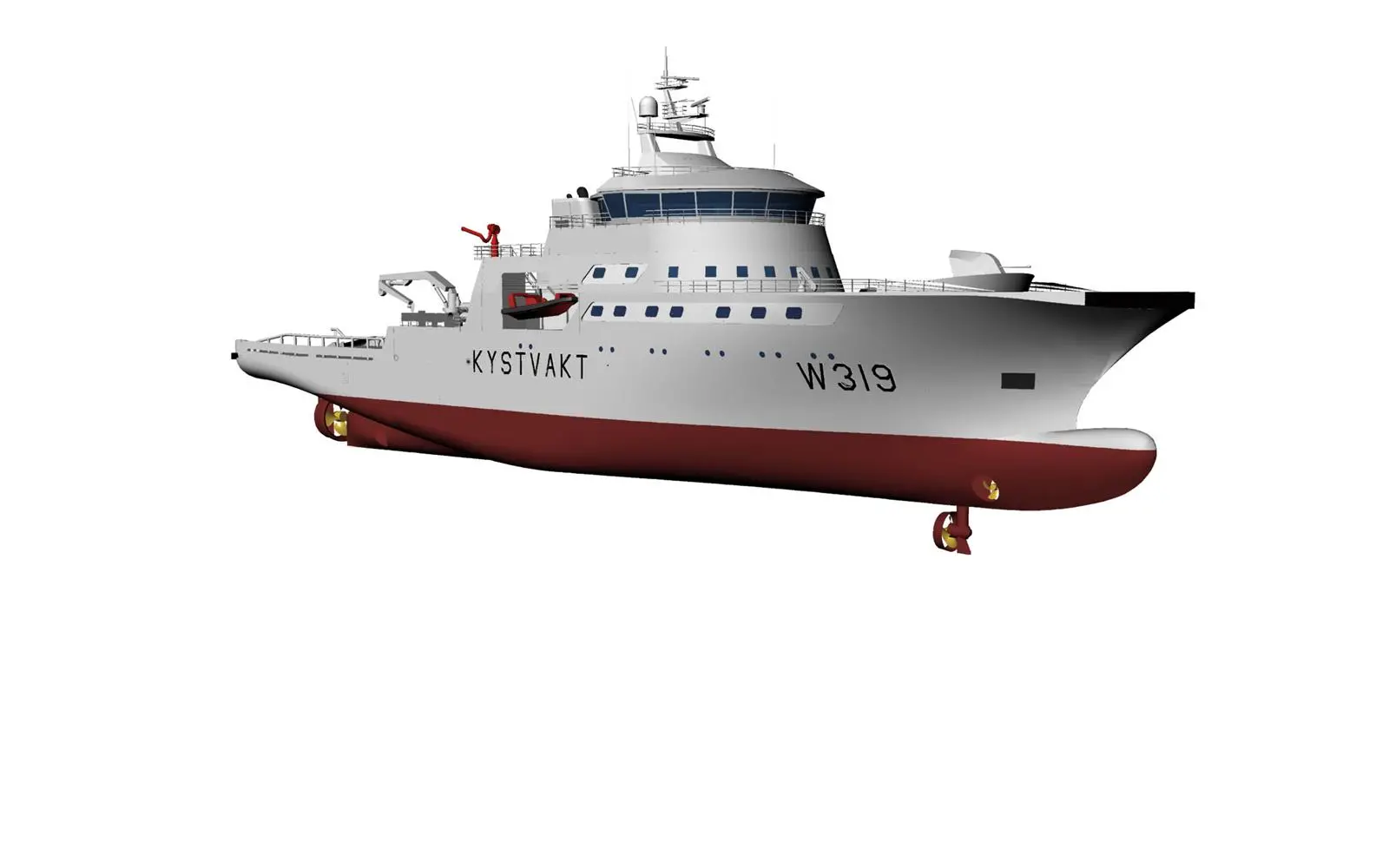
The three new coastguard vessels have a special relationship with a tragedy that, 12 years ago, moved people the world over – the loss of the Russian submarine, Kursk with all its crew.
The KV Barentshav, Bergen and Sortland each have a 440m² deck area designed to take a very particular 300-tonne load. This is the weight of a specially-developed submarine rescue package for trapped submariners; should a disaster strike again the world will not simply be reduced to watching helplessly.
“If we had this package then, the Kursk’s crew could have – would have – been saved…” says Leifmar Andreassen of Remøy Management, the company which has helped to develop and manage the craft for the Norwegian coastguard service.
Recently, the KV Barentshav and KV Bergen have been involved in training on deployment of the submarine rescue unit, while the Sortland will do its initial training either later this year or early next year.
However, Mr Andreassen explains to The Motorship that the vessels are not all about emergencies – although they do have to respond quickly if need be.
The KV Sortland, like the others of the class, is a 4,025dwt vessel, 93.30m long, with a beam of 16.60m, and a draught of 6.2m.
The ships were built by Kleven in Norway at its Myklebust yard, with hulls fabricated at Severnav Shipyard in Romania. A gas-electric system powered by lower power LNG-fuelled units serves for the slow speed manoeuvring that takes up a large proportion of the coastguard’s time. It’s a very efficient application, which keeps down both fuel consumption and the environmental footprint. However, to give the power necessary for high speed response – and especially should there be a call for a submarine rescue – the vessels have a higher power Rolls-Royce diesel unit, driving a CP propeller by mechanical means.
This main diesel engine is a 4,000 kW Bergen B32:40L8P, engine with a 750rpm speed, and is complimented by three Mitsubishi GS16R-MPTK and a GS12R-MPTK. Beside this sits a Mitsubishi S6A3-MPTA diesel unit for other power needs and a Mitsubishi 6D16T-32 emergency engine. It also has a useful bollard pull of 100 tonnes.
Speed and fuel consumption works out to give a maximum 20 knots using 22m³ of diesel and 27m³ of LNG per day. The economy speed of 12 knots uses just 16m³ of LNG a day, while the standby mode of 4 knots only uses 5.5m³ of LNG per day. Quite a difference.
The Sortland has been designed with a multiple set of capabilities planned in, gaining a class notation of +1A1, ICE-C, Tug, Fire Fighter I, Oilrec, E0, Dynpos-AUT. It has a capacity of 641m³ marine diesel oil, 362m³ of fresh water, 1,642m³ of ballast water and an oil recovery capacity of 1,075m³. It can also take 28m³ of lubrication oil, 4m³ of hydraulic oil and the same amount of sludge, a dirty oil tank of 8m³ and a bilge water tank of 15.5m³.
However, it’s the 200m³ cargo hold and the 440m² cargo deck area that is built to take the high load stresses which is of special relevance to the submarine rescue package. This is kept in Scotland, UK, at Faslane on the Clyde, and can be mobilised quickly: it is flown to the nearest airport to where it is required, to rendezvous with its designated carrying craft, and the whole thing aims to be at the endangered submarine’s side within 72 hours – although the recent trials have pointed to possibly shortened times. The skipper of the Bergen, Truels Hovde, told The Motorship that in training, given two shifts, the vessel should be ready in 24 hours and ready to get to the site.
The rescue package itself, which has been kept in readiness for the last couple of years, is owned jointly by France, Norway and the UK. It consists of a new free swimming submersible vehicle with its own, portable A-frame lift and recovery system. It also has an intervention system for survey and rescue preparation, which includes a ‘lock on’ device that seals itself against the submarine’s hatch.
Furthermore, there is a pressurised transfer facility to help safely decompress personnel coming up from the deep. The rescue submarine has a crew of two pilots and an attendant, and can rescue 15 people at a time, with an eye to a four-hourly transfer. It can effect rescues from depths of 40m to 610m, and can cope with 60° degree inclines. It also has the ability to remain effective with internal pressures as high as 6bar. The vessel is designed to operate at rough sea conditions, will operate in 5m waves and be able to remain on station in 10m high seas.
Although the ROV is free-swimming, the coastguard will monitor and guide its crew through fibre optic umbilical cables providing video, communications and data.
Principal particulars
Length oa – 93.3m
Beam – 16.6m
Draught – 6.2m
Deadweight – 4,025dwt
Main propulsion – Bergen B32:40L8P Diesel, 4,000kW
Secondary propulsion – 3 x Mitsubishi GS16R-MPTK
1 x Mitsubishi GS12R-MPTK
Class – DNV +1A1, ICE-C, Tug, Fire Fighter I, Oilrec, E0, Dynpos-AUT.
²
Related Articles
 PROPULSION
 GENERAL NEWS
 HYDROGEN