



South Africa reinvigorates and extends Polar capabilities
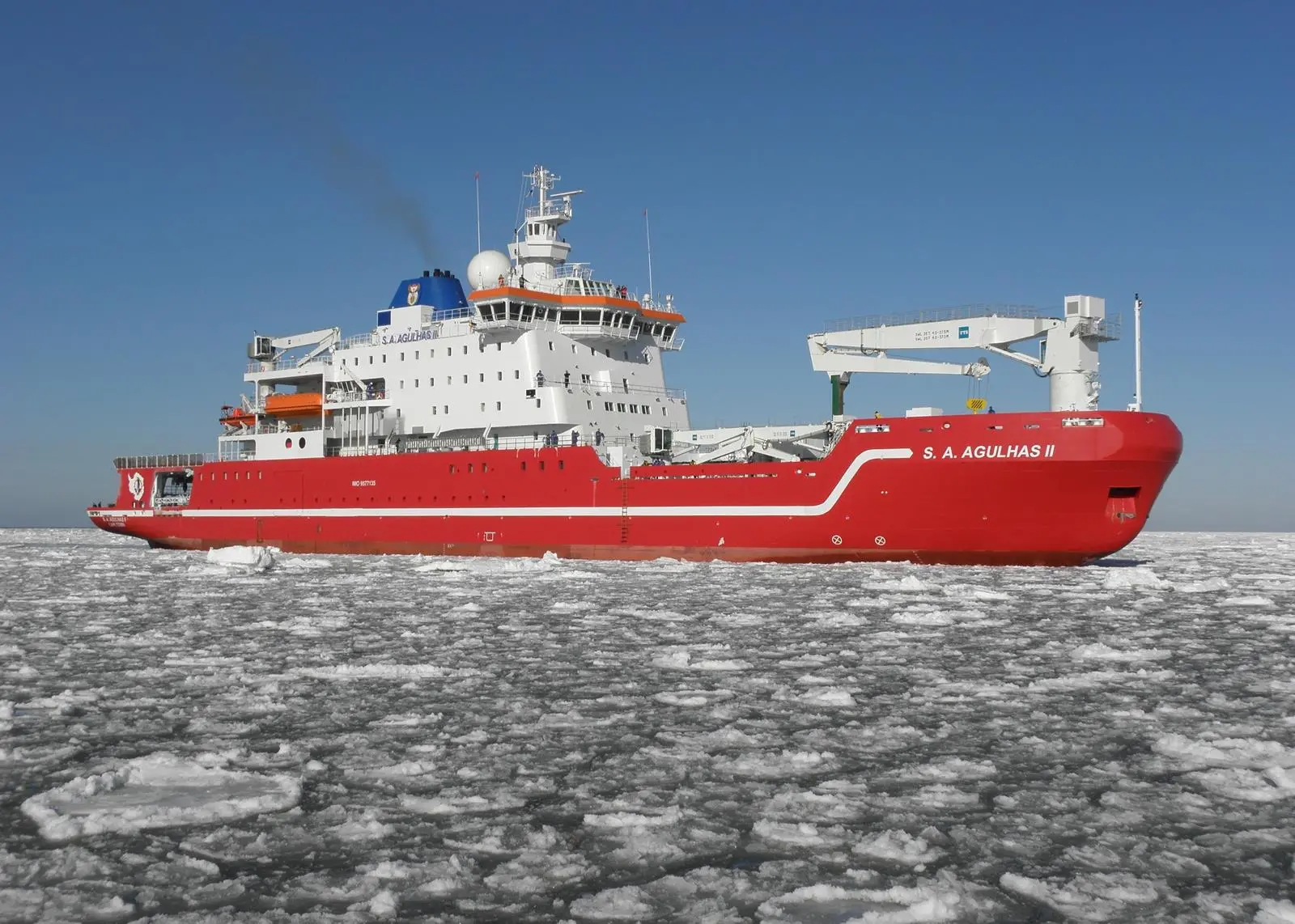
While assuming core responsibility for maintaining logistic support to South Africa’s research bases on the Antarctic mainland and on Marion Island and Gough Island, the 13,000gt S.A.Agulhas II has been purpose-designed for a much wider and expanding role that includes shipboard scientific research, meteorological measurements, oceanography and eco-tourism.
The state-of-the-art polar vessel constitutes an investment of R1.3billion by South Africa, and is pivotal to the long-term sustainability of the country’s interests and obligations in the Antarctic. As a product of STX Finland‘s Rauma yard, she affords fresh testament to Finnish strengths in ice-going vessel technology and construction.
Superseding her 1977-built predecessor S.A.Agulhas, which has embarked on a new career as a national sea training ship with a research role, the state-of-the-art S.A.Agulhas II is manned, managed and maintained by the South African company Smit Amandla Marine on behalf of the South African Department of Environmental Affairs (DEA). The latter oversees the country’s involvements in Antarctica, and its commitments and obligations to the Antarctic Treaty.
Strengthened for ice class navigation to IACS PC-5 standard, the 134m-long S.A.Agulhas II was ordered with a tentatively foreseen operating profile to include about 180 days in relief voyages to the SANAE (South African National Antarctic Expedition) base on the mainland and to the stations on the Gough and Marion Islands, and about 100 days on dedicated research voyages. Relative to the earlier vessel, the new ship is expected to be used more widely in the Southern Ocean for scientific work, and is also seen as a catalyst for rebuilding South African deep-sea oceanography capacity.
One of the new ship’s tasks is to conduct continuous measurements of a range of meteorological parameters for transmission from her automatic weather station to the South African Weather Services. Weather balloons are inflated in a special hangar, and floating weather buoys are launched during transit voyages.
The vessel has eight permanent and six containerised laboratories equipped and instrumented for various fields of marine, environmental, biodiversity, meteorological, climatic and hydrographic research. A deep coring facility is installed for sampling seabed sediments to a depth of 5,000m. Deepwater probes can be deployed via a large door on the starboard side, while a hydraulic A-frame on the stern is used for towing sampling nets and dredges, and for putting out and retrieving arrays of sensors.
A structure known as a ‘drop keel’, housing transducers for measuring the density of plankton layers and small fish and for gathering other data, can be lowered through the hull bottom to a depth of 3m below the ship. The vessel is also equipped with moonpool, of 2.4m x 2.4m main dimensions, extending from what is known as the ‘environmental hangar’ through three decks and the ship’s bottom. This provides an alternative launch area through which to lower sampling probes when the ship is working in pack ice.
A commanding feature of the ship’s top hamper is an observation tower from which researchers may view birds, seals and cetaceans while under way. The uppermost of the two observation decks is enclosed, so as to afford some shelter in low temperature environments.
For her supply and replenishment duties, S.A.Agulhas II incorporates hold space for 4,000m³ of dry cargo in her forward section, served by a 35t heavy-duty crane and three 10t cranes, all of which can also be used to transfer scientific equipment, materials and vehicles to and from the ice shelf. Cargo can also be flown off by helicopter. A dedicated heeling tank counters list induced by the swinging out of heavy loads. It is understood that the ship is the first of her kind to be authorised for carrying both passengers and bulk fuel, specifically polar diesel, Jet A1 helicopter fuel and petrol.
Accommodation is provided for 45 crew, including four cadets, plus about 100 researchers and passengers, to the extent that her DNV notations include passenger ship classification. The outfit includes a library, a gym and a small hospital. The vessel has a high endurance factor, equating to 15,000 nautical miles at service speed, and is fitted with a landing area and hangar space that can handle two helicopters of Super Puma type or equivalent.
The ice bow form was designed at Rauma and proved in the Aker Arctic ice laboratory near Helsinki, using extensive model tests. Further model testing was carried out by SSPA Sweden to confirm seakeeping and power predictions.
Key criteria bearing on the power, nature and configuration of the power and propulsion system were the requirement for a high degree of operational flexibility, while offering overall fuel efficiency and acceptable through-life maintenance costs, against the backcloth of an extremely varied duty profile and challenging service conditions.
The range of scenarios includes open water transits at service speed, traversing pack ice at low speed, maintaining position for extended periods at the ice shelf, towing lightweight nets at two or three knots, and station-keeping while conducting deep, vertical oceanographic profiles and coring.
Applying the power station principle, in which the main generators supply electrical energy to cover not only propulsion but all shipboard consumers, the diesel-electric installation employs four Wärtsilä 32-series engines as prime movers. Each of the six-cylinder diesels has a nominal maximum rating of 3,000kW, driving its respective alternator.
The two electric propulsion motors turn 4.5m-diameter, Rolls-Royce controllable pitch propellers. The system gives a maximum open water speed of 16 knots, for a service speed of 14 knots. Icebreaking performance is such that the ship can force a passage through level, 1m-thick ice at a speed of 5 knots.
So as to fulfil IMO’s Safe Return to Port (SRTP) requirements, the main engines are located in two separate machinery rooms, and the vessel is capable of making port with one engine room flooded.
An integrated, electrical engineering package embracing energy, propulsion and automation systems was ordered by STX from Converteam, now new owner GE Energy’s Power Conversion business. The drive solution adopted is based on two induction propulsion motors, each rated for 4,500kW at 140rpm and supplied by PWM-type MV7000 converters. The transformer-less system has added functionality due to its multi-drive architecture, such that the propulsion converters also supply the motors for the stern thruster and two bow thrust units.
Space and weight savings result from the dispensation with propulsion transformers, and the technology is claimed to increase efficiency and availability of the propulsive chain, and yield savings in maintenance time and costs.
Also figuring in Converteam’s scope of supply was the C-Series vessel control system, comprising power management, centralised power plant and alarms management, and vessel, machinery and auxiliary systems.
The sphere and nature of the vessel’s deployments, requiring the utmost dependability and operating precision in harsh weather, sea and ice conditions, has called for advanced functionality as well as very high reliability as regards bridge equipment.
The fully integrated navigation system (INS), compliant with DNV’s NAUT-AW notation, was delivered by Raytheon Anschütz, and includes a suite of six, wide-screen workstations covering radar, chart radar, ECDIS and conning functions. The INS also incorporates the DP system, integrated to share information such as waypoints with the navigation system. This is used for the most precise operation within the ice fields, and for automatic heading keeping when berthing at the ice shelf, or when bottom-sampling by means of the ship‘s own grabbing equipment.
One of the radars is equipped as an ice radar, with advanced ice imaging capabilities, assisting the navigators to identify the optimal route through icy waters and reduce fuel consumption and the risk of hull damage. The ECDIS features autopilot remote control. Both bridge wings are equipped with a chart radar, and also have the option for integrating the conning display to provide full navigation data indication during docking operations.
Principal Particulars–S.A.Agulhas II
Length overall 134.20m
Breadth, maximum 23.00m
Depth 10.55m
Draught, design 7.65m
Corresp. Deadweight 5,020dwt
Gross tonnage, approx 13,000t
Cargo hold capacity 4,000m³
Passenger/researcher capacity 100
Crew 45
Main Diesel-electric gensets 4 x Wärtsilä 6L32, 3,000kW each
Propulsion motors 2 x 4,500kW
Speed, maximum(open water) 16 knots
Speed, 1.0m level ice 5 knots
Classification DNV
Ice class PC-5
Flag South Africa
Related Articles
 PROPULSION
 GENERAL NEWS
 HYDROGEN