



Encouraging breaks as Germans hold their own
The ground-breaking Flensburger Schiffbau-Gesellschaft (FSG) put a smile on the face of German newbuilding this year with a remarkable run of six orders in six months while the sale of the Sietas Group brought some security, and support crystallised for cash-strapped P&S.
It was all encouraging and badly needed news for a newbuilding sector which still remains generally depressed, but in which specialist offshore work remains a life-line for quite a few shipyards.
Those yards now even include traditional ro-ro shipbuilder FSG. Outshining even the mighty Meyer for once and in rapid succession, FSG added three big orders to an already bulging portfolio, bringing total newbuild orders since last December to half a dozen.
In the same short period, the yard performed a smart about-turn and gained a foothold in offshore, doing exactly what it said it wanted to do – diversify to survive. This, as FSG retained its firm lead as the world’s leading builder of ro-ro ships.
As this report went to press, FSG added an order for a 116m ro-pax ferry for Scotland’s Caledonian Maritime Assets and, remarkably, orders for two 127m offshore seismic newbuildings for Western Geco, all three for delivery in 2014. The offshore ships are FSG’s first purely offshore building venture and it has never before built this type of vessel.
The work followed orders for two 151m multi-functional project load vessels for Holland – also the first of their kind to be built by the yard – and one for a 210m con-ro for Canada, the biggest ever built by FSG.
MD Peter Sierk said: “An enormous amount of work now faces us to justify the confidence which our customers have placed in our yard, because only when we deliver the usual high quality to their complete satisfaction will new chances arise for the future”.
Mr Sierk said the chance to build the seismic ships was like being awarded “a penalty in a football final”. He added “you miss the shot at your peril. We won’t!” As for the Scottish ro-ro, he noted it would have to replace two ships in constant service and must therefore be capable of meeting very high demands on a daily basis.
“This order demonstrates once again that we can score points with individual and innovative solutions which are in the best interests of the customer. That’s our forte”, he added. “Because FSG is so good in the research and development sectors we are also able to convert this strength into a real competitive advantage.”
To further strengthen FSG’s already formidable design and engineering sectors and back the positive order situation, the yard has undertaken a recruitment drive. A new office in Hamburg had, at last word, taken on 35 new engineers. Said Mr Sierk: “We want to underpin our intention to remain the leaders in research and development”.
Recent developments at Meyer Werft reflect the same kind of confidence in the future demonstrated by FSG. One is the opening of a new €8 million pipe facility using robot processing and welding technology. It produces pipes of 25mm-200 mm automatically for cruise ships – ships which Meyer said utilise 250km of piping on average per ship. State visitors said the centre showed “innovative energy and corporate courage” while yard MD Bernard Meyer said it would “further improve productivity and quality and strengthen our ability to compete”.
Another positive recent step for Meyer was the appointment of Bernard Meyer’s eldest son Jan as third MD alongside his father and Lambert Kruse. The shipyard has been in Meyer family hands for six generations and will eventually now pass to a seventh generation. Jan Meyer has worked at the yard since 2008 and has also worked at shipyards in Denmark and, significantly, Korea. His father is a strong supporter of European vigilance in the face of Asian efforts to dominate European cruise ship building.
Being delivered in autumn was the 122,000gt Celebrity Reflection, Meyer’s tenth ship for Celebrity and the fifth in the Solstice Class. The newbuildings are billed as pioneers in energy efficiency. Work is also under way on the first of two 144,000gt Breakaway Class cruise ships for Norwegian Cruise Line. The first is for delivery next spring and the second in 2014. They will each carry 4,000 passengers.
Earlier this year Meyer delivered the 71,300gt AIDAmar. The sixth of seven for AIDA Cruises, she has a pilot heat recovery plant which uses the heat from the engines to operate the air conditioning and water preparation plants. Meyer said the system was a world first and that the ship saved a ton of fuel per day.
For delivery at the end of the year is Coral Energy, Meyer’s first prototype LNG tanker with a dual-fuel engine. She is for Dutch owner Veder and will be about 156m long with a cargo capacity of 15,600m³, cooled to -164°C. The 15.8 knot ship can be powered by LNG as well as heavy fuel oil.
Subsidiary Neptun in Rostock is playing a big part in the construction and outfitting of Coral Energy. That yard continues to churn out luxury river cruise ships. After completing a series of six 135m Longships Class newbuilds for the Swiss Viking River Cruises, Neptun was building a second series of the Diesel-electric Schottel/Caterpillar-driven ships for delivery next year to Viking, providing good work for the small yard’s 450 strong workforce.
Rescue appeared in sight late summer for the P&S Werften in Stralsund and Wolgast – Volkswerft and Peene-Werft to the old hands – also still with good work in hand into next year. Apart from cash-flow, the group’s main problem appeared to be delivering ships as originally planned.
Delivery of the first of two much-delayed, 169.5m ferry newbuildings, Berlin, was finally taking place “mid or late September” a Scandlines spokeswoman told The Motorship. That’s some seven months after she should have been delivered. Delivery of sister ship Copenhagen was “expected at the end of November”, she said, also seven months late.
Substantial penalties were inevitable on the €230 million job and will not have helped the P&S cash situation any, even though the yard insisted they were not the cause of it and were limited. Scandlines itself however made no bones of the extra costs involved in chartering tonnage to bridge the gaps opened by the delayed newbuilds and had to forego income from the new ships and recoup costs of new port facilities.
Elsewhere P&S handed over KBV 032, the first of a series of four 52m long new workhorses for the Swedish Coast Guard. That was in early June and the yard also said KBV 031 was undergoing sea trials and would be delivered “soon”. The second two ships were being delivered in “summer” P&S said.
The situation with the delivery of a series of five ice-breaking container and supply ships ordered by Royal Arctic Line was also a little confusing as The Motorship went to press. The yard has been building the ships since late last year but none appeared to have been delivered as of early July.
A RAL spokesman told this correspondent earlier this year that the biggest of the five – 113m long and for 606TEU – was being delivered in June. Two 71m long 108TEU ships were for delivery in August and October and the last two, a new 45m long, 36TEU type, were being handed over in November and December, he said.
Due for delivery as this issue went to press, was the first of two 195.2m long ro-ro newbuilds for Denmark’s DFDS. The original announcement spoke of delivery “by mid 2012”. Keels were laid in August last year and a DFDS spokesman told The Motorship early this year the ships, together worth €128 million, were for hand-over July and October. Again however, there was no word of that delivery or of any delay mid July.
P&S is this year also completing a 180m long and 32m wide heavy lift offshore construction ship for a Far East owner. It’s being fitted with a 2,000t capacity crane, a helipad on the upper deck and GPS. P&S said the welding work on the crane tower was the first offshore-related work for Wolgast. It also said the tower job, along with deckhouse, section and superstructure construction was lasting until October.
For delivery up to next year are the two 172m long offshore installation vessels OIG Giant 111 and OIG Giant 1V. They are for Singapore-based Offshore Installation Group (OIG).
News on the group’s cash-flow problems appeared good as this report went to press with a rescue package taking shape and approval from Brussels to hand. The conditions of that approval however might cause problems, and not a few headlines, later.
A spokesman for the state government of Mecklenburg-Vorpommern (MV), Andreas Timm, told The Motorship the EU Commission had approved a government loan guarantee to help the yards over a reported cash short-fall of €300 million. Berlin and MV guaranteed €152.4 million while banks, suppliers and the work force also pledged contributions. However Mr Timm said the EU approval was conditional on a restructuring plan for the yards first being presented. “We are still working on that”, he added.
New investment was also being sought. There were encouraging media reports that the group’s good order situation had prompted considerable interest from investors and even potential buyers of the group.
Reports agreed that the top priority was to sort out financing first prior to restructuring, perhaps even trimming the yards’ nearly 2,000 strong work force. No-one wants the yards to collapse with so many orders in hand and to lose so many jobs there and in dependent industries.
The future of the three firms in the insolvent Sietas Group in Hamburg appeared more secure after they were sold-off separately. Receiver Berthold Brinkmann said offers for the individual firms were together greater than any offer for the group and added there were also sound strategic reasons for the split sales.
All the new investors are in shipbuilding and Mr Brinkmann said the maritime sector in Hamburg would “gain new momentum from strong shipbuilding companies”.
Norderwerft in Hamburg went to Bremen specialist builder Lürssen, which was also taking over its 94 employees and bringing in others. Norwegian shipbuilding supplier TTS bought marine crane and lifting gear subsidiary Neuenfelder Maschinenfabrik (NMF) and took over its 130 employees. Sietas Werft itself was sold to the Dutch VeKa Group, which also has shipbuilding interests, and initial reports said almost all of its 400 workers could still find employment there because of the yard’s current order situation.
Sietas is building a delayed 139m long wind turbine installation vessel for delivery next spring to Holland’s van Oord, which also has an option on a second ship. The type 187 vessel, which Sietas helped design, carries 6,700t and has a 900t capacity crane.
For delivery reportedly in August was the 7,350m³ dredger Elke Möbius – a sister to the 119m, 7,445t Werner Möbius, built in 2010.
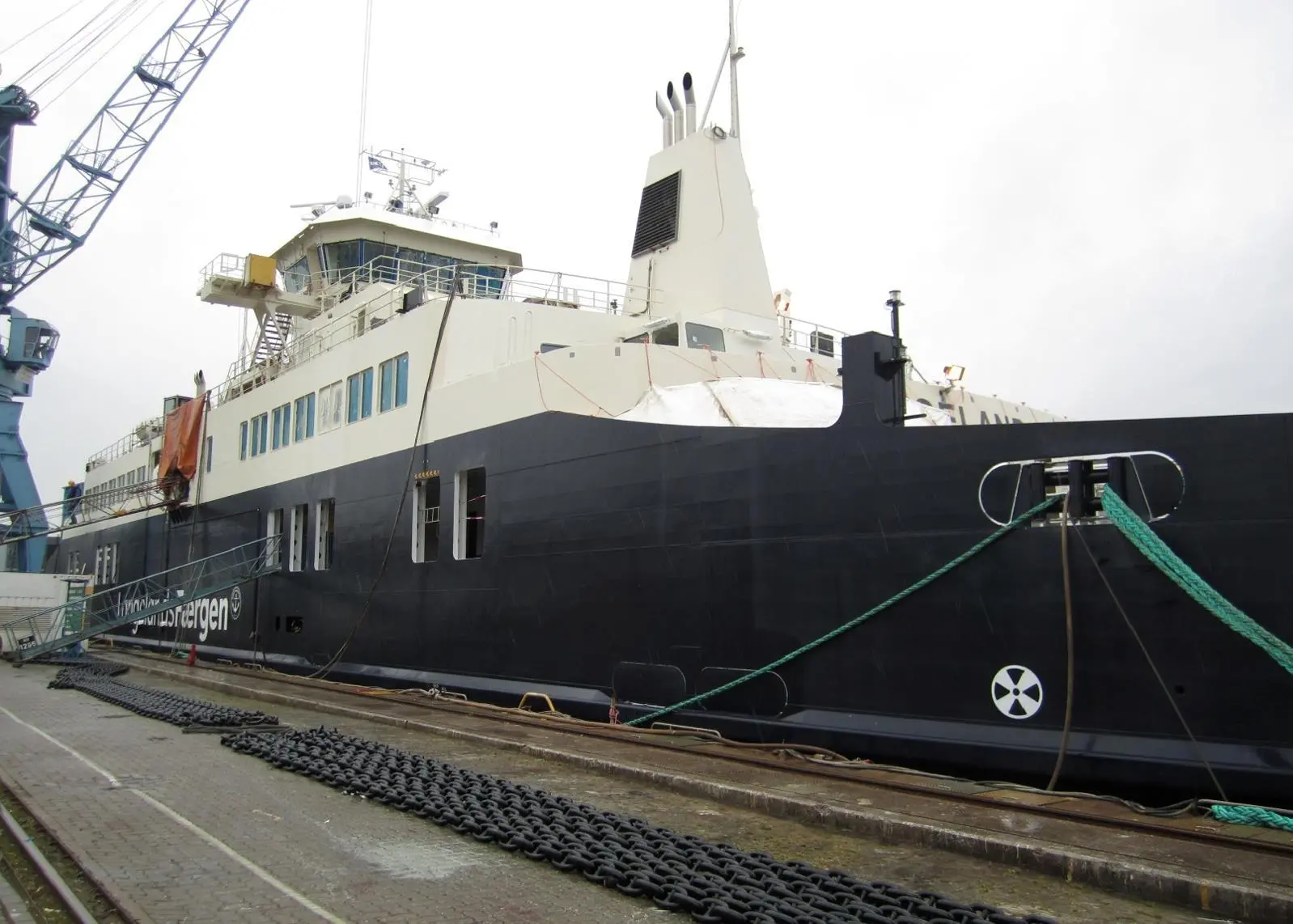
Also being delivered was the 99.9m double-ended ferry Langeland, sister of Lolland, which Sietas handed over in March to Danish owner Faergen. A third order was cancelled.
Costing €20 million apiece, they are of 4,780gt and carry 600 passengers and 122 vehicles on a total 624 lane-metres. They are driven by Caterpillar 850kW diesel-electric engines and azimuth propellers which can operate with bio-diesel and are also capable of conversion to LNG.
In a joint operation elsewhere, the German Navy’s third 173m long task force logistics and medical auxiliary Bonn, was at the Emder Werft & Dockbetrieb (EWD) – the former Nordseewerke Shipyard (NSW) – for completion in September.
Her hull was towed to Emden from Peene-Werft in Wolgast and her deckhouse was built by FSG in Flensburg. EWD was installing the engine room and fitting two 14,400kW MTU engines as well as shaft plant and operating systems.
Sadly the Bonn project was likely to be the last pure shipbuilding job at EWD, which was sold in 2009 and converted to wind turbine building.
Related Articles
 PROPULSION
 GENERAL NEWS
 HYDROGEN