



Innovative diesel-electric system for Dutch cargo ships
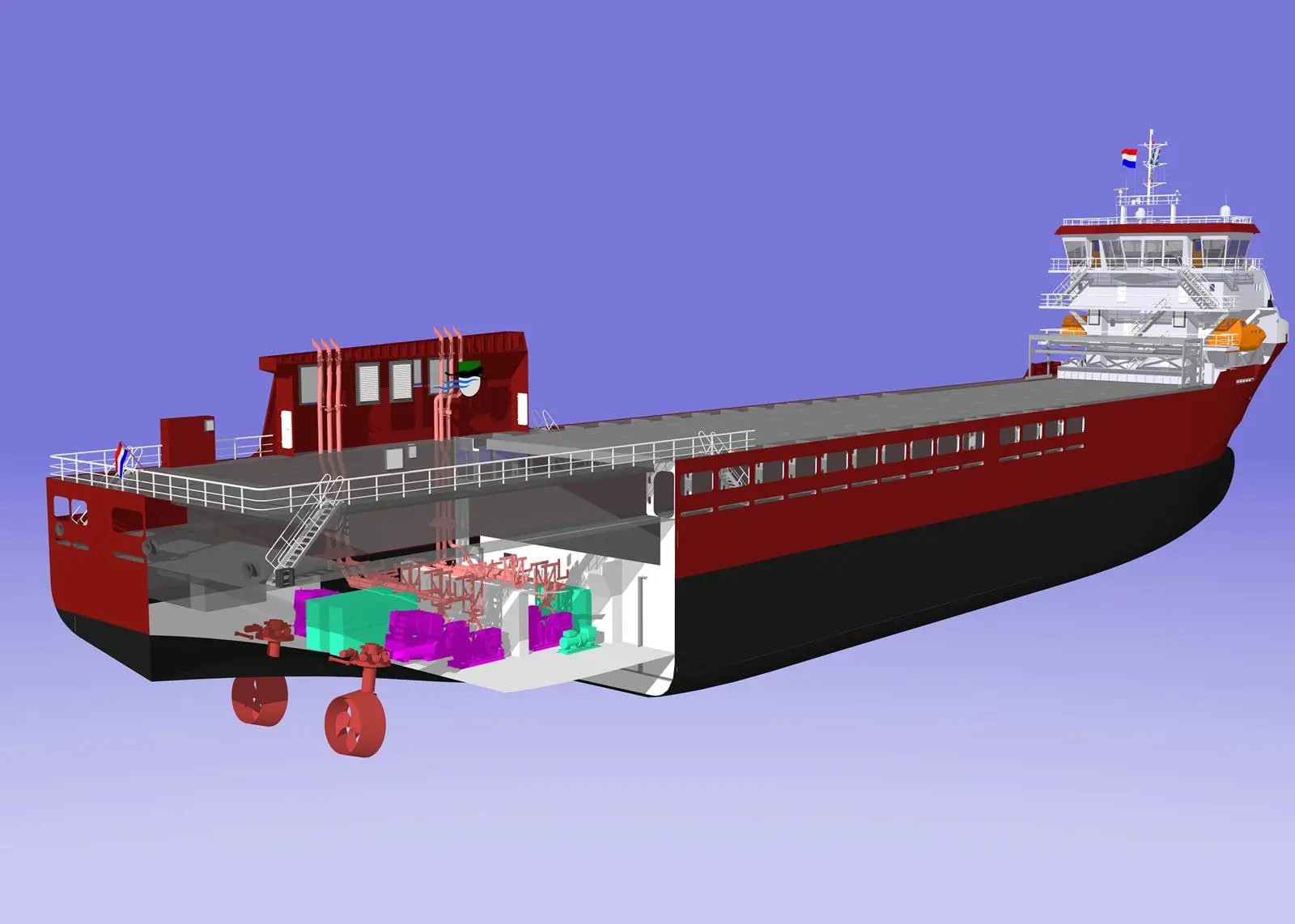
A new generation of innovative coasters suited to special cargo transportation, including deliveries of wind farm components to offshore locations, has been specified with the partial DC power configuration. The 6,000dwt first-of-class Jaguar was completed and named at the beginning of June at Harlingen, in the north Netherlands.
Employing a diesel-electric installation offers important advantages in precisely matching energy delivery to power needs at any point in a ship’s operating profile, and confers greater flexibility in ship design, as the various elements can be optimally positioned, and this advantage has been fully exploited in the 6,000dwt vessel type. The ensuing maximisation of the hull volume for revenue-earning purposes has made for a very large capacity in relation to the vessel’s overall size, with an exceptionally long upper hold extending above the compact machinery spaces.
But the incorporation of a DC bus system, given its range of prospective extra benefits, may prove to be the additional, signal factor in spurring the industry’s uptake of the diesel-electric mode in the general dry cargo vessel market beyond the present three-ship programme.
Equipped for dynamic positioning, and arranged with the superstructure forward, giving added protection to the long, unobstructed sweep of the cargo areas certified for an ‘open-top’ sailing condition, the Jaguar embodies Vuyk Engineering Groningen (VEG)’s VG6000-E design. Through collaboration with Vacon Benelux, the Netherlands-based subsidiary of Finnish electric drives manufacturer Vacon, and electrical installation contractor Alewijnse Marine Systems of Nijmegen, the VG6000-E class debuts the diesel-electric propulsion arrangement with a DC bus.
Owned by Jaguar Shipping of Vlieland, and freight-managed by Amasus Shipping of Delfzyl, the Jaguar is set to be followed this year by second and third examples of the design, Abis Shipping’s Abis Dover and Abis Dublin, also to be commercially husbanded within the Amasus fleet. Groningen shipbuilding facilitator Shipkits, which secured the orders for all three vessels, entrusted the main construction to its Szczecin yard in Poland, using steel fabrication packages from another Dutch company Centraalstaal. Ship completion takes place at Harlingen.
Each ship has six small prime movers, wherein Scania diesels drive the main gensets. The six 500kW aggregates are equally divided between two separate engine rooms, in each of which is a DC switchboard. Each genset is equipped with a harmonic filter and AFE (active front end) rectifier that transforms the AC power into DC for the 750V DC main board. All the primary consumers are equipped with a standard industrial DC/AC inverter, ensuring the supply of a clean, sinusoidal current. Thus the DC bus feeds variable frequency DC/AC inverters to drive the propulsion system consisting of two azimuthing Z-drive thrusters in the stern and two bow tunnel thrusters.
The power distribution from the two boards is controlled by several inverters and by two programmable logic controllers (PLCs). In keeping with the redundancy provisions that permeate the entire powering and propulsion system, the two PLCs both control one portside and one starboard system. Flexibility is achieved through the engine switching and engagement possibilities, enabling power supply and engine usage to be optimised in accordance with an operating profile characterised by wide variations in energy requirements.
The system has been designed to ensure maximum operational reliability through the comprehensive redundancy provisions and use of standard industrial components. The ability to match actual power output with precise energy needs at any point, plus the application of an intelligent management system, promises substantial fuel savings over time.
The adoption of a common voltage rail of 750V DC obviates the need for generators to run exactly in parallel, as is necessary in an AC network, with its attendant requirement for a more advanced power management system. Phase difference and frequency are not an issue with the DC board, and power management is simplified because the Vacon inverters distribute the power naturally and evenly over the generators. Extra power can be obtained in a matter of seconds, it is claimed, whereas this process can take several minutes in a conventional AC solution as the generators must first be synchronised.
Harmonic distortion of frequency and current can be an issue with standard AC systems. However, in the Dutch-developed system and vessel series, each genset line is fitted with a filter, so that distortion is tackled at the start of the system, before the main board. This represents an important alternative to the more usual practice of addressing harmonic distortion at the ’end’, or consumer side, of the electrical system. Overall, the DC bus solution makes for a fast reacting, stable system, in addition to the operational, design, and fuel-saving benefits of diesel-electric propulsion.
Furthermore, the application of AFE converters at the power input side of the system ‘future-proofs‘ the system by potentially allowing combinations of different kinds of gensets, with varying speeds, frequency, voltage, AC or DC or power capacity. This provides possibilities in connecting renewable energy sources, for instance.
Related Articles
 PROPULSION
 GENERAL NEWS
 HYDROGEN