



Smaller German yard work points up economic clout
The Schiffswerft Diedrich in Oldersum provides a good example of a small yard which stays comfortably busy year through the year with a string of regular local shipping clients, most of them ferry and excursion craft operators.
More complex than many of those routine jobs, however, has been the replacement of engines in the 32m long excursion ferry Baltrum III as part of a major conversion of that 40-year-old ship. Diedrich installed two new Scania main Diesels Type D1-12-59 of total 662kW described as more eco-friendly and with lower sulphur emissions. They replaced KHD Type SBA 6M816 Diesels of 470kW. The ship’s reverse gear plant was replaced with two Reintjes units Type WAF-244L.
To ease installation, Diedrich took out and rebuilt part of the ship’s bottom. As well as the engine work, it installed a new bridge console, replaced bridge interiors and installed thicker safety glass on the lower deck. The underwater hull was painted and the ship underwent heeling tests.
A similar repair and maintenance job on the 44.6m ro-ro ferry Störtebeker included inspection of propeller, shaft, rudder and bow thruster as well as check and repair of stern door welds and repairs to the ship’s Diesel engine.
The Port of Kiel’s tug and ferry concern SFK may also announce welcome small ship conversion work, perhaps for local yards, if it goes ahead with ideas outlined earlier this year to expand its fleet. SFK managers said they were planning three newbuildings, but were also considering two conversions as alternatives. The two ships concerned are the 32.7m passenger ferries Laboe and Strande, both built in the early 1980s for about 300 passengers apiece.
SFK’s Andrea Kobarg told The Motorship late August that a decision was still in the air and that the company was “still considering whether newbuilding or refit is the best option”. She added that it would now be the end of the year before a decision was taken.
In Hamburg the sale of the J.J.Sietas Group has brought some welcome news for former repair subsidiary Norderwerft. Now renamed Norderwerft Repair, its sale to family concern Bremen-based Lürssen has been finalised with all its jobs intact and a repair future apparently assured.
Managing partner Friedrich Lürssen said he would take on all 94 staff and continue to offer and expand repair there for both merchant and naval vessels in the facility’s three floating docks. Lürssen said the yard’s strengths would be further developed and new capabilities added.
After visiting three different small yards inside a year, the odyssey of veteran 82.2m sail training ship Gorch Fock was due to end this autumn. The 54 year old ship was originally docked last year at Lindenau Werft in Kiel for routine hull work. After the hull was found to be in a worse state than first thought, she was moved to a dock at the BREDO Shipyard in Bremerhaven early this year. The dock was leased by the small Elsflether Werft after it bagged the contract for more extensive work on the ship.
Gorch Fock left BREDO late summer and was towed back to Elsfleth for re-rigging and trials which reports said were ending late September. The final bill for her renovation, originally put at less than €1 million, is likely to have risen to more than €4 million in the meantime.
Lindenau meanwhile continues to make up for losing Gorch Fock with useful repair and overhaul work. Still in receivership but staying afloat with repair and overhaul, it docked the 59.8m former Baltic excursion ship Gloria D (ex Wappen von Heiligenhafen). After lying-up for years, she was ordered to be overhauled by authorities in Hamburg and towed to Lindenau. MD Dieter Kühne told The Motorship the work was paid for by her owner and was carried out on the hull and on her two Deutz KHD-SBA 8M 528, 8-cylinder Diesels, shaft and rudder.
Kühne said the yard also overhauled the 53m tug and supply ship Noortruck, the 26.8m Lübeck fire-fighter Senator Emil Peters and the 27m Kiel tug Kitzeberg. Two lifting pontoons for authorities in Brunsbüttel and the motor ship Marittima from Lübeck-Travemünde provided further work for the yard.
Earlier two ships called at the same time. One was the 32,500dwt product tanker Seahake, built by Lindenau, which came in for boiler work. The other was the 24,765dwt bulk carrier Ladytramp which called for urgent on-board repair work on her four 25ton on-board cranes. “Things are beginning to happen in the repair sector”, said Kühne, adding that “further projects were under discussion” as of late July.
Just a couple of hundred yards down the road from Lindenau the small Gebrüder Friedrich Bootswerft has also been busy. Among other jobs it handled was the two-month overhaul of engine and other equipment on the 25.5m Rostock police patrol boat Warnow and the overhaul of the 50m luxury yacht Lady M while a pilot boat and a former Swedish patrol boat moored alongside for work.
In the continuing absence of conventional newbuilding work, a variety of repair and maintenance jobs continues to help keep heads above water alongside offshore manufacture at Nordic Yards. A recent unusual conversion at the group’s Wismar facility has been the manufacture and installation of steel frames for five stainless steel juice tanks on the 42,497dwt juice transporter Ibis Arrow. The work lasted five months. It covered tank sub-structures, strengtheners and conical roofs as well as accessories and services. It was followed by the installation of the steel tanks themselves, each about 16m high and more than 11m wide. Nordic said it was chasing follow-up orders.
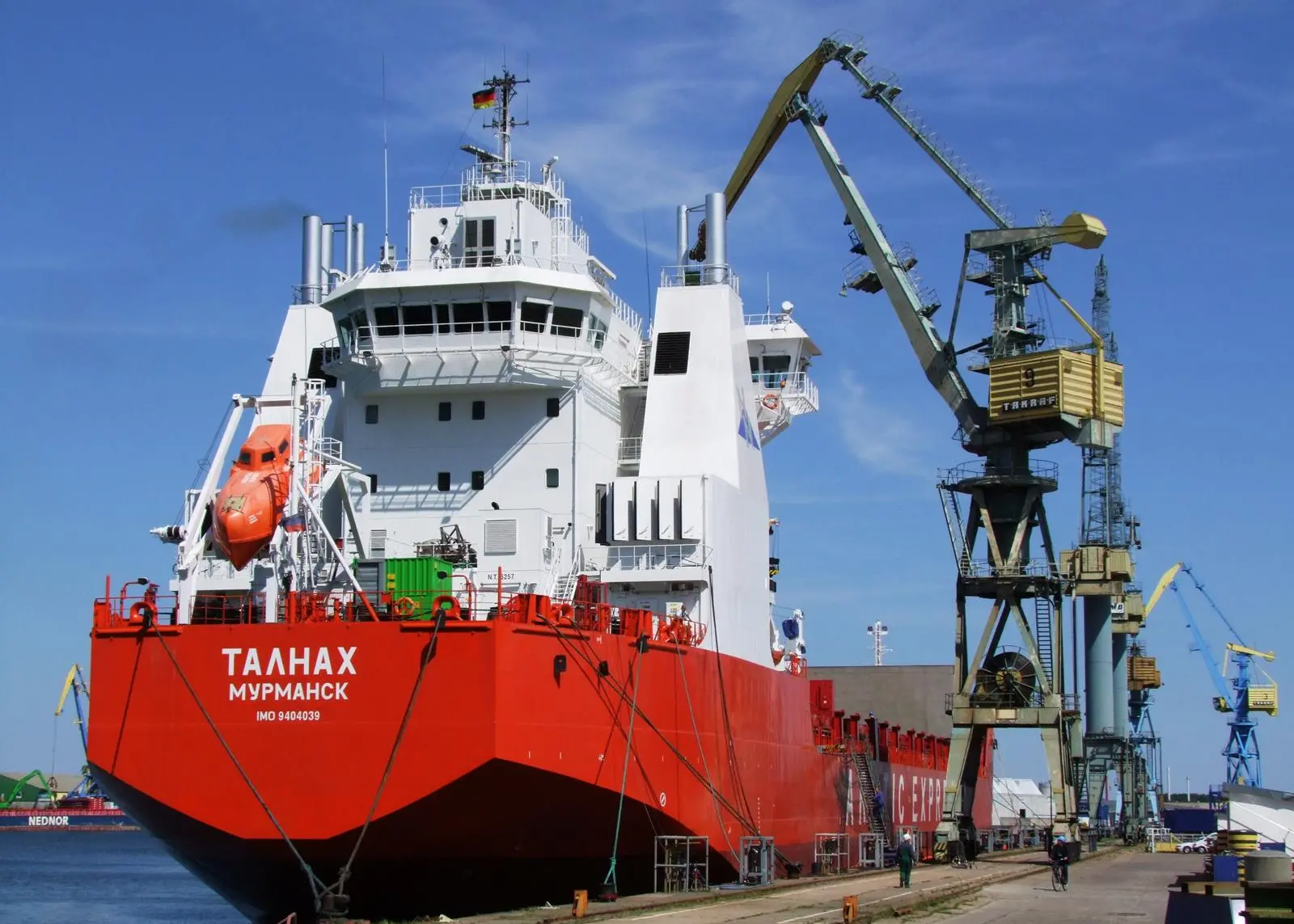
The tank job paralleled the more conventional, extensive modernisation of the Russian Arctic container and multi-purpose ship Talnakh. In less than six weeks, two loading cranes were retrofitted, a new port diesel generator installed and additional container supports incorporated to provide extra cargo capacity. A shelter deck was added and the underwater hull was grit-blasted and coated. Routine maintenance was also undertaken. Talnakh was built at Nordic in 2008, one of four ACS 650, ice-breaking, 18,000dwt ships. Nordic modernised her sister Norilskiy Nickel last year.
Among specialist vessels in German yards of late have been two veteran research ships which are being phased-out by the Government over the next few years. Engine specialists Motorenwerke Bremerhaven (MWB) overhauled the 97.5m Meteor while Germany’s biggest polar research ship, the 118m Polarstern, docked atLloyd Werft Bremerhaven (LWB).
Operators of the Meteor told The Motorship that although she will not be replaced for at least another seven years, she will continue to undergo regular maintenance and that this is essential. Her former captain Niels Jakobi said the now 26-year-old Meteor docked for her second visit to MWB inside a 12 month period. She was there late last year for work costing about €2 million and the latest visit was costing about €1 million. Asked why so much was being spent on the old ship now with replacement ahead, Jakobi told The Motorship a start would not be made on the new Meteor until about 2019, meaning completion about 2020.
“If we were to no longer carry out certain works”, said Jakobi, “the ship would age very rapidly and that would be against our principles”. He added that was why there were even plans to install a new water ballast treatment plant in the ship “over the next few years”.
“The current Meteor needs to sail for at least that length of time and has to guarantee safe operations as well as the safety of the scientists on board right up until her last day in service”, he explained.
Jakobi heads the Institute of Oceanography’s co-ordination centre for German research vessels at the University of Hamburg and is also responsible for the 93m German research and survey ship Maria S Merian. He revealed that ship was going to Emder Werft und Dockbetriebe in September for work including the installation of an improved EM122 sounding plant – the type already installed on Meteor.
Jakobi said the latest work on Meteor included hull conservation and anti-fouling painting as well as tank conservation. He said her two Diesel generators were also overhauled as were winches and interiors. Some anchor chain was swapped and a winch console was modified. Modernisation work was also carried out on the scientific equipment and the integrated bridge. Other reports said her four MaK 6M 322 1,000kW engines underwent overhaul, a main reason no doubt why she was sent back to specialist MWB. The same reports said Meteor was returning to Bremerhaven this year to exchange measuring equipment.
MWB also docked the 23-year-old, 45,977dwt Hapag-Lloyd container ship Heidelberg Express for routine repairs and class renewal work. Several crew members were reported hurt during her stay when a fire broke out, apparently during welding work on a Diesel tank. Christian Denso at H-L confirmed the incident but said it had no major effect on the planned work on the ship.
The other research vessel in the news this time is Polarstern, which serves with the Wegener Institute in Bremerhaven. Since her successor is not due into service until about 2017, she too will need several more years of repairs and maintenance. Given the comments about Meteor, she is likely to get it.
The double-hulled icebreaker called at Lloyd Werft Bremerhaven for voyage preparation work and overhaul. Driven by four KHD RBV 8M540, 3529kW engines developing 16 knots, she has served since 1982 and while she was at the yard she was opened to the public for the first time in three years. Thousands turned out to see the popular ship because of her now certain replacement.
The new Polarstern will cost €450 million and is likely to be just as big and even more sophisticated than the old one. Who will build her is not yet known, but a yard like LWB, which has regularly repaired and serviced the old ship and has newbuild and completion capability, must be among the frontrunners for the job.
Elsewhere at LWB, managing director Rüdiger Pallentin told The Motorship late August that little had changed in the generally quiet repair situation. In an earlier first half year report Pallentin said busy winters with lots of passenger ships were being followed by springs in which specialist vessels, these days offshore vessels, tended to dominate. That, he said “mirrored the current climate in German shipbuilding”.
As autumn approached, Pallentin said “we are negotiating with a number of shipping companies about different projects, among them cruise ships, but as long as there are no decisions, there is also nothing to report”. He said the yard was however currently keeping its head above water with routine docking and repair work, but gave no details.
At Germany’s other big repair and conversion facility, Blohm + Voss Repair in Hamburg, things also appeared routine in repair and overhaul. The yard continues to demonstrate its offshore prowess with the ongoing conversion of the Enquest Producer, but at the same has also continued to demonstrate merchant capability by docking a trio of container ships. If previous years are anything to go by, regular cruise ship customers will begin to call again for annual checks and overhaul as the year wanes.
Spokesman Michael Brasse told The Motorship new ship work was expected in September and October and added that good news was likely in early September. But no details were forthcoming as The Motorship went to press in late August.
The boxships that called in summer for general repairs and class work included the 54,155dwt Liverpool Express from Hapag-Lloyd, which also underwent cleaning and underwater hull coating. Also docked were the 53,462dwt Cap Roberta from Offen and the 45,452dwt Cap Richards.
Prior to that, the yard completed the €15 million modernisation of the51,044gt Crystal Symphony. That work included the removal and overhaul of her rudder as well as the overhaul of bow and stern thrusters.
Well-ensconced at the yard, and due to stay there until about mid 2013, was the 92,000dwt FPSO EnQuest Producer, which arrived in January as the Uisge Gorm and is undergoing life extension work lasting 17 months. It is the yard’s first big offshore vessel conversion since 2009.
Revealing more details, B+V said the EnQuest Producer job was won after “a hard-fought bidding phase of around 12 months” involving shipyards internationally. It also said the work covers the conversion of the processing plant on the 248m long vessel, the installation of two boilers and two steam turbine sets (12MW), conversion of the turret and mooring system, overhaul of the engine plant, modernisation of the electrical and alarm systems, renovation and extension of crew accommodation, modernisation of the helicopter deck, structural steel reinforcing work and a comprehensive preservation programme.
Expectations that the re-engining and modernisation of the 23 year old Russian trawler Lira by German firms might soon lead to further such retrofit work had not been realised as of late August. Zeppelin Power Systems (ZPS) had said it was hoping for follow-up orders because the trawler is one of 37, many of which are still in service. “Modernisation could be economically interesting compared with the cost of a newbuilding”, it said. However, ZPS marketing official Christina Roos told The Motorship late August “there are no further developments to report as far as projects like the Lira are concerned”.
ZPS and Caterpillar Marine Power Systems in Kiel modernised the drive system on the 120.47m trawler and integrated the new equipment into the existing engine room set-up with a view to lowering operational costs and increasing efficiency. Lira’s two SKL 6VDS 48/42-AL2 7,200bhp main engines were replaced with two MaK Type 8M32C units. Existing gearing, capable of transferring up to 5,830kW, was replaced with a ‘double in-single out’ unit from Reintjes. The new engines and gearing along with a new electronic remote control device meant the existing SKL 8VD 26/20 auxiliary Diesels did not need modification, another saving for the owners.
With an available total performance of 8,000 kW, two wave generators each of 1,500kW and a drive shaft/gearbox/propeller transfer of up to 5,300kW, the trawler “now has a powerful drive plant that is tailor-made to demand”, ZPS said.
With similar economies in mind, German owner Rickmers is this year installing ABB EMMA energy management systems on five of its ships. Rickmers said the system will help ship managers “to operate its ships at a maximum level of energy efficiency and to save fuel.” Facing changing markets and increasing price pressures, Rickmers expects the system to “improve profitability and reduce the overall environmental footprint”. It was estimated by ABB that at current fuel prices “the estimated payback of the system is less than a year”.
The first system was due for commissioning this autumn in Rickmers Singapore with EMMA fully operational in all five ships by the end of year, Rickmers said.
Related Articles
 PROPULSION
 GENERAL NEWS
 HYDROGEN