



Bulker receives EGCS retrofit
The system can receive gas from multiple sources, including main and auxiliary engines and boilers. With EGCS installed, the ship can operate using HFO in ECAs and comply with IMO Annex VI emission requirements. The company says that this will reduce cost for the owner/operator over time, with the payback period depending on the price differential between low sulphur distillate fuels and HFO.
In 2005 Clean Marine began development of the multi-stream, hybrid EGCS suitable for both open and closed loop operation in any type of water be it sea, brackish or fresh water. The system is ‘multi-stream’ because a single gas liquid interface unit can serve several exhaust sources simultaneously, rather than having one cleaning unit per source. The ‘hybrid’ designation refers to the system’s capability of using liquid caustic soda (sodium hydroxide – NaOH) without precipitation issues to compensate for low alkalinity level in the cleaning water, allowing the system to operate equally well in any type of ambient water. In open loop operation, the cleaning water is discharged direct to the sea, while in closed loop, the cleaning water is recirculated and held in a tank for later discharge to sea or ashore, after cleaning by adding NaOH.
The system has been trialled in conjunction with MAN Holeby Diesel, with extensive trials of the multi-stream and hybrid features between 2006 and 2008. This led to a trial installation of a 10MW system onboard the MV Baru in 2009-2011, and a research and demonstration unit at Marintek in Trondheim was installed in 2011.
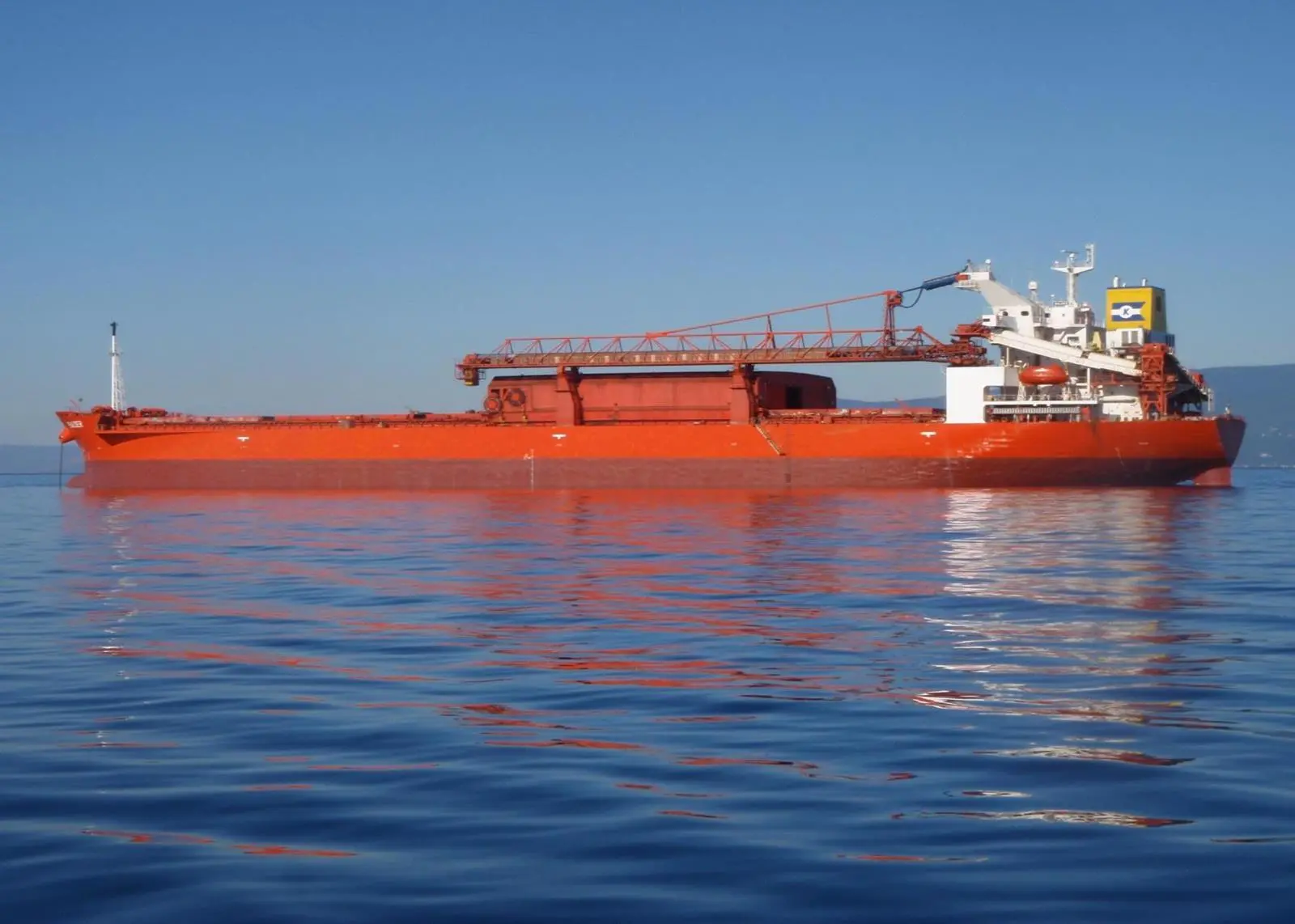
The latest full-scale installation was carried out onboard the 48,000dwt 10-year-old Handymax self-unloading bulk carrier Balder in May-June 2012. The Balder project was instigated in cooperation between shipowner Torvald Klaveness, shipyard Victor Lenac in Croatia, ship designer SRS and Clean Marine, with financial support from Innovasjon Norge. As well as verifying the large scale performance of the MkIII version of the EGCS, the project aims to define and tune the process from initial dialogue to full system commissioning and handover to the owner for a retrofit EGCS project.
The company says it is well aware of the challenges related to installation of an EGCS – the interface with machinery and structure and subsequent approval by class, the available time for installation in connection with regular dry docking and the importance of planning, preparations and supervision during installation. It has therefore defined a five step approach to meet the challenges and to act as guidelines when executing a project.
These steps are:
- Concept study; including basic equipment specification, installation layout and budget (four weeks) followed by the preliminary contract, i.e. letter of intent
- Detailed study; including ship inspection and quotes from yards and suppliers (four to six weeks), followed by the main contract for installation and purchase of equipment
- Pre-planning; (12 to 14 weeks)
- Installation; (four to six weeks) and
- Commissioning (one week).
This involves a probably total timescale of 27 to 33 weeks, including contract periods.
Before any detailed planning and serious discussion with class and ship yards can take place the lay out of the installation needs to be conceptually defined, thereafter assessed and agreed. From the previous Baru full scale project the following key stages were highlighted for the Balder installation:
- Installation drawings and documentation for class approval and workshop documentation
- Installation and equipment specification for yards quotation and equipment and material ordering
- Degree of piping and structure prefabrication
- Equipment delivery versus prefabrication and vessels arrival
The installation time is critical, in order to avoid additional off-hire caused by the EGCS installation in connection with a regular dry docking. Clean Marine has set the ultimate goal of accomplishing an EGCS installation within a normal 10-21 day dry docking period.
For the Balder, the aim was set to complete the EGCS installation within 28 days or as long as it took to complete other general and particular repairs, which eventually took 33 days. At the time of sailing all EGCS work was completed except for minor piping work which was completed on the voyage. Standards and procedures for future projects are being formulated based on this experience.
The Balder installation comprises a multi-stream system connected to the single main engine, three auxiliaries and a boiler, equivalent to a total output power of around 11,000kW. The system has the capacity to treat 110,000kg/h of exhaust gas, in either open- or closed-loop operation, using salt, fresh or brackish water and NaOH, with a liquid flow rate of 350m³/h. Planning began in November 2011, followed by firm agreement with the shipowner in February 2012. The ship arrived at the yard for dry docking on 15 May, and left the yard on 17 June 2012. The remaining minor work was completed while sailing, and the system commissioned between July and September 2012.
Drawings and documentation were prepared for Class approval, and the system certified according Scheme B (continuous monitoring).
The hardware comprises:
- EGC unit;
- Multi stream gas/liquid interface unit;
- Dual water supply pumps, dual high pressure pumps (10 bar), circulation pump for closed loop operation, and dual NaOH dosage pumps;
- Circulation water cooler for closed loop operation;
- Water supply strainers and filters, WTU (effluent Water Treatment Unit filter);
- Motor valves and exhaust dampers;
- Monitoring equipment for gas, PAH, turbidity, pH, pressure, temperature, levels;
- Electrical frequency drives, switch board, control board including PLS.
The work involved removal of the old funnel, fabrication of a new, wider, funnel, and installation of the EGC unit. The upper part of the aft peak tank was converted to provide a NaOH storage tank (110m³ – sufficient for about 100 days operation), a holding water tank (110m³) for closed loop operation in port, sufficient for about 10 days assuming 1 MW power, a system tank (15m³), a wet room with cooler and circulation pump for closed loop operation, and a dry room for frequency drives, switchboards and control boards. A new sea chest was fabricated and dual (redundant) main supply pumps installed, with additional piping and cabling. The equipment added a total of around 80.5t in weight, including pipework and cabling.
Related Articles
 ALTERNATIVE FUELS & LUBRICANTS
 FUELS & LUBRICANTS