



Woes for shipowners and shipbuilders
Whether the UK industry declined because successive governments ceased to regard manufacturing as a priority, or whether the government lost interest because of the decline of the industry is an interesting point. We would take the former view – in countries like Norway, there is both a flourishing industry and government involvement, proving it can be done.
But the marine press cannot change what has gone before, unfortunately. Though it might be worth our present rulers remembering that in international maritime publishing, arguably Britain leads the world. And we are proud to be part of that.
The Minister spoke of laid-up ships and depressed freight rates – familiar complaints today. But in contrast to his successors (interestingly of the same political hue) he spoke of close cooperation between government, shipowners and shipbuilders, which he said would bear fruit in increased efficiency and competitiveness. Indeed, the editorial comment shared much of that optimism as far as British shipbuilding was concerned, though it sounded a note of caution when it contrasted the generous UK government aid for aircraft and aero engine development with the assistance offered to marine engineering.
Most of the rest of the issue was devoted to marine engine developments and prospects, but a table of motor ships completed in 1962 revealed what our predecessors regarded as a “surprising fact” – that tonnage completed in Japan was almost twice that produced by British builders. Nevertheless, Britain had regained second place in the international table, thanks to a marked falling-off in West German production. Sweden had also done well, taking third place from the Germans. With the exception of Canada, India, Australia, Egypt and Brazil, with some 17 ships (nine of which were small-tonnage Canadian vessels) between them, the rest of the world’s ship production was European. No sign of China, Korea, or even the USA.
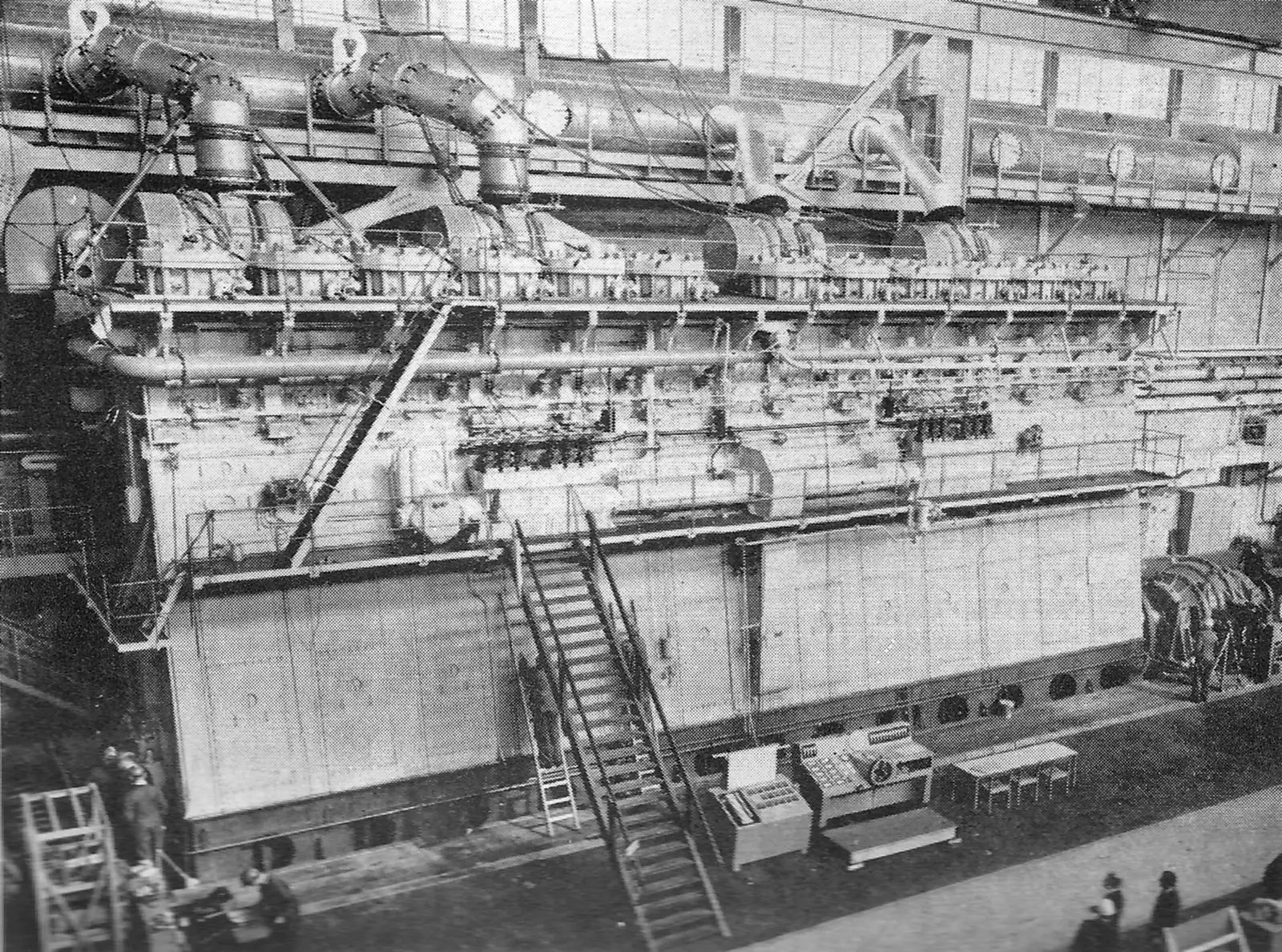
Some of the aforementioned engine developments look not at all dissimilar to today’s prime movers, though obviously lacking the electronic control and very high pressure turbochargers. Among these were a 12-cylinder, 21,600bhp 84cm-bore MAN-Kockums two stroke, then one of the most powerful in service. The technical director of Sweden’s Götaverken, Anders Linden, considered the implications of designing-in higher pressures for increased efficiency and higher output of large engines. He concluded that the problems could be overcome, and new developments such as computers and advanced measuring instruments – things we take for granted now – would have an important part to play in speeding up the process of technical development.
Other engines from 1963 look strange to our eyes. The opposed-piston engine still had its adherents, most notably Doxford, which reported generally good results from its P-type engine, though admitting there was little scope to extend the bore size and power range further because these would lead to excessive crankshaft weight. However, the J type promised to be the lightest engine on the market in the 20,000bhp class; other benefits claimed for the opposed-piston design including better balance, lower vibration, better distribution of internal forces, good fuel consumption and near-perfect scavenging. Harland & Wolff was another company favouring opposed pistons, developing the B&W design, and the latest thoughts were outlined by the company’s chief engineer, Mr C.C. Pounder. He contrasted the opposed piston engines with the B&W single-acting, poppet-valve two strokes and found his engine superior, a view that seemed to be backed up by a survey of customers.
Related Articles
 50 YEARS AGO
 50 YEARS AGO
 50 YEARS AGO