



When a little lift can make all the difference
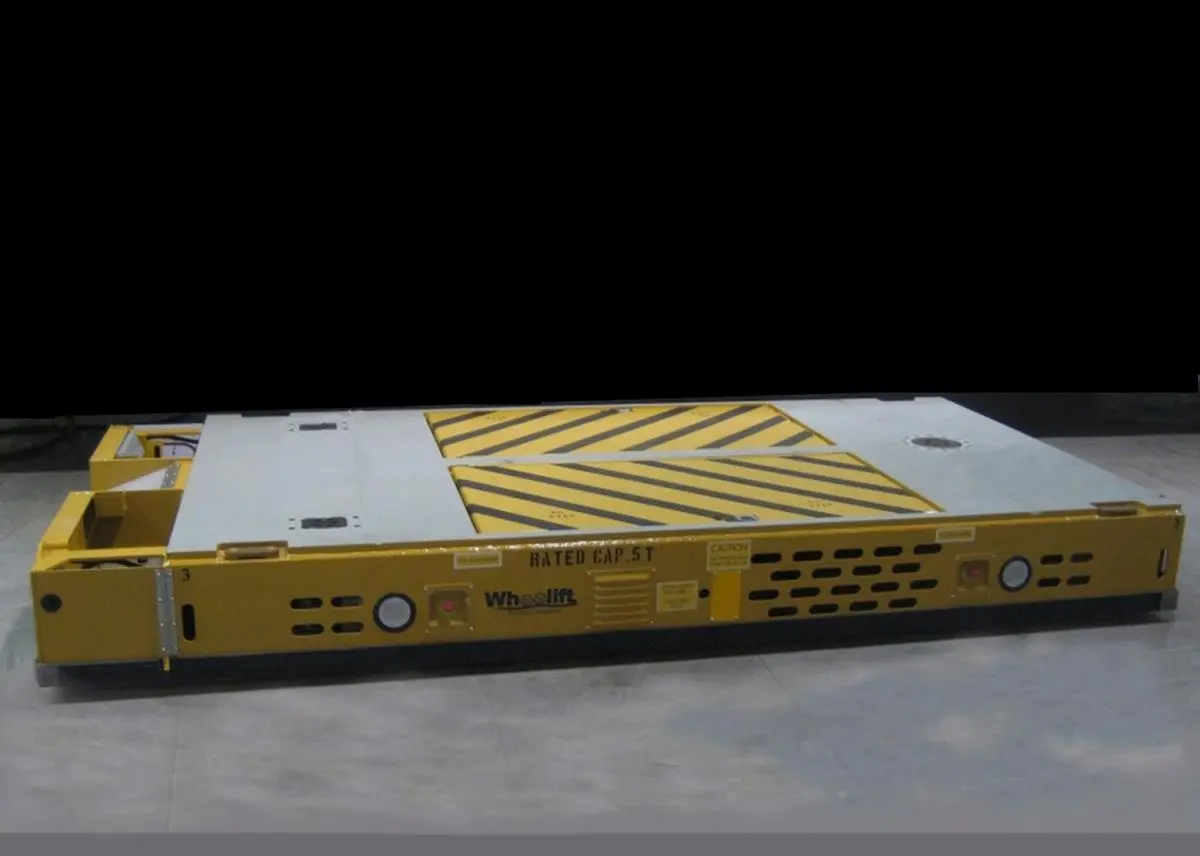
However, there’s a new transporter, based on a tricycle, which could make the job of manoeuvring a vessel’s heavy-but-delicate parts into position far easier and faster.
“We can move large sections around with very small clearances,” Trikelifter inventor Mel Terry of Wheelift Systems tells MS. The unit is different to larger models in that it has a very low profile and is extremely compact – this tricycle version is made for lighter loads in the 2 tonne to 9 tonne carrying range which means it is only around 2m or 2.5m long.
The new Trikelifter uses a an electrically-driven axle with a single steerable wheel in front and two fixed-direction but differentially driven wheels at the back, governed through an embedded controller which both lines up the rear wheels and forward axle and keeps the bed horizontal. It gains its ‘lift’ ability through vertical lifting cylinders on each of its support points and this allows the otherwise rigid three-point transporter to drive under a stand-supported load, hitch it up and carry it off – with a very high degree of accuracy. Mr Terry points out that it is just as possible to have two transporters drive under a load and operate in tandem as a single unit, via a single operator.
However, perhaps one of its most useful features is that the small Trikelifter can itself be easily moved, carrying on other duties around the yard as and when need be.
Congested spaces are one issue, but Mr Terry explains that another is down to ship design. For example, some vessel’s propulsion systems can be hard to get at and in these cases maintenance teams often rely on welding bat-eyes to help crane-lift the hull – but these lifting eyes then have to be taken off again and the hull recertified, a long and costly process.
Here the other, larger Wheelift transporters can slip underneath and lift up the hull: the result of driving every wheel with the same type of independent servomotor used with milling machines is, unsurprisingly, the precision of a milling machine. This gives the accuracy needed to align and install shafts, rudders and propellers even in very congested spaces.
Further this kind of precision means a second unit, fitted with a tower, can be used to ease things like shaft and propeller system apart or mate them up again. “You can imagine this can be a tricky business,” says Mr Terry, “but all the moves can be calculated to within 1/32 of an inch – less than 0.8mm – and its truly omnidirectional.”
Related Articles
 PROPULSION
 GENERAL NEWS
 HYDROGEN