



All-electric air supported hull vessel comes closer to reality
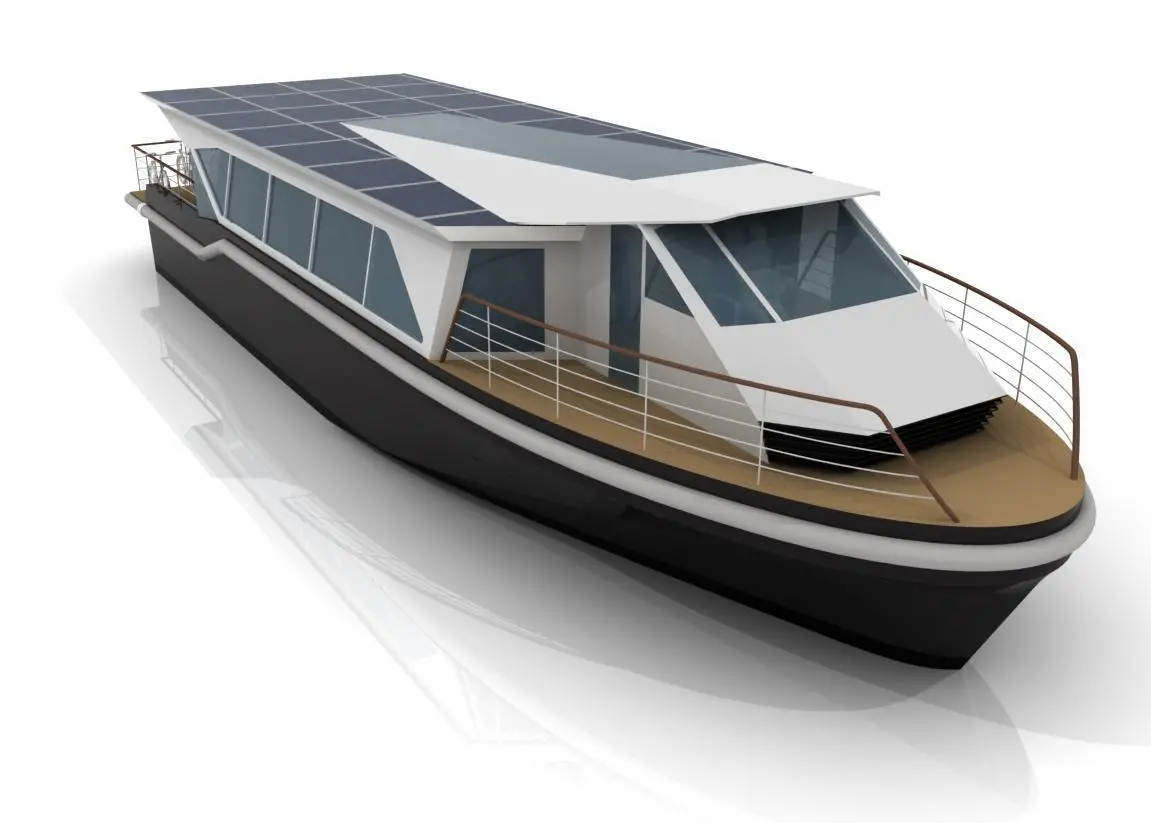
The three-year project was launched in 2011, and is being coordinated by SES Europe of Norway. Besides SES Europe, other partners involved include SSPA Sweden, Lloyd’s Register. Carbonia (Sweden), Diab (Norway), Aqualiner (The Netherlands) and Amberjac Projects (UK). The brief was to develop a low-wash, emission-free vessel, capable of carrying up to 100 passengers and a number of bicyles at 30-35 knot speeds.
SES Europe reports that the first project phase has now been completed. This encompassed extensive tank testing of the air supported vessel (ASV) technology and validation of suitable battery concepts. With these goals achieved, the BB Green project is moving on to its next phase, namely building a full size prototype and test vessel.
According to SES Europe, the tank testing proved significantly reduced hull resistance for the ASV monohull over a wide range of speeds, from very low speeds up to and beyond the specified 30/35 knots. Cell testing of the proposed Lithium-Ion Titianate battery chemistry also met expectations.
The project now calls for testing the concept in full scale and under real operational conditions, and is inviting shipyards and boatbuilders with knowledge of composite vessel construction to participate in a public tender process. Because the project budget relies on support from the European Commission, tenders must come from European companies.
The BB Green prototype is envisaged as being of carbon sandwich construction. The complete composite engineering as well as construction materials will be supplied by Norwegian partner Diab. In line with the project’s goal to enhance overall efficiency, the carbon construction will contribute to keeping weight to a minimum. Diab will work closely with the successful tenderer on optimising the yard’s construction principles and methods to take advantage of the emerging materials and construction principles.
The ASV hull form has been jointly developed by SES Europe and Effect Ships International, the latter owning the global commercial rights to the patented technology. Partner SSPA Sweden has provided valuable assistance in the hull form development, testing and optimisation.
The ASV principle relies on a cavity underneath the hull, forming a sealed air cushion chamber, into which a lift fan system feeds pressurised air, reducing wetted surfaces to a minimum and supporting up to 80% of the vessel’s operational displacement on the air cushion.
SES Europe points out that the wake wash is a critical issue for operation on sheltered waters close to the shoreline with plenty of traffic. As the vessel will be supported on a cushion of air at a standstill, the transition to cruise speed (22 to 30 knots) will follow swiftly with a far less pronounced ’hump’ than a conventional craft.
Twin podded propulsion units with contra rotating propellers have been specified, to provide a compbination of high efficiency and good manoeuvrability. Like the kift fans, the propulsion units will be electrically driven. The configuration is designed to enable safe and predictable handling in confined waters. The electric lift fan system will be located in the bow region, supplying air under pressure to maintain the ’cushion’ effect which will also contribute to motion damping as well as lowering resistance.
The general arrangement, layout and exterior design for the prototype has been undertaken with assistance from Italian designer; Studio Sculli; using a semi-stealth flat panel superstructure design to give a contemporary look as well as keeping down production cost for the topside. The prototype will be about 20m long, with a beam of 6m, and built to Lloyd’s Register class. The vessel will be fitted out with full instrumentation for assessing performance, efficiency and onboard motions.
The range of the vessel will be a direct function of the battery size. For the commercial version of the BB Green ferry, a range of 12 – 14 naut mile at cruise speed is considered adequate, which should be achieved from a standard 400kWh battery pack. Quick recharge capability and a high number of recharging cycles are key requirements for the battery. Depending on the final operational profile, the selected Li-ion (nano tech) cell chemistry should handle 15,000 – 20,000 cycles before losing adequate capacity. In practice; with 300-350 days of annual operation and 10-12 recharges a day, battery life should be at least four years.
Dutch end user partner, Aqualiner, reports considerable interest for the new concept. In The Netherlands , both Zuid –Holland province and the Port of Rotterdam have expressed strong interest in the project. This has been matched by other Dutch regions and even a large US transport group operating passenger transport services in and around major US cities has enquired about the project.
Related Articles
 PROPULSION
 GENERAL NEWS
 HYDROGEN