



Making progress, crabwise
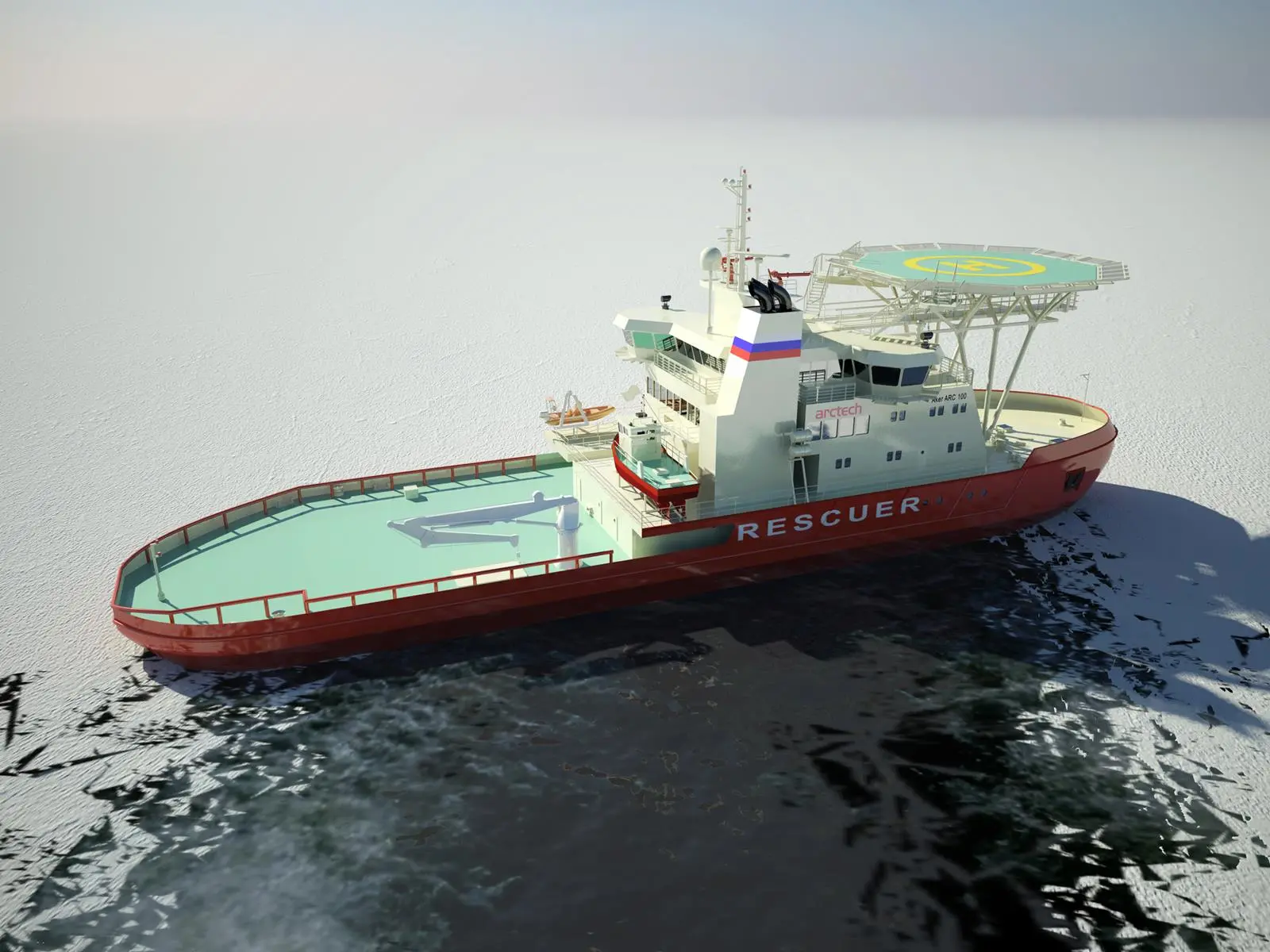
Firstly, it’s benefited from the pod-drive ice breaking capability that was originally carved out by independent ice-breaking tankers such as MT Tempera, built for Neste Shipping to handle their Russian imports. Mikko Niini, MD of Aker Arctic explains that the double acting “stern first working” vessels came about when icebreakers showed they could actually go backward faster than forward: however, it was the introduction of azipods that made the most of the effect, “flushing ice away from the hull and so lowering resistance,” he tells MS.
Operations in the Gulf of Finland do still need quite a bit of power: this new 75.2m vessel has three main generator sets producing 3.0 MW each, most of which goes to feed three Steerprop azimuthing thrusters of 2.4 MW each. Combined with the hull’s hydrodynamics it means “the vessel can practically turn on the spot” says Mr Niini.
Further, the 20.05m beam ARC 100 can make way continuously through 1.0m thick level ice, making good progress facing either ahead or astern. However, the vessel can also simply point all the power to one side and cut a channel by going crabwise through the ice –the oblique angle to one side of the hull almost acting like a third bow.
“One important cost saving aspect to this is that whereas normal icebreaking work needs two craft running in tandem to clear a channel for a tanker, this boat can simply turn sideways, pointing into the ice with its asymmetric side, and cut a nice big channel right through on its own,” says Mr Niini. So, it will leave a 50m wide passage in 0.6m thick ice at two knots while operating in oblique mode.
It has a need to be able to operate independently for quite a while without returning to base, as it will be used mainly in the very remote and icy areas of the Gulf of Finland, so it has a range defined by a limit of 20 days at 75% power. Life support functions run for 30 days, and cover the needs of the crew of 12 with six spare cabins for temporary personnel – all the cabins are equipped with a private WC/shower module.
The Russian operators have also thought about the necessity of a being able to respond effectively to an oil spill. The oil control booms project through hatches in the side of the craft, but rough water can make containment difficult. Mr Niini explains: “We carved a tunnel right through the craft, which takes the sting out of the waves and allows for better oil recovery: but just as important, the vessel can move sideways in a very controlled manner and this means the whole vertical side of the vessel can be used as part of the spill control area.”
The balance between the space needed below deck for oil recovery apparatus and very large tanks – of which 1,500 cubic metres can be used for recovered oil – means that this topside area has to take much of the cargo or other equipment. However, the deck area is quite spacious, coming to 400 square metres, and has plenty of room.
Stability requirements have been fulfilled both at the 6m design draught and at the 7m maximum draught. Trim and list control by using ballast and fuel transfer makes up for different loading scenarios, and last but by no means least, the ship can operate in ambient air temperatures down to -30C.
By Stevie Knight
Related Articles
 PROPULSION
 GENERAL NEWS
 HYDROGEN