



Fast cat can become semi-submersible
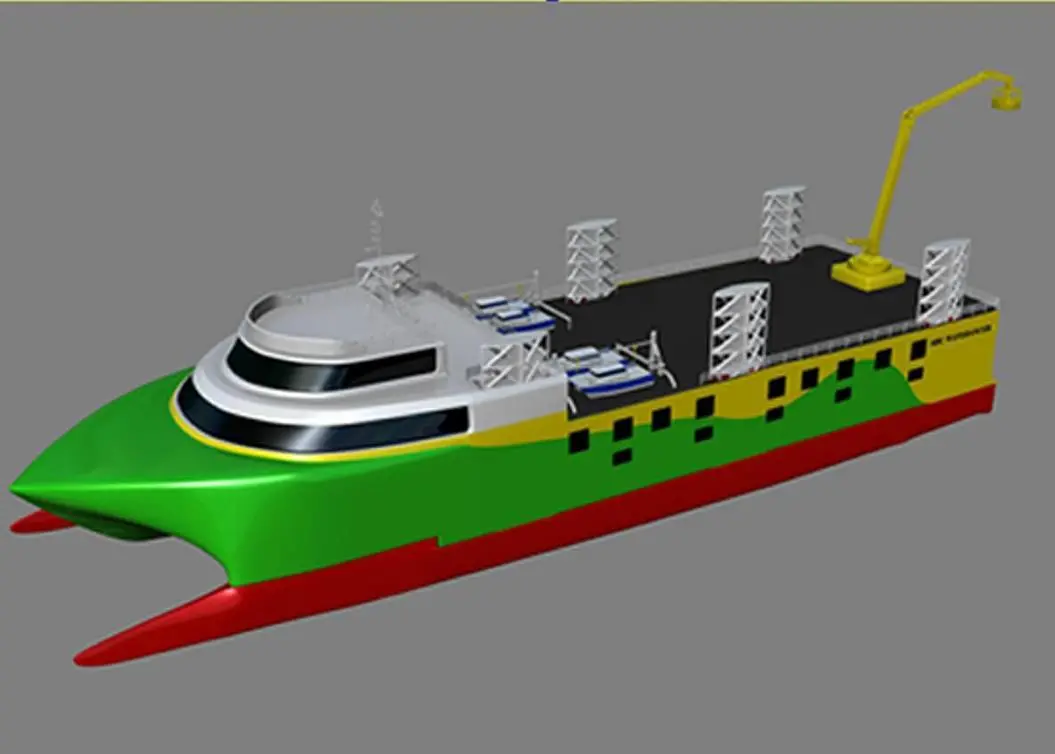
The proposal has been developed by OSSeas Consulting, which is based in the British Virgin Islands. The consultancy has developed the concept design, which has a lower hull section that during normal running at sea integrates closely with the main hull but which, when on station, can be lowered to create a semi-submersible platform.
The SHC Wavedancer looks like a normal wave piercing passenger-type catamaran when in transit mode with slim side hulls that support the weight of the vessel and a central, ship-shaped hull that would come into effect in higher wave situations to provide additional buoyancy. When the vessel arrives at its operational station, the two side hulls can be lowered under hydraulic power in the manner of a jack-up platform so that the lower hulls are now well under water and so are largely immune from wave movement in similar fashion to a semi-submersible vessel.
OSSeas Consulting claims that the Wavedancer will be able to make use of its wave piercing hull design to achieve fast transits to a work site, and then be able to deploy its underwater hull form to provide a stable work platform. It is anticipated that one of the first applications of this technology is likely to be in the offshore wind farm construction sector where the Wavedancer could provide direct crew and materials transfer as well as carrying tenders that could be used to transfer personnel to other structures in the vicinity.
The designers predict that speeds of up to 40 knots could be possible with the vessel in transit mode. With a 100m long hull, carrying an 800 tonne deadweight, the designers anticipate that the power requirement would be in the order of 30MW which would be divided between four diesel engines of 7,500kW. Water jet propulsion is the favoured option because of its flexibility in accommodating a variety of loadings, and this would allow the vessel to operate on just two engines when maximum transit speeds were not required. An alternative version with around 40MW of power installed could operate at between 50 and 60 knots.
When the vessel is in semi-submersible mode it would be powered by electric thrusters. These four thrusters, attached to the lower hulls, would be retractable so that they would not add resistance when in high speed transit mode, and the use of electric power would make it easier to connect the power supply to the generators in the main hull. Normally, the main propulsion diesel engines would be sited in the twin lower hulls, as with a normal wave piercing catamaran design, but the designers are considering installing these in the main hull to reduce potential problems with connections to the fuel and control systems when the hulls were lowered. Diesel electric propulsion is also being considered.
Because the two lower hulls will operate independently from the main hull when the vessel is in semi-submersible mode the designers envisage that they will be connected by a sub-structure that would link the two side hulls rigidly together. This substructure bracing would fit snugly into the upper hull when in transit mode. The lower hulls would be supported on four legs when lowered and these could be either lattice structures like a rig platform or they could be solid and integrated into the superstructure when appearance is important.
The superstructure of the SHC could be configured to suit the operations that the vessel is designed for, and could include significant accommodation for personnel as well as cranes and other tools. The wide beam of the catamaran concept would provide a large working deck area.
OSSeas Consulting can see a number of applications for this concept, benefiting from the dual-mode form of operation, in addition to the wind farm construction application. The military could employ the high transit speeds and then make use of the stable platform when in the operational area. Diving support and the operation of ROVs are other obvious applications, as are hydrographic and surveying operations where the SHC should be able to extend the window of operations significantly. The high transit speeds would enable the vessel to take up station rapidly when a weather window showed up.
The designers anticipate that the vessel would be able to remain on station in semi-submersible mode in waves of 4m to 5m height, which is in excess of normal vessel operating conditions. The four electric thrusters would provide dynamic positioning capable of holding the vessel in position in such sea conditions.
Dennis Knox, of OSSeas Consulting, has worked in the offshore gas and oil industry for over 40 years. “I see the SHC as having the possibility to transform working operations in the sector but there are applications outside the offshore sector where the technology we have developed could be used such as for certain types of cruise vessel and even super yachts.”
Related Articles
 PROPULSION
 GENERAL NEWS
 HYDROGEN