



German newbuilding shows its mettle
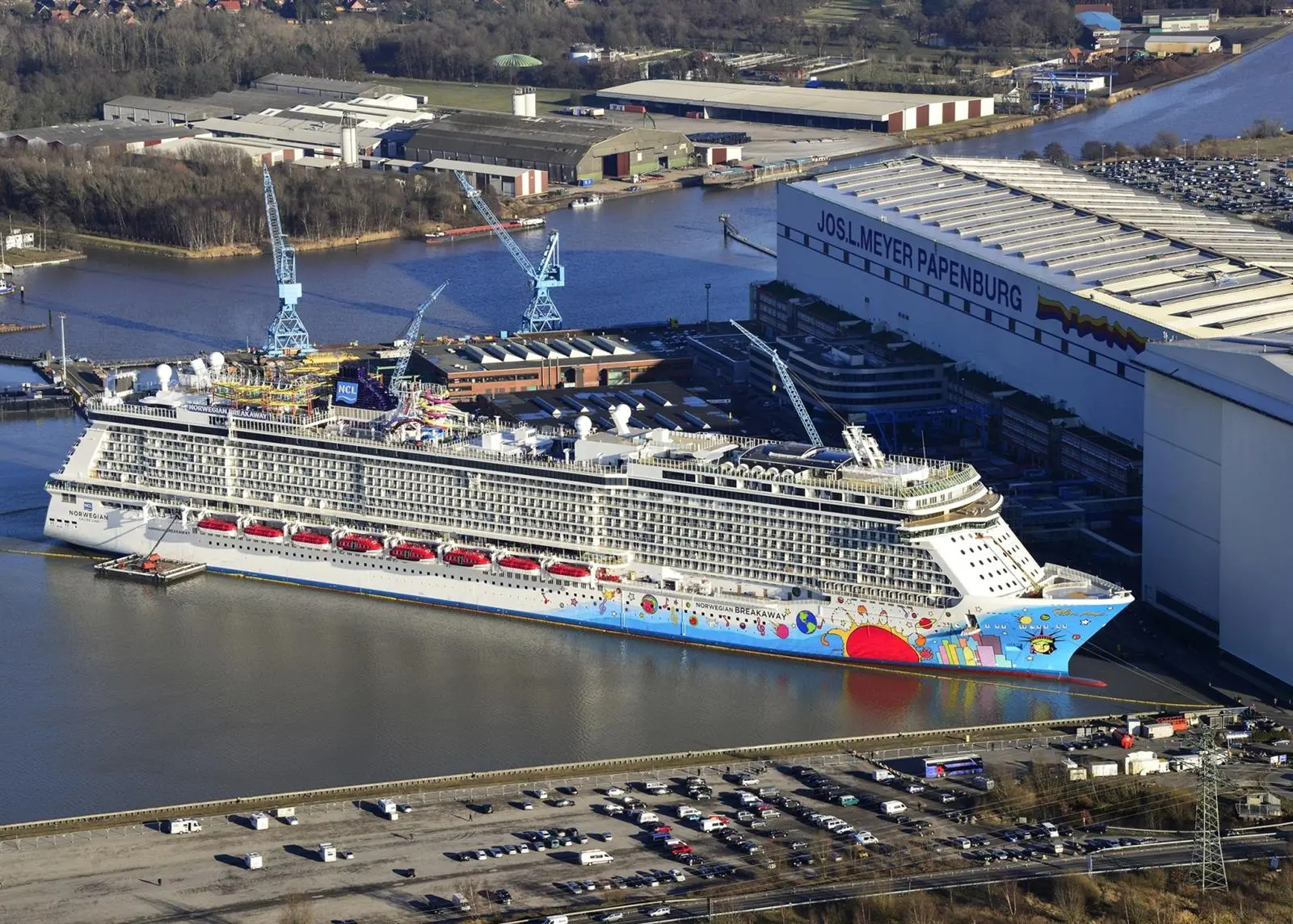
Meyer Werft still heads the newbuilding list. In that nothing has changed since the decline of tanker, container ship and other big newbuilding. But Mayer is increasingly uneasy about foreign competition and prices, as are others, despite good work in hand.
Meyer’s ships continue to grow. Last October it delivered Celebrity Reflection, the last of five 126,000gt Solstice Class ships. In March this year it completed NCL’s 146,400gt Norwegian Breakaway, the biggest cruise ship so far built in Germany. Even bigger ships are to follow.
Breakaway’s sister Norwegian Getaway is still being built, but has already made headlines twice this year. A fire in March caused damage put at “less than half a million Euros”. In the same month Polish-built sections were delayed for days when the Kiel Canal closed because of a lock breakdown.
More positive was Meyer’s new contract worth about €700 million for a 163,000gt Breakaway Plus cruise ship for NCL for delivery in 2015 with an option for a second delivery in 2017.
Also delivered this year was the €300 million, 71,300gt AIDAstella – the seventh and biggest from Meyer for AIDA Cruises. She is billed as one of the most eco-friendly cruise liners afloat, but that did not stop AIDA from switching to Mitsubishi for its next two 125,000gt newbuildings worth €900 million.
The AIDA blow was followed by failure to win RCI’s Oasis of the Seas, worth about €1 billion, even though Meyer is already building RCI’s two 167,000gt ‘Project Sunshine’ ships Quantum of the Seas and Anthem of the Seas, for delivery 2014/2015.
Meyer’s Peter Hackmann told The Motorship that Oasis had been one reason why Meyer had decided to re-think its costs and to strengthen and improve its ability to compete beyond 2015.
MD Bernard Meyer told employees in February that although the yard was still “relatively well off… we have not won further interesting projects of late because we were too expensive”. Stiff international competition had led to a dramatic slump in the price of new ships and there were simply too few orders for too many yards, he declared. He announced savings of €51 million this year and increased productivity to meet stiffer foreign competition.
To better utilise capacity in Papenburg, the building of the 115m, €124.4 million research ship Sonne and of a 135m inland cruise ship has been transferred from subsidiary Neptun Werft in Warnemuende. Mr Meyer was quoted as saying: “Papenburg has often helped Neptun. Now Neptun is helping Papenburg”.
Neptun Werft remains packed with inland cruise ship orders. In a first, it recently named 10 135m Longship Class vessels for Viking in a single remote-controlled ceremony. All are being delivered over the next few months. Meanwhile Viking has booked another ten and secured options. Two are for delivery as early as August and September and the rest up to April 2014.
The Longships draw just 1.6m and are powered by what Viking says are ecologically friendly hybrid engines which are quiet-running and “produce fewer vibrations for a smoother ride”. Neptun is building an almost identical ship, its 11th, for Arosa Flusskreuzfahrten for delivery by year’s end.
Neptun did most of the building of Meyer’s recently delivered LNG tanker Coral Energy. That 155m, 15,600m³ ship was the 55th built by Meyer. But it is also the first of a new tanker generation with a medium-speed, eco-friendly Wärtsilä 50DF dual-fuel main engine of 7,800kW and a pair of Wärtsilä 20DF dual fuel auxiliaries. Meyer was reported also developing such engines for passenger ships.
Tanker newbuilds are rare in Germany these days so the delivery of two at once is a treat, particularly when both are new types.
For service from May is the 86m long Dettmer Tank 140, the first in a series of Type C, 1,800dwt double-hulled inland tankers. Designed as a prototype for future Dettmer tankers the owner has invested €6 million in her. Julia Dettmer told The Motorship the firm might order three or four from builders Hitzler Werft.
The new Dettmer ship has fins under her stern to feed water to twin Volvo Penta propellers and a Van der Velden rudder. Her two main engines are MTU 8V 4000 M 53 R units.
The delivery of another new type, Reestborg, shows that although general cargo ship newbuilding is now unusual in Germany, it is not dead.
The 170m, 23,000dwt multi-purpose ship is by far the largest ever built at Ferus Smit Shipyards in Leer. The yard said the combination of a newly developed ‘bulbless’ bow, negative stem profile and large slow-running propeller provided an impressive 15 knots at full power of 4,350kW. The yard also said noise levels were low and manoeuvering was excellent despite her size.
Attracting attention in Hamburg is another new ship design – this one a heavy lift ship prototype from HeavyLift@Sea.
MD Hendrik Groene told The Motorship the market had “reacted very positively to the 22,000dwt, 169m HLV1600 design. “We have had many enquiries from owners and shipyards”, he said. “We expect orders in the foreseeable future”.
HeavyLift@Sea has said the ship will be flexible and versatile, both in propulsion and design. Mr Groene said the heavy lift market had changed a lot inside a short time and that the demand now was for newbuilds like the HLV1600 which will carry everything from heavy lift and offshore project loads through containers to bulk cargo. “Shipowners are now demanding not only a high level of performance but also versatile application options and maximum ship utilisation”, he said.
Newbuilding has resumed at defunct P&S Werften, now operating as Stralsunder Schiffbaugesellschaft, and there is still hope the former Volkswerft will survive.
The newbuilding is the result of a deal receivers clinched with DFDS after bankruptcy last year to complete two special 195m long ro-ro ferries for a reported €90 million. The first is expected to be completed this year and the second next year. There was however no further word as The Motorship went to press, of progress in efforts to sell the two largely completed,169.5m ro-pax ferries Berlin and Copenhagen, cancelled by Scandlines. Officials earlier reported a lot of interest.
The future appeared more positive for smaller former P&S partner yard Peene-Werft which was being taken over 1 May by Bremen-based luxury yacht and naval yard Luerssen after being bought for a reported €17 million in December.
Encouraging for newbuilding was the completion by Peene of the last two of four 52m Swedish patrol boats ordered from P&S in 2008 and re-ordered last year. One was completed in February and the last was for delivery in April.
It remains to be seen just how much of a role newbuilding will play under Luerssen at Peene-Werft in future but one thing appeared certain – whether repair, newbuilding or both, it is likely to have something to do with yachts.
They remain a staple product for the Luerssen Group and some other German yards. Luerssen subsidiary Kroeger recently delivered its first private luxury yacht of the year, the 88m Quattroelle. Reports said the multi-million Euro, five-deck vessel had a heli-pad and three tenders. For delivery next year is an 87m newbuilding with the project name Global.
Elsewhere a new 81m luxury yacht, reportedly one of two for delivery in 2014, also taking shape for Abeking & Rasmussen in Lemwerder. The ADM Germany group shipyards Nobiskrug and ADM-Kiel are also still very active in the sector.
Fortunes have improved dramatically at the Nordic Werften in Wismar and Warnemuende. The group this year booked another offshore transformer platform construction job worth more than a billion Euros and says it is now “out of crisis”.
The platform, DolWin gamma, is the biggest in the yard’s history. Spokeswoman Susanne Meyer told The Motorship work would start late this year for completion 2017. It is the fourth such structure ordered from Nordic after HelWin alpha, BorWin beta and SylWin alpha. Only seven are on order world-wide.
The structures may not be shipbuilding as we know it, but they are impressive – the latest is as high as an 11-storey block of flats and 55m wide. More to the point, they demand a wide range of shipbuilding skills and are keeping more than 1,100 people busy for a long time.
Yard owner and MD Vitaly Yusufov explained “Nordic Yards has long since outgrown its role as a traditional yard. We are now a maritime systems integrator and manage complex processes”.
Other work however closely resembles traditional newbuilding. Starting in the second quarter is construction of an 80m maintenance ship for offshore wind turbines and the yard is also building two 86m ice-breaking rescue and salvage vessels.
The 32m wide wind turbine jack-up vessel will have four lifting legs to raise the ship into the air as a working platform. It can replace the heaviest wind turbine components at a height of up to 100m with its on-board crane and is also stable enough for maintenance work at 45m depths. Delivery is set for spring 2014 and there are options for two more.
Incidentally – the Nordic jack-up looked like being pipped to the post by Sietas Werft, delivering what is billed as Germany’s first ever ship of this type to Van Oord in July. The 140m long and 38m wide DP2 jack-up vessel is for offshore wind farms and will boast a 900 ton capacity crane.
Nordic’s 19m wide rescue and salvage ships are together costing €150 million and are for the Russian Ministry of Transport. Work has reportedly already begun and they are for delivery in 2015.
They will be used for patrol and rescue service on Arctic routes and in oil and gas fields and will boast bow helicopter pads and complex emergency equipment. They will also break ice up to 1m thick in ports and at sea and will fight fires and combat oil spills. In addition they will be sophisticated enough to study the ocean floor and objects at depths of up to 1,000m.
Germany’s world ro-ro leader Flensburger Schiffbau-Gesellschaft (FSG) has delivered its three biggest ships ever and more special ship deliveries lie ahead.
In February it delivered UN Istanbul for Turkey’s UN Ro-Ro. The 208m, 4,094 lane metre newbuilding was the 15th for the longstanding customer and the third in a series handed over in recent months.
The ships, which carry 283 trucks/trailers, are the longest and biggest newbuildings built by FSG. UN Istanbul follows the identical Ulusoy 14 and Ulusoy 15 for another regular Turkish customer Ulusoy Sealines. FSG said building on its experience with so many previous ships had made the latest newbuilds “even more economic, efficient and eco-friendly”.
Specialised technology, just as evident in small ships as big ones, still keeps German shipbuilding alive and sophisticated small ships remain a staple in German yards.
With work already under way on Meyer Weft’s Sonne further word, particularly on yards, could now come this year about who will build several other planned Government research ships, part of an €850 million Berlin programme. To this has now been added the news that there will be a new 75m fisheries research vessel with room for 26 scientists to replace the existing 63.1m Walther Hedwig III, which has room for just 12.
Tassilo von Leoprechting, spokesman for owners the Ministry of Agriculture and Food, told The Motorship it was hoped to have the vessel in service in 2016 at an estimated cost of €96 million. He said tenders would be invited as required from yards throughout the EU after plans had been drawn up.
The old Walther Herwig III would be sold, he said. Another Ministry official was quoted as saying the reason for that was not just because the old ship, which was only built in 1993, was too small but also because it was “repair-prone”.
Related Articles
 PROPULSION
 GENERAL NEWS
 HYDROGEN