



The raisin in the sausage
Norway prides itself on the strength of its maritime cluster. In fact the country has, rather than a single cluster, three distinct geographical groupings.
Maybe the most familiar is the Oslo-based cluster, Oslo being the seat of not only the country’s government – and a government that strongly supports shipping and the maritime industry in general, but also the home of the Norwegian Shipowners Association and various other industry bodies, plus many other shipping and marine companies in their own right.
Ålesund on the west coast, and the surrounding region, is home to the Norwegian offshore cluster, with its strong tradition in the North Sea, where strength and experience has been built up over the years giving Norway a leading position in the worldwide oil and gas sector, resulting in a strong presence in the emerging markets.
However, the customary pre-Nor-Shipping press event for 2013 focused on a third cluster – centred on Bergen – the members of which like to think rivals Oslo in its strength. Bergen describes itself as Norway’s ‘industrial shipping capital’. And the figures are certainly impressive. Out of a total NOK 80 billion turnover, NOK 27 billion is generated in the Bergen region. The maritime cluster in Bergen employs over 20,000 people. The city is home to the Norwegian Navy. The Port of Bergen has Norway’s largest turnover of coastal and international cargo, and is Scandinavia’s largest port for oil traffic. Plus Bergen is the most-visited cruise port in Norway.
Perhaps the most significant statistic, though, is that ship owning and management companies around Bergen control 510 vessels under the Norwegian flag, plus over 530 ships of 100gt-plus under foreign registers. This, claims Maritime Bergen, makes the city the largest maritime city in the country, both in terms of tonnage and vessel numbers.
The cluster is rounded off by other maritime services based in the region, not only equipment suppliers and shipbuilders, but also finance and insurance.
Bergen’s claimed strength – industrial shipping – is defined as being based long-term contracts and customer relations, and the development of new vessels to meet market demands, brought out through close co-operation between owners, customers, designers and shipbuilders.
One Bergen shipowner which typifies this approach is Westfal-Larsen. As well as a fleet of 12 chemical tankers, the company operates 22 bulk carriers, 20 of which are so-called ‘open hatch’ design specially developed for the forest products trade, and in particular wood pulp. ‘Open hatch’ means that the hatch opening extends for the full width of the cargo space, rather than the conventional type of hatch cover. The ships are equipped with travelling gantry cranes, designed for handling pulp and paper products, though the ships, and handling equipment, are equally able to load other cargoes.
Part of the Grieg group, which like most of the Bergen shipowning community is still a family-controlled business, Grieg Star Shipping is involved in a similar trade to Westfal-Larsen, with 30 specialised open hatch bulkers, including a 10-ship newbuilding programme. The company points out that the open hatch concept was first conceived in Bergen some 40 years ago. Its latest generation of open-hatch vessels employs conventional-type Cargotec electric cranes rather than the usual gantry cranes, and with fuel saving and emission reduction in mind – in common with all the Bergen shipowners – Grieg has been working with DNV on a hybrid system, combining diesel generators and battery storage, to power the cargo cranes. Such a system is expected to save around 30% of fuel used in crane operation, resulting in an estimated annual saving of $110,000 per ship.
Odfjell is another well-known shipowner, based in Bergen, and still family controlled. Majoring on chemical product tankers, the company has grown through mergers and acquisitions and, with revenue from ship operations becoming tightly stretched, is increasingly reliant on its associated tank terminals business. Further diversification has come through an entry into the gas carrier market. Odfjell points out that Bergen is the world chemical tanker capital, with a dozen or more significant players based in the region. The company is increasingly focusing on environmental issues, and regards its place in the Bergen cluster as being a significant element in its success.
Needless to say, the offshore sector is well represented in the Bergen community, led by GC Rieber Shipping and Atlantic Offshore. Both operate within specialised niche markets, GC Rieber’s shipping interests focusing on the seismic, subsea and ice expedition sectors. Atlantic Offshore is the renamed and restructured former Sartor Shipping business, operates chiefly in the standby /rescue and PSV segments, with around 19 mostly high-end ships, though the size of the fleet constantly varies as new orders are delivered and vessels come on and off charter or operational agreements – for example Atlantic Offshore currently operates two of the Ulstein ‘Blue Ship’ PX121 PSVs
In the Bergen-based equipment sector, TTS is an important player, claiming a top three position in its worldwide markets, namely offshore deck machinery, marine cargo handling and ro-ro equipment, and ports and logistics equipment. The group forecasts significant opportunities, notably through its Chinese operations.
Bergen has its own eponymous engine brand of course. Bergen Diesel is part of the Rolls-Royce empire, and has laid a solid foundation for the future through its leading position in gas-fuelled engines, concentrating on the pure gas market rather than dual fuel.
Norwegian Electric Systems is a young company, but has solid experience in diesel-electric ship propulsion. It came into being after Scandinavian Electric Systems was sold to Rolls-Royce. The company specialises in integration of drive systems. Its Quadro Drive, described by CEO Jan Berg as the ‘raisin in the sausage’ (a Norwegian expression equivalent to the English ‘icing on the cake’) with its light weight, compact dimensions, record of reliability, and very low total harmonic distortion, is a good example of NES’s advanced technology.
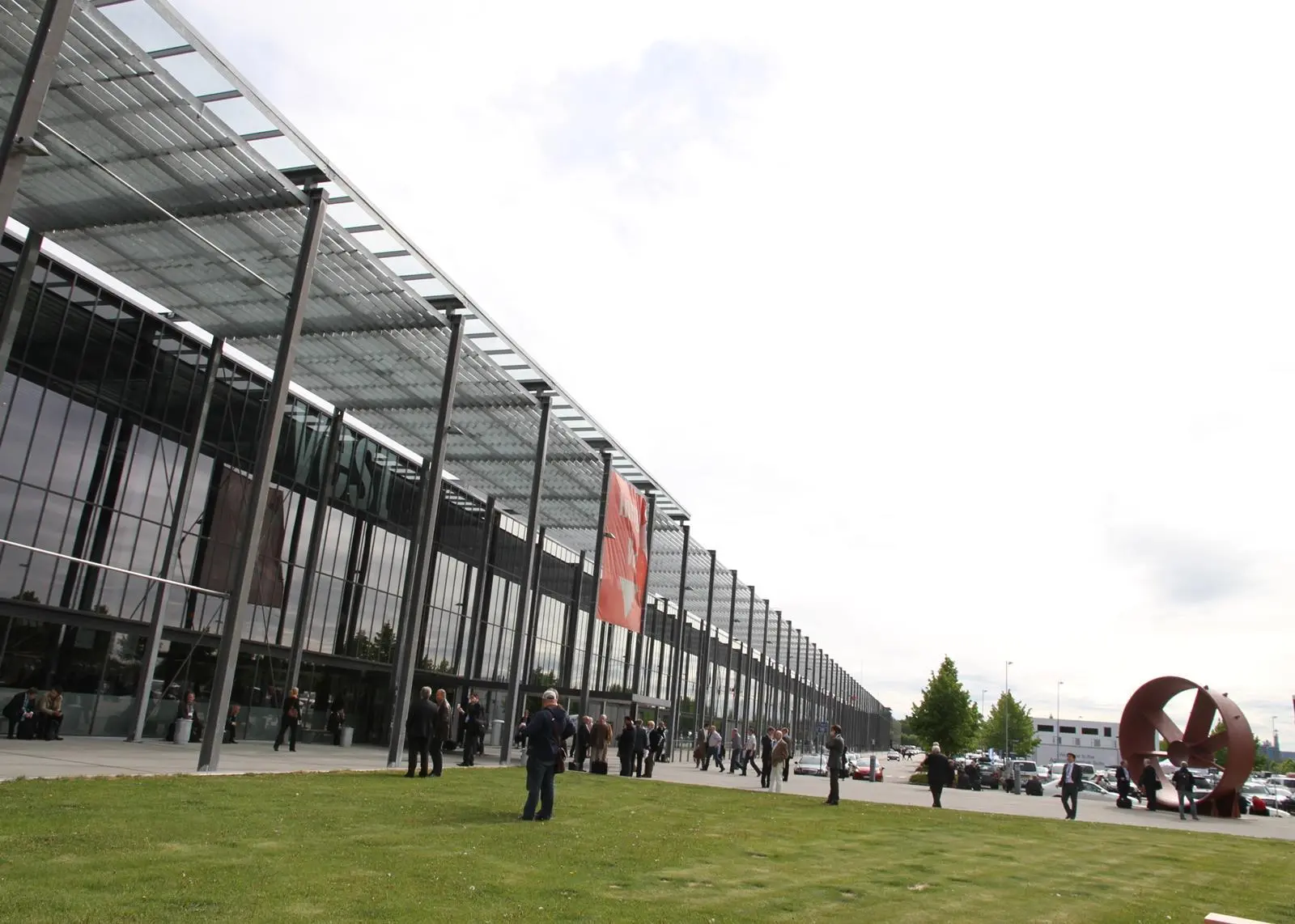
That is a short resumé of some important elements in just one of Norway’s maritime clusters – so it logically follows that Norway is an ideal location for one of the two main marine technology trade fairs. Returning, for its 24th incarnation, to its home in Lillestrøm, north of Oslo, Nor-Shipping 2013 aims to cover “the entire value chain of the maritime industry”.
Nor-Shipping 2013 is putting great emphasis on the various events and innovations associated with the exhibition, which although it may not be as large as SMM is still of considerable size, just as comprehensive, and, arguably, more manageable for the visitor.
The main Nor-Shipping conference asks “What’s next for the maritime industry?” and among those looking for the answer will be Norway’s minister of trade and industry Trond Giske, IMO secretary-general Koji Sekimizu, and Masamichi Morooka, of NYK, who is the current chairman of ICS. The event continues with the theme ‘changemakers’ aiming to find innovative solutions, which will push the maritime industry towards a period of greater stability and unlock business opportunities in new markets, fuel-efficient design, LNG fuelling and smarter use of new technology.
Among participants in this discussion are Andreas Sohmen-Pao, Group CEO of BW Gas and BW Maritime, Vice Admiral Peter Neffenger of US Coast Guard and Kongsberg CEO Walter Qvam.
Being Norway, the offshore business has to feature strongly. The Agenda Offshore event will feature speakers Helge Lund, CEO of Statoil, and Andy Brown of Royal Dutch Shell who will share insights about oil and gas companies’ dependence on maritime suppliers for technology, equipment and vessels. Norway’s supplier industry – with its technological know-how and long experience – is expected to play a key role in offshore developments locally and globally, including, Brazil, West Africa or the Gulf of Mexico.
Norway claims to be home to the second-largest and most modern offshore fleet. And the country’s orderbook, comprising 326 vessels, was worth $36.1 billion last year, the largest of any nation, according to Clarkson Research Services. Many of these are sophisticated offshore vessels that are involved in all petroleum activities from seismic surveying to production.
A ‘New Frontiers’ round table will look at how expansion into deeper waters and harsher climates are creating huge demand for offshore services. Kristian Siem, Chairman and CEO of Siem Industries, and Remi Eriksen, CEO of DNV Maritime and Oil & Gas, will be among those joining the discussion.
“Norway’s maritime companies can yet again push the borders by reinventing themselves as ocean industry experts,” said Nor-Shipping director Vidar Pederstad.
Further innovations for Nor-Shipping 2013 include the ‘Nor-Shipping Island’, an area in the city of Oslo which aims to further increase the networking opportunities for which Nor-Shipping is already known, though various events taking place during the exhibition period. Venture Park is another introduction, providing start-up companies with a platform for testing the market and meeting potential partners and investors, in a new ‘Innovation and Venture Hall’ at the exhibition site. The Venture Forum will run alongside, as an arena for companies to match up with investors. It will include talks by the investment and innovation communities and a series of exclusive presentations of investment opportunities to investors.
“Leading players from the maritime world have always gathered at Nor-Shipping to share insight, build relationships and showcase their knowledge and products,” says Mr Pederstad. “Maritime investors, venture capitalists, entrepreneurs and growth companies are all part of the Nor-Shipping community. Venture Park will allow them to increase the synergies and interaction between them,”
Ocean Talent Camp is an expanded version of an idea first tried at the last Nor-Shipping in 2013 – a recruitment drive run alongside the main exhibition, hoping to attract young talent into the maritime cluster, ensuring that key jobs can be filled in the next decade and the industry’s continuing growth is assured.
Related Articles
 ALTERNATIVE FUELS & LUBRICANTS
 ALTERNATIVE FUELS & LUBRICANTS
 OPINION