



Matching cylinder oil to the ship
Several lubricant suppliers have offered ‘single solution’ mid-BN range oils which are said to cater for a range of fuel sulphur contents and vessel operating conditions, saying that modern lube oil technology has advanced sufficiently to make this viable. Castrol Marine believes that a range of oil grades is necessary to meet all two-stroke lubrication needs. The company points out that conditions in the industry are constantly evolving, and the ‘one size fits all’ solution was formulated before slow steaming became more widespread; moreover OEM recommendations bear out its own findings.
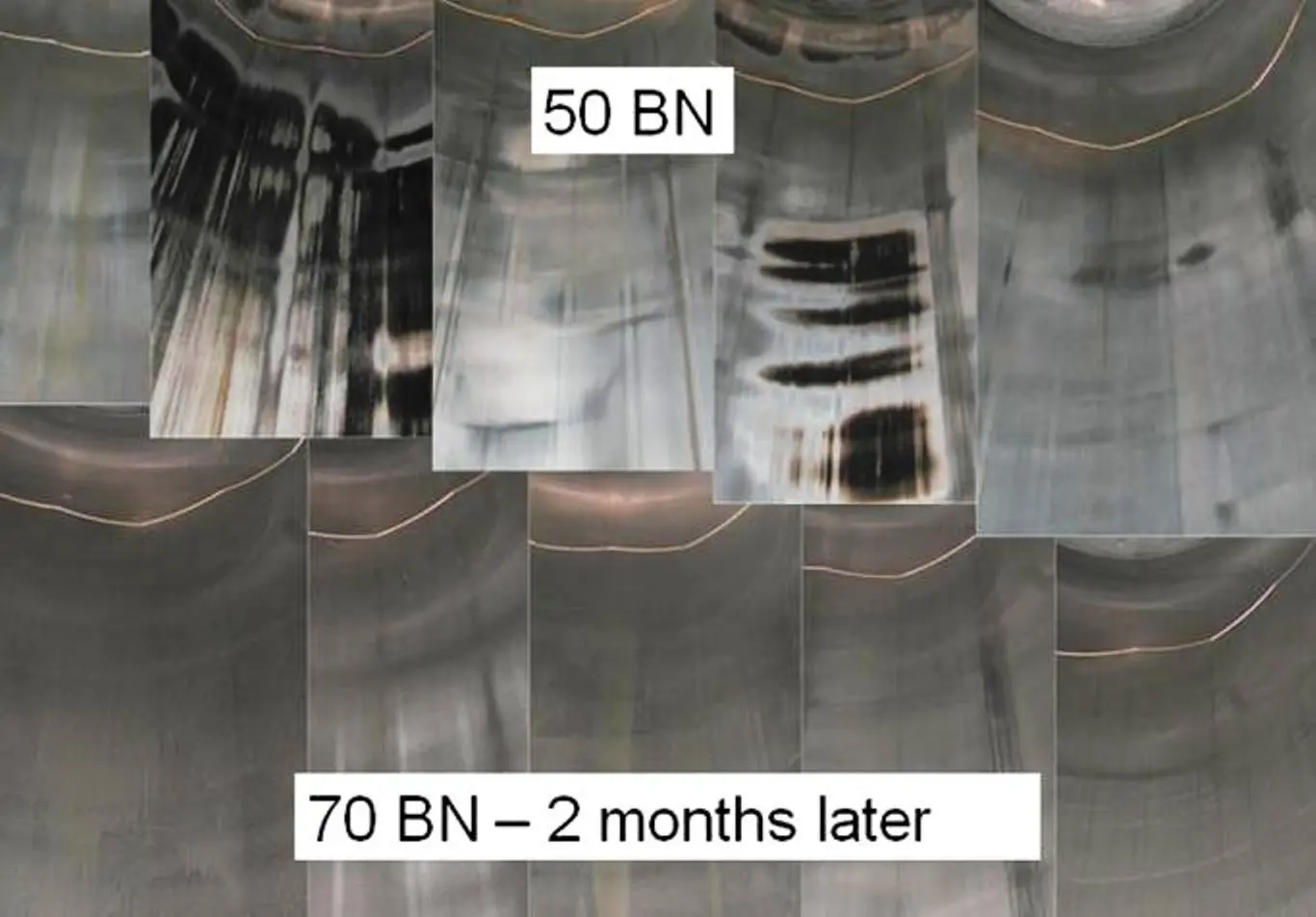
The Motorship recently spoke to Paul Harrold, technology manager for Castrol Marine and Energy Lubricants. He referred to recent case studies carried out by the company, and presented at the recent CIMAC congress. One study concerned a ship with a Wärtsilä RT-Flex main engine, which had been running successfully with Castrol’s 70BN oil at a 0.9g/kWh feed rate. After changing to another supplier’s mid-BN product at the same feed rate the engine started to exhibit corrosion problems. An increase in oil feed to 1.1g/kWh reduced corrosion, but even this 20% increase in feed rate (and consequently 20% extra oil consumption and cost) failed to completely solve the problem. The owner approached Castrol, which recommended its 80BN cylinder oil, initially at 0.9g/kWh. As no further corrosion was found, the feed rate was cut to 0.85g/kWh with no ill-effects. The company plans to reduce this further, to 0.8 or 0.75g/kWh, with the agreement of the engine designer.
This, says Mr Harrold, shows the importance of matching the lubricant to the vessel, taking into account all of the variables such as engine type, fuel sulphur content and operating conditions, including slow steaming. Although this might result in a shipping company having to purchase more than one grade of oil for different ships in the fleet, adding complexity at the purchasing stage, it will make life much simpler and result in greater assurance and confidence for the engineers onboard.
Both fuel sulphur content and slow steaming can influence lubricant choice, particularly with the latest generation of super-long stroke engines operating at slower speeds and higher pressures. To accommodate the increased risk of acid production, from high pressures and temperature differentials between full and part load operation, Mr Harrold says a higher base number is needed. The same applies, to a slightly lesser extent, with older engines operating under slow steaming with turbocharger cutouts. The number of Mk 9 and long-stroke G-type engines afloat is still relatively small, as some suppliers point out in response to a recent bulletin from MAN which stated that mid-range oils were not recommended for these engines, but Castrol advises caution in all cases, particularly when engines are modified to optimise them for slow steaming.
The increase in ECAs has, says Mr Harrold, had little effect on overall fuel sulphur content, merely changed the distribution. Before the introduction of ECAs fuels of different sulphur levels were used throughout; now the trend is to use lower (1%) sulphur fuels in ECAs, resulting in increased use of 3.5% sulphur fuels outside ECAs. Therefore, for most ships which spend relatively little time in ECAs, a high BN oil will be perfectly suitable. As the proportion of time in ECAs increases the situation changes, but maybe not as much as might be imagined. The danger comes from ash build-up resulting from increased use of low-sulphur fuels, but in practice ships travel more slowly in ECAs, partly to cut consumption of the more costly fuel, which limits ash formation, as the lube oil feed largely follows the propeller curve.
Post-2015, and subsequently post-2020 or 2025, increased use of distillate fuels will change the situation completely. But the situation is far from certain, because, says Mr Harrold, the widening differential between distillate and residual fuel prices, is likely to encourage the use of scrubbers. What he does foresee, however, is that rather than opt for exhaust gas cleaning from the outset, most operators will initially use distillates with a view to fitting scrubbers at a later date, when the technology is more mature and the fuel price differential more certain. To cope with the very low sulphur content of MGO, a much lower base number is needed – MAN, for example, recommends 10-20BN. This means that ships using distillate in ECAs and HFO in the open sea will need to use two distinct lubricant grades, and change between cylinder oils as well as change between fuels. The one-grade ‘multi-purpose’ oils will not be able to cope with this widely-different BN range, says Mr Harrold. He says that one OEM has stated that the choice in future will be 70-80BN or 10-20BN, depending on whether heavy or distillate fuel is in use, so mid-range oils have a limited life.
“Owners must consider the total lubricant cost, rather than just the cost per ton of a particular oil,” he points out. “Although a high-BN oil of 70-80BN costs more, because it can be used at a significantly lower feed rate, then the total cost will be less.”
Mr Harrold points out that scavenge drain oil analysis techniques can often be misleading. The shipboard test systems use magnetic analysis to measure iron particles in oil samples. Although the presence of iron is indeed a pointer to excessive wear but may not necessarily reveal corrosion, so a full laboratory analysis is preferred. Moreover, too-high feed rates, or worn stuffing boxes, can result in an excess of oil in the cylinder which is not only wasteful but can mask more serious issues.
As LNG as fuel gains popularity it will further challenge the lubricant specialists. LNG carriers with large four-stroke gas-fuelled engines have been operating successfully for some time, so LNG-fuelled four-stroke technology is well-proven. Dual-fuel two-strokes are likely to be a different matter. Mr Harrold expects the high-pressure gas system as employed and tested by MAN to be less of a challenge, as the properties of LNG and distillate fuels in such applications are not dissimilar. With the low pressure system proposed by Wärtsilä, ash formation could be more likely, so further research will be needed.
Related Articles
 ALTERNATIVE FUELS & LUBRICANTS
 FUELS & LUBRICANTS