



Holding costs down in the deep end
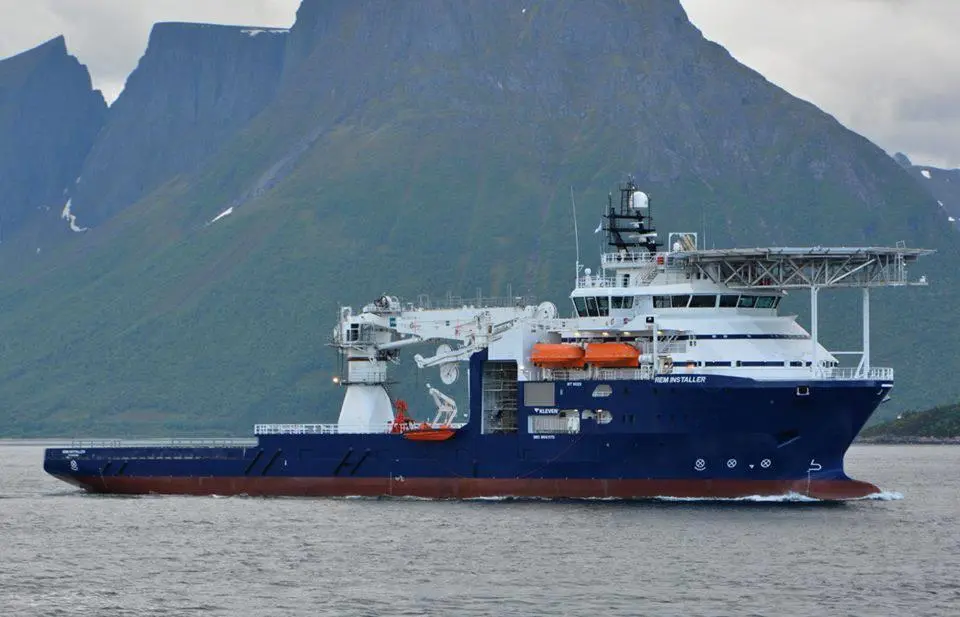
One of the main issues has been the size of crane: subsea construction tends to need a good sized capability to cope with the growing seabed component sizes, but there’s more to the tipping point that the physical stability – the decisions on what vessel to use for which job are also finely tuned.
So one of the latest deliveries by Kleven Maritime, the Rem Installer, is actually quite a compact vessel explains Erling Oftedal of TTS. It’s been built to a Marin Teknikk MT 6022 design and the ship comes to about 108 metres long with a 22 metres beam. “Of course there are tensions between the growing component sizes, capability and price,” he says, adding that North European owners are experienced at shaving the costs, but they are equally sensitive to the flexibility of the vessel and have an eye to future contracts.
“The ship size means you can keep costs in the NOK550m to NOK650m (€70 to €83m) range: more than this and you get a fairly steep rise in price. So there were a lot of meetings with REM and Kleven and we have worked on a design that means you can put a 250 tonne active heave compensated crane on a 110m ship rather than the 150 tonne cranes more usually found on this size.”
The AHC subsea crane, besides lifting up to 250 tonnes above the surface, can handle loads down to a depth of 3,000m. The crane has an extensive 36 metre reach, but the important point is the placing of the 20 tonne AHC winch: “If you take the usual route, the winch reels are around 10m in the air, but the weight of the wire alone, 3,000m of 100mm line, comes to around 160 tonnes. So this means about 250 tonnes all in all – it makes a substantial difference to the ship’s overall stability,” says Mr Oftedal, “so we have put the winch below the deck.” Further, this layout reduces the requirement for added deck strength, and all this together frees up cargo space. “The weight goes below, capability goes up,” he adds.
Its location also frees valuable space on deck and allows for easier maintenance access; not least appreciated by service personnel bound to make repairs whilst the vessel is in rough and cold waters.
It also helps that TTS haven’t been in the offshore market too long, says Mr Oftedal. There’s a lot of new technology inside: the winch has a separate power unit and secondary regulated motors combined with a high tech gearing solution that gives a particularly quick reaction time so it has only gives a deviation of around 3cm in a 1.5m wave. “An experienced Subsea Seven inspector said he’d ‘never seen such accuracy on a winch before’, as while quite a few achieve a 95% accuracy mark, this crane made nearly 98%.”
On the whole, it may be that the extra capability could swing the decision for some projects to use two smaller size ships rather than a single larger vessel “as it can actually be the cheaper, more efficient option”.
Related Articles
 PROPULSION
 GENERAL NEWS
 HYDROGEN