



No freeze to icebound operations
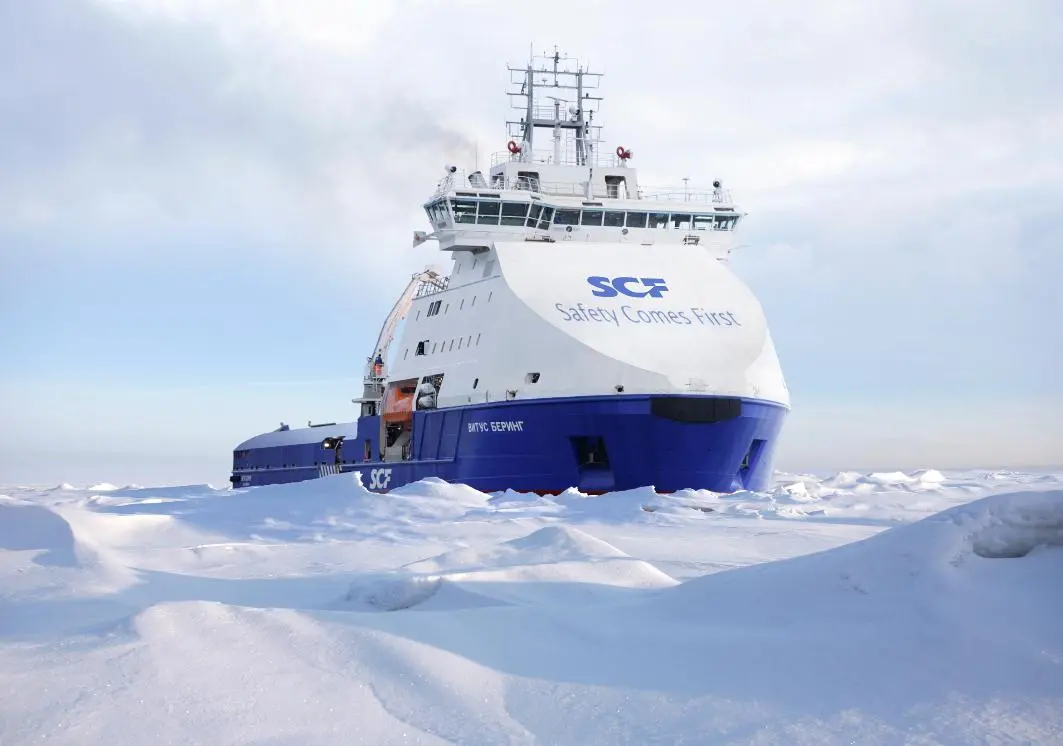
Despite the twin arguments that – given the shale gas bonanza – the Arctic is too harsh for oil and gas exploration as we know it and that the regulatory climate has taken on an almost equally investment-chilling role, there is still reason to believe that energy platforms will carry on inching out into the extremes. Russia has a predictably large stake in pushing the boundaries and many still believe that the Arctic will sooner or later be more widely plumbed for its oil, gas and mineral reserves.
“I am confident that there will be a market for this kind of exploration,” says Esko Mustamäki, managing director of Arctech Helsinki Shipyard, the Finnish builder of this pair of vessels for Russia’s state-owned shipping company Sovcomflot. “Although it is slow to start and the global economy has to be in the right position for such large investments, including a stable oil price, these things will eventually come together.”
“Of course there are challenges; for the support ships you have to design the hull differently and it has to stand up to higher loads. The propulsion is also scoped for ice and obviously the equipment and outfitting is designed for low temperatures: everything exposed has to have an oil-based, not water based design unless it has another source of heat,” explains Mr Mustamäki, but given this, he says, you can keep ships operational despite the extremes.
“We’d had a lot of experience building the SCF Sakhalin back in 2005, and of course operations in the field, which gave everyone time to think over the modifications,” he points out. It is a real multipurpose vessel, especially since part of its remit is to deal with a sensitive issue – emergency oil spill response.
The detail is important with equipment that has to cope with extremes: for example, part of the oil recovery system from Lamor includes a particular design of brush skimmer developed for Arctic use. This incorporates static ice deflection pipes and rotating brush wheels which collect and separate the oil from the water; any pieces of ice that get swept in are crushed by screws inside the hopper and these also feed the oil to an efficient built-in positive displacement oil transfer pump: further, the skimmers are also equipped with a warm-water injection system to keep the oil flowing in the cold conditions.
As well as standing by for emergency response – the vessel has two fire-fighting pumps and fire retardant shielding so it could act as a rescue vessel for 195 platform personnel – Vitus Bering and Aleksey Chirikov are also able to transport slightly more cargo than their predecessor SCF Sakhalin: they have dry and wet bulk tanks and more room for containers on the slightly larger, 700m² aft deck too.
A double-ended ship, below the canopy the 99.9m hull is very close to the form of the SCF Sakhalin, and like its forerunner it makes use of its two ABB Azipods to break ice both when going ahead or astern. These 6.5MW propulsion units – along with everything else onboard including the pair of 1300kW Berg bow thrusters – are powered by four Wärtsilä diesel generating sets. This includes two large 12-cylinder Wärtsilä 32 engines and a pair of slightly smaller 6-cylinder Wärtsilä 32s, which together push out a combined 18,000kW (24,000 hp) with 13,000kW for propulsion. The ability to carve the power up in different ways “gives much more flexibility to the drive” explains Mr Mustamäki.
Despite the muscle, the Wärtsilä engines still have a fairly compact footprint that fits in to the relatively limited space available in this particular engine room; however, more importantly they have been designed with an eye to cold climates and so have an ability to cope with sucking in air at temperatures as low as -35°C.
Besides doing a respectable 15 knots in open water, the vessel can maintain 3 knots in 1.5m level ice and, according to Mr Mustamäki, it is able to penetrate consolidated ice packs that are brought together by wind and tides to form ridges up to 20m thick – earning an Icebreaker 6 class by the Russian Maritime Register of Shipping.
However, a certain level of automation also enables the vessel to stay out at sea unsupported for 40 days. Central to operations is a system by Metso that helps the user to control what can be complex situations, as well as optimising machinery performance and fuel consumption. These are big items anyway, but the drain of both grows correspondingly greater in unrelentingly extreme conditions. Jarle Nilsen of Metso adds that “early detection of possible disturbances and also a quick recovery” plays an important role.
Last but not least, an equally vital piece of equipment is the boiler. The configuration has been changed, and it’s now made up of two boiler units instead of one, explains Mr Mustamäki. Although the capacity is the same this layout allows more flexibility with both creating and directing heat, as well as giving a better redundancy.
So, while it isn’t ever going to be ‘a piece of cake’, at least the icing is something that shipyards like Arctech are ready to deal with.
By Stevie Knight
Related Articles
 PROPULSION
 GENERAL NEWS
 HYDROGEN