



The wind as fuel
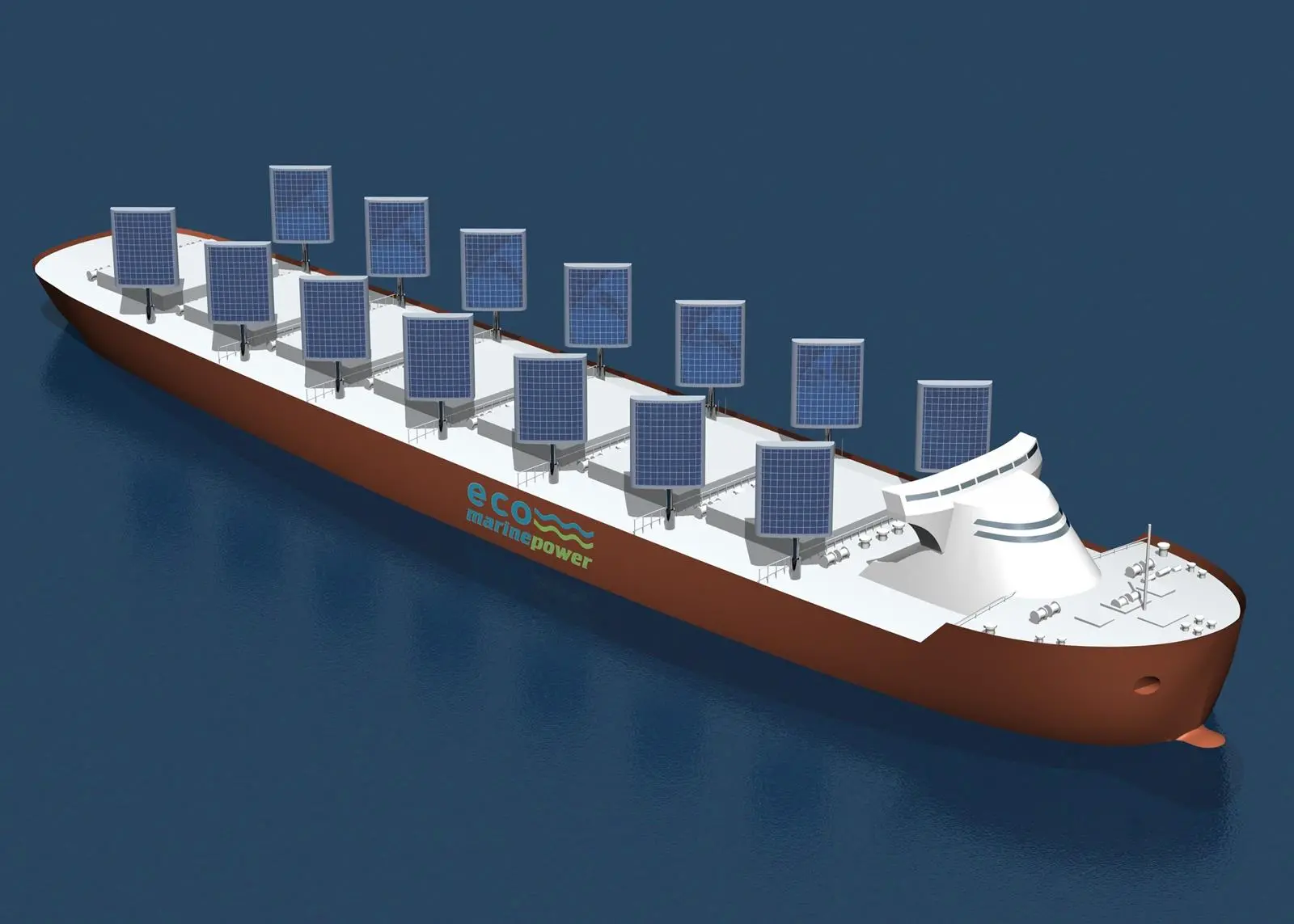
As fuel prices rise ship owners start to look at the wind as a means of gaining a free ride from this power source. It has happened in the past when fuel prices rocketed, and today, when fuel represents a significant proportion of the operating costs of a ship, there is again renewed interest. The interest today has increased because shipping is resorting to slow steaming or even drifting with the engines off in order to conserve fuel. This is a scenario where wind assistance can offer a much greater benefit.
We already have wind assistance being used on some cruise ships that try to re-enact the thrill of the sailing ships of old, and the Royal Oman Navy has recently ordered a square-rigged ship from Damen as a training vessel. These types of sailing ship tend to be labour intensive but the systems becoming available to help modern shipping are aimed at employing automated or semi-automated operation, so that limited experience and labour is required to operate them and the systems allow for the ‘sails’ to be controlled remotely, from the safety and comfort of the bridge rather than manually on deck.
The types of ships that can use sail assistance are limited to those where having the sailing equipment installed on deck does not interfere with the cargo handling. So sail assistance would best benefit bulk carriers and tankers, with bulk carriers top of the list because they tend to be under less time pressure than tankers.
The big challenge facing the developers of sail assistance systems is to make the transition from paper to reality. So far only a handful of projects have reached the reality stage and few, after being fitted to one ship, have progressed any further. The reasons for this lack of advancement on tested concepts is not obvious but it has to be assumed that it comes largely from the increased capital costs of the vessel and the volatility of fuel prices which can make it difficult to produce a realistic financial picture of any benefits. Another possible factor is the over-optimistic predictions of savings by the companies developing the systems. They will always look at the positive aspects, while the ship owner will focus on the negative aspects and it is always easier to do nothing rather that take a potential financial risk.
Sail assistance has been a feature of development for many years. There was a spell in the 1970s when several alternative systems were fitted to small vessels to try and prove the concept. The Japanese were amongst the first to experiment with a larger vessel – the Shin-Aitoku Maru – which was a coastal tanker equipped with two masts fitted with early wing sails.
Wing sails are seen as a possible solution for several projects. These harness the power of the wind with sails that are aerofoil shaped in cross section. On the latest developments such as the UT Wind Challenger from Japan, these wing sails are constructed from composite panels that are arranged to telescope into each other so that both sail and supporting mast can be retracted nearly down to deck level. This is an ingenious solution that can reduce the windage of the sails in very strong or head winds and which could make the cargo handling easier, but the retracting solution adds considerable mechanical complexity and in its retracted form takes up space inside the hull. The UT Wind Challenger was projected as a solution for a 180,000gt bulk carrier, the largest vessel for which sail assistance has yet been proposed.
Other sail assistance projects have followed a similar line of development, but they have tended to follow the simpler solution of having fixed masts and sails. The rotating masts can be fully controlled from the bridge and in strong winds they can be feathered to reduce resistance. It is claimed that a fully formed wing mast can produce forward thrust at an angle of a little over 30° to the wind, which means that the sails would be able to develop useful thrust in most conditions.
A further development of the wing sail concept was created by the Danish naval architect firm Knud E Hansen. Here the wing sails were coated with solar panels so that not only do the sails provide propulsion thrust but they are a useful source of auxiliary power. Japan’s Eco-Marine Power has developed a similar system and reports that a prototype sail is currently under evaluation.
An advanced type of wing sail is under development by Northern Ireland based Oceanfoil. This sail system is based on one originally developed in the 1980s when a prototype system was fitted to the 6,000gt coastal cargo ship Ashington where fuel savings of 10% to 15% were recorded. Oceanfoil has now refined the original system to improve its efficiency and after extensive model testing the company reports that a full scale system will be available for sea trials early in 2014. The original Oceanfoil system used four individual aerofoil wings arranged in a stabilising triangular pattern to generate thrust.
The Flettner Rotor has a long history as a wind propulsion system. Here, vertical thin rotors are rotated under power in such a way that they generate thrust through the Magnus Effect which can be translated into forward motion. Modern research led to a new generation of rotors and four of these were fitted to the E-Ship 1, a specialised cargo ship designed for transporting wind turbine units. One rotor was fitted to each corner of this 13,000gt ship and reports suggest that under rotor power alone a speed of 5 knots was possible.
A variation of this approach is what is being termed a Windmill Ship. Here a propeller or vertical turbine is mounted on the deck, and this produces electrical power which is used to power an electric propulsion motor. This concept harnesses the latest wind turbine generation technology and it is claimed that such vessels could sail upwind. But the penalty comes in the form of a considerable additional top weight and an obstructed deck.
Yet one more development of wind propulsion has been produced by British company B9 which has adopted a more holistic approach. In their project vessel, wind power is harnessed via sails mounted on three masts in square-rigged fashion. These sails are furled by remote control and a new hull design has been developed with minimum resistance. The engine is a Rolls-Royce unit designed to operate on gas produced from waste material. This approach should produce significant fuel and emission savings, but it demands that a ship owner commit to a completely new design of vessel rather than adapt more conventional designs which may be a step too far.
German company Skysails is the one company that has made the significant development step into full scale application. Skysails has already fitted its system, that uses an inflatable kite sail, to a variety of vessels including fishing and cargo ships and the latest contract is for one of the third generation systems, that is claimed to be equivalent to 2,000bhp. This will be fitted to the 25,000 tonne Aghia Marina bulk carrier owned by Anbros Maritime and currently under charter to Cargill.
With so many alternative projects either on the drawing board or under development it is small wonder that ship owners are reluctant to take the plunge on wind propulsion. The research needed to find the right system could be daunting and it is easier to do nothing. Skysails has perhaps found the right solution in a system that is relatively simple, which can be retro-fitted easily, and which does not obstruct the deck area. But there are plenty of challengers out there waiting ‘in the wings’ with alternative systems.
Related Articles
 ALTERNATIVE FUELS & LUBRICANTS
 ALTERNATIVE FUELS & LUBRICANTS
 OPINION