



Wind assistance – the story continues
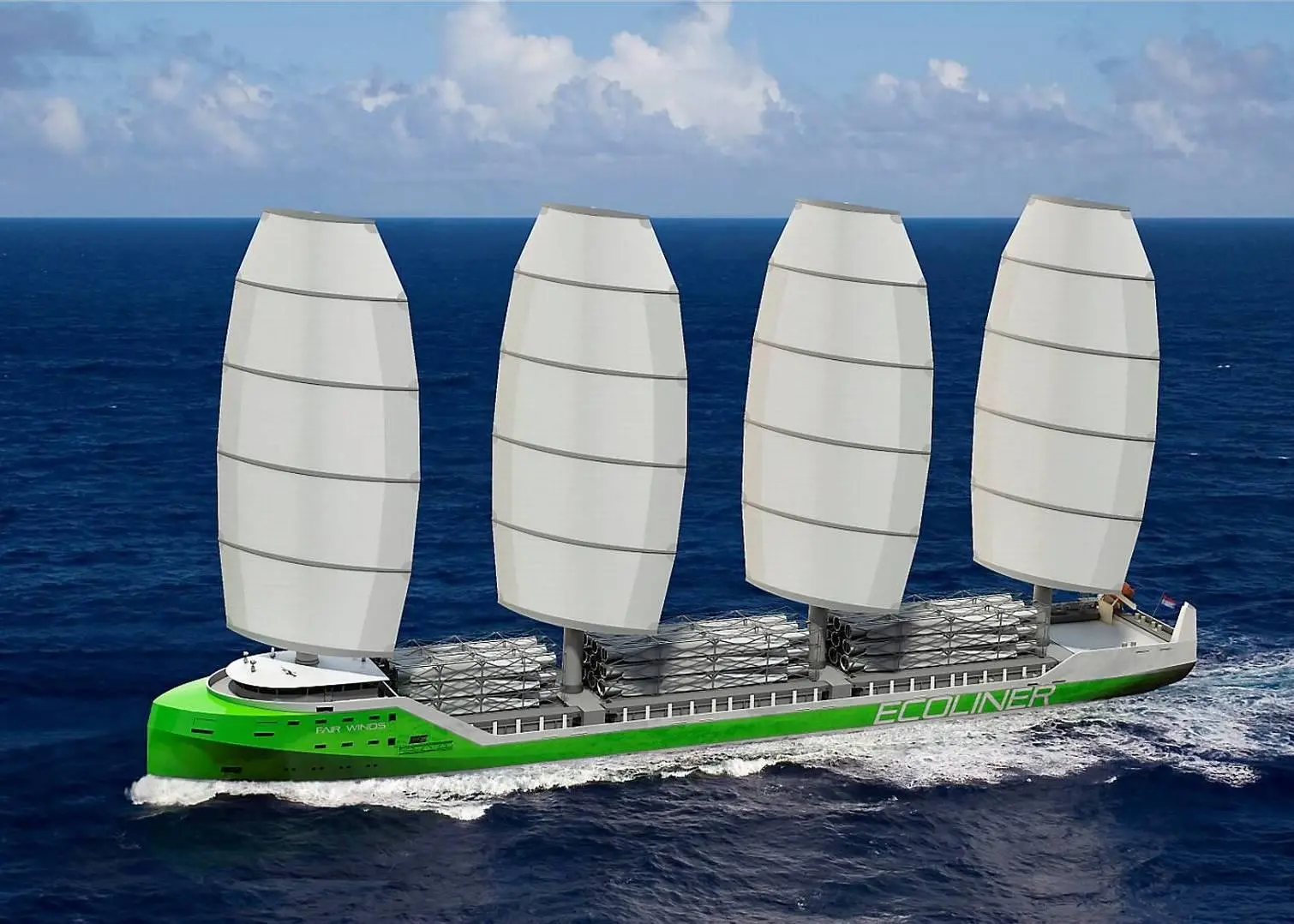
The latest design for a wind-assisted ship has come from an established design team at Dykstra Naval Architects, which claims considerable experience in sail systems. The Amsterdam-based team has been involved in many successful award-winning sailing superyachts, as well as working closely with Greenpeace on concept studies and the design of the new Rainbow Warrior III. Other projects include large sail-training vessels, and there is currently a 160m four-masted sailing yacht on the drawing board.
The Ecoliner has been developed as a container ship that is designed to operate on a pre-established route, mainly using engine power but using the sail system when the wind is favourable, thus reducing fuel consumption whilst still maintaining a good speed over ground.
The Ecoliner has a length of 138m, which gives a capacity of 8,210dwt at a displacement of 11,850 tonnes when operating at a draught of 6.50m. Although suitable for container operations, the vessel has been designed as a general purpose cargo ship and therefore is suitable for operating with other cargoes on routes outside the mainstream container routes.
The design features a forward bridge and accommodation in order to maximise the cargo deck area aft. The initial designs show a vessel with four masts each of which has a sail held in shape by curved yards. The air draught has been contained within the requirements of the Panama Canal and the designs show six yards on each mast. This allows the sails to be furled by simply lowering the sail progressively reducing the area by one yard space as required.
As a container ship with containers on deck the sails are lowered around each mast in the space between the container stacks. The masts can be equipped with cranes attached to each mast for cargo handling so that the masts serve a dual function. Alternative versions of the same basic design could serve as tankers and bulker carriers.
At present the shape of the hull is being fine tuned for maximum efficiency and various layouts for the sailing rig are being studied with wind tunnel tests scheduled in order to optimise the sail shape and the sail and mast configurations. Reefing systems are also being finalised.
A diesel electric propulsion system is proposed for the Ecoliner, using a stern-mounted azimuthing thruster at the stern to allow good manoeuvrability and control.
Dykstra built up experience of the Dyna sail system proposed for this ship from the company’s design for the yacht Maltese Falcon which has a similar system on three masts.
In a matching development, Lymington, UK-based Humphreys Yacht Design is developing proposals for a 3,000-4,000dwt cargo vessel with three masts and having a similar type of sail system to the Ecoliner. Tank tests for this project have recently been completed at the Wolfson Unit in Southampton, with the aim of developing a hull with maximum cargo volume and minimum resistance. This development is being carried out for the B9 Shipping project, mentioned in Design for Performance, The Motorship, September 2013.
Related Articles
 PROPULSION
 GENERAL NEWS
 HYDROGEN