



Bespoke German cruise ship set to be a game changer
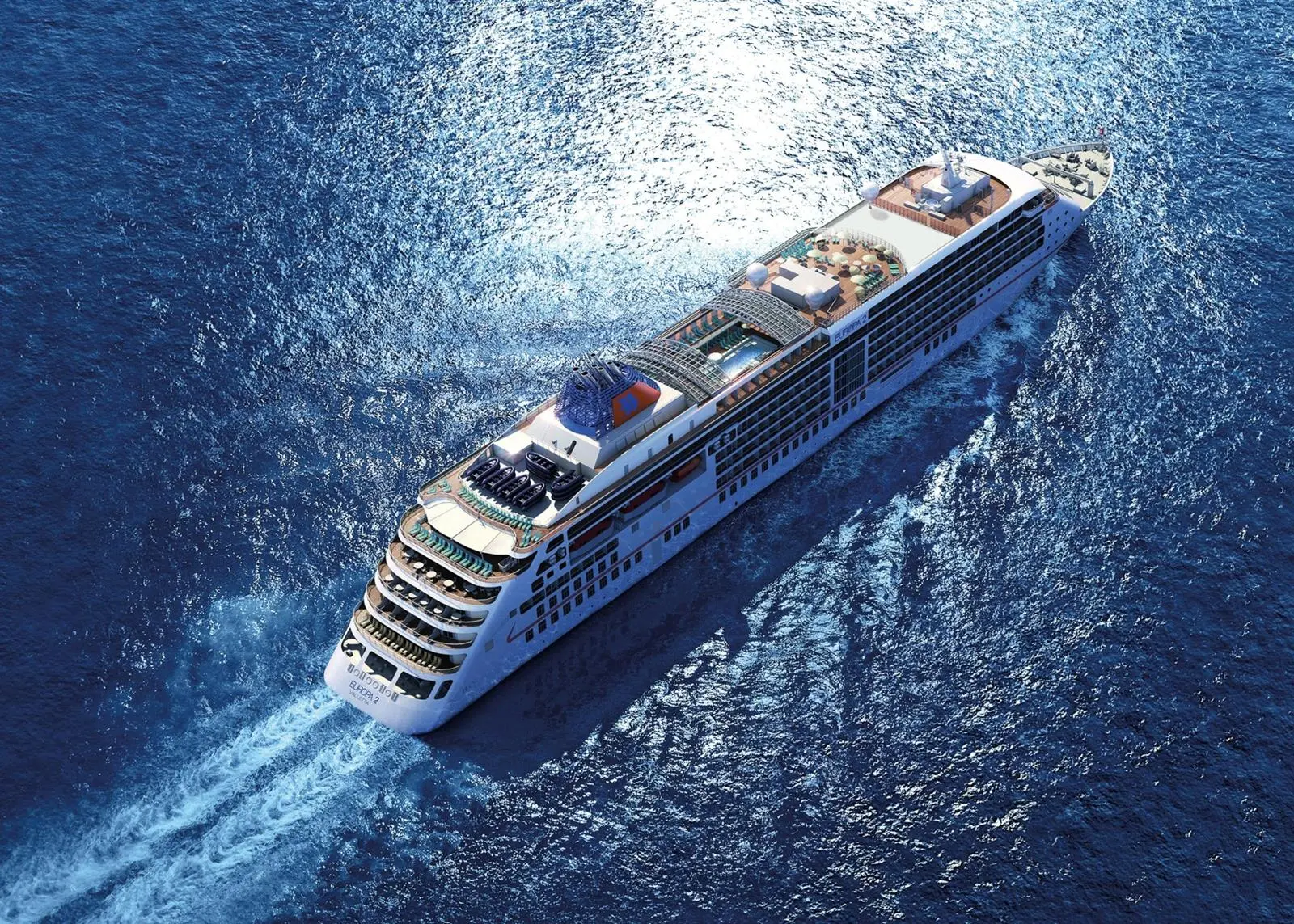
Quality married with contemporary style and non-formal, spacious living at sea have been the themes that have permeated and shaped Hapag-Lloyd Cruises’ Europa 2 newbuild project. Altogether striking and wholly distinctive in design, the 42,830gt addition to the fleet combines German technical standards and precision with French skills in the construction and outfitting of luxury passenger ships. The vessel has attracted plaudits from the travel industry, rating her above even her widely acclaimed, 14 year-old consort Europa.
The latest ship encapsulates a major strategic intent on the part of her German owner, as the means of generating a new target group among the affluent executive and professional classes, especially those still in work and younger in age. Moreover, Europa 2 and her associated cruise programme and concept is central to the Hamburg company’s bid to extend its market among English-speaking passengers, from the UK, North America and Australasia, and also from the Benelux and Nordic countries. The Hapag-Lloyd ‘brand’, with its specialisation in expedition-type and luxury cruises, has traditionally drawn its customers from Germany, Austria and Switzerland.
The fulfilment of the shipbuilding contract by STX France, the one-time Chantiers de l’Atlantique, testifies to the enduring prowess of the Saint-Nazaire yard in the cruiseship sector.
The standards and precision demanded by Hapag-Lloyd Cruises, part of the TUI organisation, claimed to be Europe’s leading travel group, have set the bar very high in terms of design, specification and ship production. From a technical perspective, fundamental importance has been attached to system performance, redundancy and environmental protection, while the owner‘s attention to detail is reflected in every sphere of the interior design and outfit. At the same time, the need to ensure cost-efficiency has not taken precedence over pragmatic operational and customer-focused considerations.
An exceptionally high space-per-passenger ratio is one of the distinguishing features of the Europa 2, in keeping with Hapag-Lloyd Cruises’ emphasis on the individual wellbeing and comfort of its guests. The comparatively low, maximum passenger complement of 516 in relation to the ship’s size, plus a high crew-to-guest ratio, promise exclusivity and a relaxing environment.
Hallmarks of the project are personal service, culinary diversity, an increased focus on wellness and fitness, and a multi-faceted entertainment programme, and a shift towards a more informal onboard atmosphere with fewer of the conventional cruise rituals. With space comes flexibility, reflected in the choices available as to dining, activity and entertainment options. There are eight restaurants and six bars, and a large spa and fitness area caters to the ‘well being’ demand trend. The interior concept follows modern design trends, mixing casual and stylish ambience with state-of-the-art technology.
All 251 cabins are suites, and all have balconies. Spaciousness applies across-the board, ranging from the smallest cabin at 28m² to the largest at over 100m². Partner Ship Design of Hamburg was retained for the general arrangement, profile design, and all the interiors including the cabins, suites and public spaces, plus the crew areas. The shipowner’s expenditure on the interiors is said to have been more than twice the industry average per square metre.
The Berlitz Guide recently rated Europa 2 as the “most luxurious cruise ship”, attaining the highest score ever for a vessel of up to 750 passenger-capacity. Decisive factors were the passenger space ratio, the amount of natural light in the public spaces, the culinary grade and choice, and onboard service delivery. She is thereby among an elite in her official grading as 5-star plus.
With the focus on high-earning and time-pressed, working professionals, including those with young families, the vessel is aimed squarely at a different audience from that targeted by many other operators, even those in the ultra-luxury segment. This client group orientation has determined a distinct cruise structure based on shorter, mostly seven-day voyages that can be combined for longer periods spent on board, extending to 14 or 21 days, and without consecutive repetition of itineraries. The multiplicity of route patterns in 2013 alone entails cruises in the Western Mediterranean, Eastern Mediterranean, the Arabian peninsula and Asia.
The relatively compact vessel size, at around 225m overall, allows access to many smaller ports and harbours outside the scope of other cruise ships, while the extensive outfit of 12 Zodiacs enables passengers to be transferred to remote beaches, lagoons or other points.
The nomination in 2011 of a high-performance and updated design of Mermaid podded electric propulsion for the nascent Europa 2 had represented a prestigious re-endorsement of the system in the commercial vessel sector, following widely-publicised problems and financial settlements relating to specific installations on certain ships owned by the Carnival and Royal Caribbean groups. Rolls-Royce and GE Power Conversion, and the latter’s antecedents Converteam and Alstom Power Conversion, have been working together on pod development since the late 1990s, yielding advances in Mermaid power density and hydrodynamic efficiency.
Whereas Hapag-Lloyd Cruises’ 28,900gt Europa, delivered from the former Kvaerner Masa-Yards in 1999, had figured among the first cruise ships to have been fitted with the competing Azipod system, the solution chosen for Europa 2 entailed two Mermaid pods, each incorporating 7.25MW synchronous electric motors fed by PWM (pulse width modulation) type MV7000 converters. Mermaid was seen as a way of achieving better hull integration and meeting with the owner’s requirements as regards reliability, robustness, system compactness, manoeuvrability and low noise and vibration levels.
The PWM MV7000 converters use high-level switching components in the form of press-pack insulated gate bipolar transistors (IGBT). With an intrinsic capacity to limit any overcurrents, and offering a high switching frequency capability, IGBT technology makes the drive easy to control and results in a particularly compact design. The overall benefits conferred by these arrangements are high-performance torque and speed control over the whole speed range, rendering high availability, with improved motor efficiency, and the size of the generators is able to be reduced.
GE Power Conversion’s French plants at Nancy and Massy manufactured the motors and power converters, respectively, for Europa 2, while the Mermaid mechanical and hydraulic parts came from the Rolls-Royce factory at Kristinehamn, Sweden. Final pod assembly and tests were undertaken at Nancy.
The four main gensets are each based on MaK six-cylinder M43C engines rated at 6,000kW and supplied from Germany by Caterpillar Motoren. While the power concentration and pod efficiency gives the ship a maximum speed in excess of 21 knots, the hull has been optimised for cruising speeds, typically between 12 and 18 knots, through CFD (computational fluid dynamics) iterations and model tests at Marin’s Wageningen facilities in the Netherlands. This prudent approach can be expected to yield substantial fuel savings over time.
An expression of the redundancy built into the ship is the division of the main machinery between two engine rooms, and the location of the auxiliaries in a further, separate room.
The proactive adoption of selective catalytic reduction (SCR) plant developed and manufactured in Germany by H+H Umwelt will enable the vessel to meet tightening controls and regulations governing emissions of Nox (oxides of nitrogen). The exhaust from two of the MaK prime movers, main engines 1 and 3, is treated by way of the SCR system. While all four engines are already IMO Tier II compliant, the considerable reduction of NOx achieved using the H+H plant is such that the vessel easily reaches the Tier III standard with the two engines involved.
The SCR installation comprises two converter housings, two static mixers and two dosing panels for the injection of the urea solution into the main engine exhaust streams, fed from a pumping station and 40t storage tank. The H+H system is of closed-loop configuration, incorporating continuous monitoring via a NOx analyser.
The vessel is fitted with a Metso DNA automation system, integrating the management of the electric power plant, monitoring and various controls in the fire, bilge, ballasting, ballast water treatment, fuel oil supply, propulsion, engine room ventilation, boiler, incinerator, water and other systems. In addition to monitoring and control through the workstations, operators have recourse to an information management system that includes supporting documents and trending, replay and analytical tools.
An important means of achieving passenger comfort in difficult sea conditions, and salient to the ship’s wide-ranging deployments, is the outfit of Blohm + Voss stabilisers, using fins of 14m² surface area. Overall, though, it may be anticipated that passenger wellbeing will spring to a great extent from the space availability on board and the service modus operandi, whereby guests never feel crowded, or pressurised by formal routines.
PRINCIPAL PARTICULARS– ‘EUROPA 2’
Length overall 225.38m
Length bp 205.00m
Breadth, moulded 26.70m
Draught 6.30m
Gross tonnage 42,830gt
Passenger decks 7
Passenger capacity 516
Passenger cabins 251
Crew 370
Propulsion system Diesel-electric
Main genset engines 4 x MaK 6,000kW
Electric propulsors 2 x Mermaid 7.25MW
Service speed, at 6.3m draught c.21.3 knots
Class GL
Notations Hull: +100A5 E1, IW, NAV-OC, Passenger Ship, EP(Environmental Passport); Machinery: +MC, E1, AUT, RP3 50%
Flag Malta
Related Articles
 PROPULSION
 GENERAL NEWS
 HYDROGEN