



Ro-ro mode offers benefits in tough reefer sector
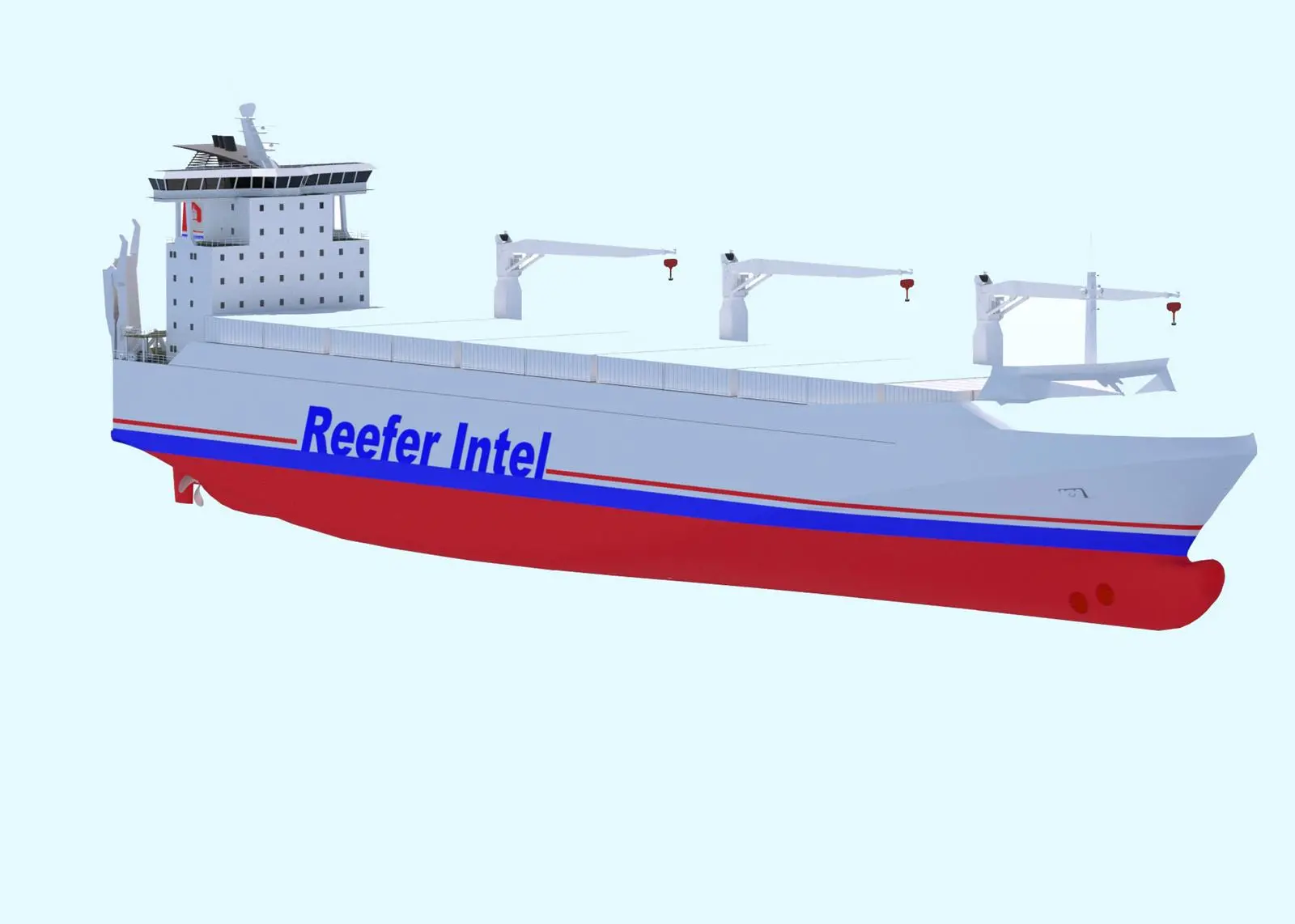
Innovative in its incorporation of an especially efficient ro-ro handling system, a new concept of reefer vessel has been proposed by Nordic interests, targeting the banana trades out of Latin America and other perishable cargo flows.
Pivotal to the design’s economic and performance attributes are the under-deck arrangements based on the use of cartridges or cassettes, for the loading, stowage and unloading of palletised cargo. The novel type also introduces to the reefer sector the heavy-duty quarter ramp means of access, otherwise associated with deep-sea ro-ro vessels and vehicle carriers. Flexibility is enhanced by the complementary provision for two tiers of containers to be carried in fully self-sustaining manner on the weatherdeck.
By combining high-throughput, horizontal pallet handling with the lo-lo mode for containerised deck cargo, record turnaround times are expected to be achieved in ports.
The ro-ro reefership has been developed by Knud E Hansen, the Copenhagen-based naval architects with an especially high profile in the ro-ro field, in conjunction with Stena RoRo of Sweden and the Danish consultancy Reefer Intel, owned by Birger Lindberg Skov, former president of Lauritzen Reefers. The new class of vessel is intended to compete on costs both with existing specialised reefer carriers and the container lines, which are gaining an increasing share of the global ‘cool‘ cargo business.
The partners in the technical project assert that the design will strengthen the pure reefer sector, allowing fruit shippers to remain in control of their complete supply chains, obviating the need for the transhipment, while realising important gains in transport efficiency.
The new vessel offers a payload of 11,500 high-cube (HC) pallets, nearly two-thirds of which would be borne on cassettes, with the remaining one-third transported in refrigerated containers. The cargo intake is claimed to represent a 45% greater capacity than comparable, traditional reeferships.
The considerably faster turnarounds promised by the design infer savings over-and-above those relating to port and handling costs. The reduced dwell times will allow ocean transits to be made at lower speeds, a factor of considerable significance given the relatively high service speeds that typify the reefer traffic. According to its promoters, the cumulative effective of the savings in fuel and increased operating efficiencies will mean that costs will potentially be cut by as much as 40% per cargo unit.
Cassettes are wheel-less cargo platforms, widely used in ro-ro trade for freight such as steel, paper and forest products, typically offering a maximum capacity of some 80t on a 12.2m unit, and handled by terminal tractors using lift trailers. In addition to a high payload capability, cassettes allow optimised use of deck capacity since they can be stowed tightly side-by-side.
Block stowing can increase intake capacity by 20% compared with roll trailer systems, and has the added merit of reducing lashings due to the inter-stow support conferred by the very close proximity of each unit to the next. A further benefit of the ro-ro cassette is the cost saving on returned empties, as units can be stacked up to five-high, depending on deck heights, and secured by simple locking pins. This is far easier and more efficient than transporting unladen roll trailers.
The envisaged new breed of reefership embodies four ro-ro decks, interconnected by ramps and divided into 10 separate, temperature-controlled sections, allowing for the stowage of a total 365 cassettes. Ro-ro cargo access and egress is to be entirely by way of the ramp on the vessel’s starboard quarter. The weatherdeck is fitted and strengthened to take two tiers of 40ft containers, amounting to 210 feu in total, with self-reliance in cargo handling assured by an outfit of three deck cranes mounted along the port side.
Reefer vessels handle cargo to and from the tweendecks using the ship’s cranes and commonly also sideport systems, and the overall stowing and discharging operation is relatively labour-intensive. Notwithstanding the design’s increased capacity, it is claimed that the ro-ro reefer lends itself to a 12-hour full cargo turnaround compared to the 36-48 hours typical of conventional reeferships.
The time savings derive both from ‘horizontal’ working of the cargo in and out of the ship and from the ability introduced by the cassette system to load units with palletised freight prior to the vessel’s arrival. In addition, the use of the ship’s own gear is focused purely on the container freight, handled simultaneously to the ro-ro loading and discharge.
The propulsion installation will comprise a single two-stroke, low-speed engine. This will be sized to ensure a 20.5 knot service speed and allow for schedule recovery in the event of delays, but will be optimised for slow steaming. Laden passage speeds of no more than 18 knots are anticipated in view of the design’s expeditious turnarounds in port. Substantial savings in time spent working cargo alongside could also or otherwise be harnessed within a given round-voyage schedule to take in more port calls, either to maximise reefer cargo catchment and/or increase backload opportunities.
Total installed power is stated as 25,340kW. The high electrical load to ensure the requisite temperature protection for the perishable cargo is reflected in the inclusion of a 3,500kWe shaft alternator, or PTO (power take-off) generator, and four 2,540kW auxiliaries in the provisional specification.
The designer said that consideration has been given to the use of various ‘green’ technologies in the ship’s plant, although it is clear that through-life environmental benefits would accrue from the promised fuel savings and overall higher operating efficiency.
Investments in dedicated reefer cargo vessel newbuilds have been very few and far between for several years. Container shipping lines have won an escalating share of seaborne temperature-controlled cargo over the past decade at the expense of the pure reefership sector, although the latter remains prominent in the banana trades.
The specialist carriers have continued to hone service strengths based on a traditional focus on cargo care, condition control, delivery punctuality and overall scheduling reliability, and by optimising the transportation and trading versatility conferred by self-sustaining, fast reeferships. The commitment by operators to the development of logistic resources embracing the complete ’cool cargo’ chain also has a signal bearing on the sector’s competitiveness and future wellbeing.
PRINCIPAL PARTICULARS–Ro-ro Reefer Vessel
Length overall 199.00m
Length bp 185.00m
Breadth, moulded 29.00m
Depth, to main deck 10.20m
Draught 8.40m
High-cube pallet capacity 11,500
Cassettes, in holds 365(ca.7,300 pallets)
Containers, weatherdeck 210 feu
Installed power 25,340kW
Auxiliary engines 4 x 2,2540kW
Shaft alternator 3,500kWe
Speed 20.5 knots
Related Articles
 PROPULSION
 GENERAL NEWS
 HYDROGEN