



Making a good marriage
“As it stands, the local content directive aims for around 60% or 65% of the total value of goods to be supplied by Brazilian labour,” says Marcus Coester of Fiergs, being careful to point out that it’s an ‘aim’, not a straight regulation “and one that can be waived if necessary”. It does happen: Nuno Antunes dos Santos of ICH Merwede points out that the company did get a waiver for a tiltable pipelay system with a 550 tonnes top tension capacity, destined for a series of vessels for Sapura Navegação Marítima. “There was no local equivalent – but fairly soon this won’t be the case” he adds.
It may seem a tempting opportunity for manufacturers looking to spread their market base, especially ones that have a particular expertise in high-tech offshore ware as the new presalt reservoirs will take a whole new layer of development, sitting as they do 3,000m down underneath a mineral crust. However, it’s worth noting that giants such as Exxon-Mobil, Chevron and BP signalled their wariness by withdrawing from the Libra presalt basin bidding rounds in October leaving only 11 players in the ring, around a third of those expected.
Mr Coester says: “While you can go it alone in Brazil, you will spend an unfeasible amount of time combing through your sourcing lists to keep inside the regulations.” Further, regarding the ‘waiver’ possibilities, it is important to understand that Brazilian authorities will protect those who have already taken on the country’s investment-related commitments, so they are concerned that “any future flexibility could be considered a penalty for those who believe in the existing rules”. However, Mr Coester points out it’s rather a case of ‘glass half full or half empty’ as after all, the local content rule still leaves 35% of the build content available for import – and it’s a very large glass.
Crane venture
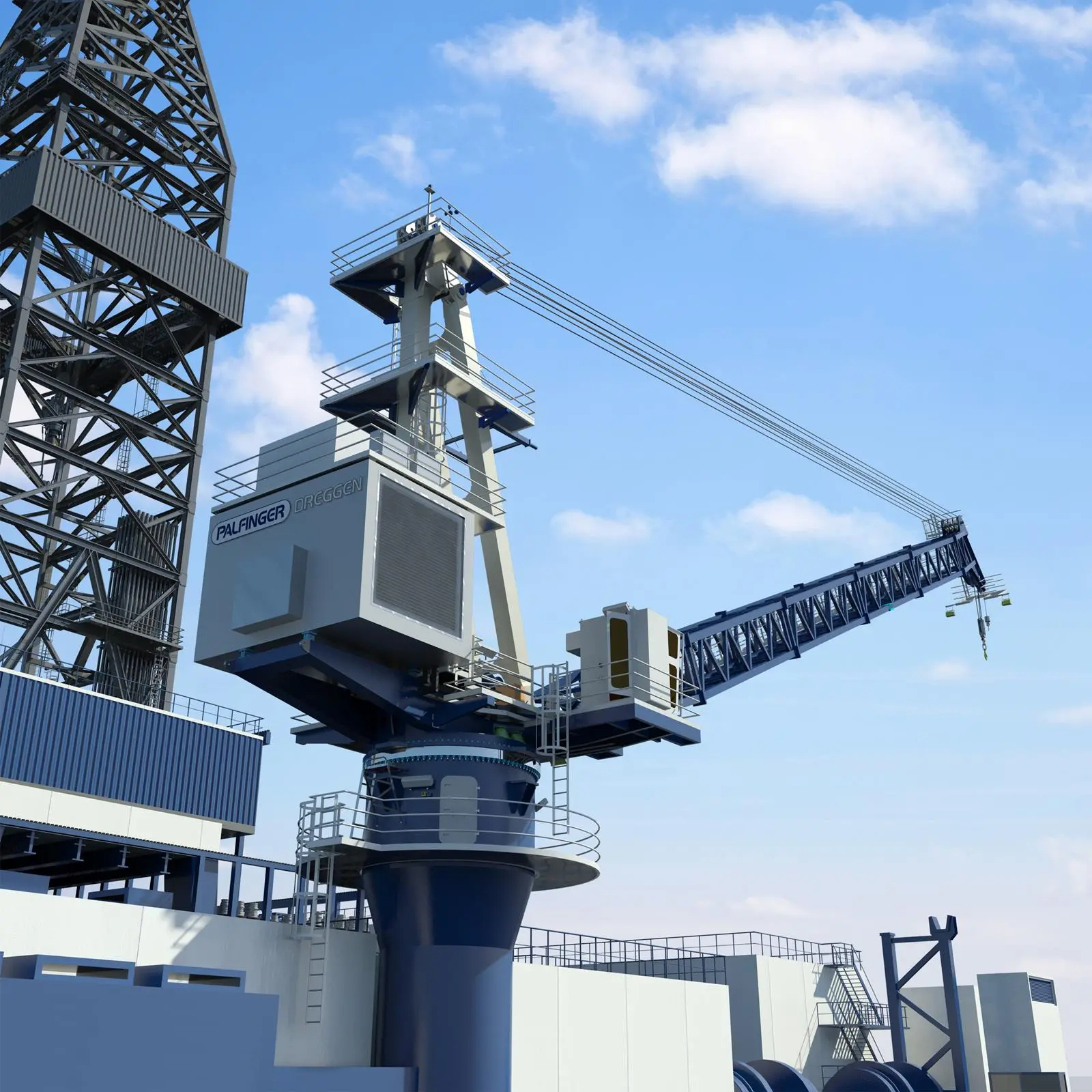
Given this, Palfinger’s joint venture partnership with Koch Metalúrgica was probably the most realistic way for the company to find a fairly secure way into the market explains Morten Jervell Pettersen of Palfinger’s Offshore Cranes division. It has only come after a long courtship: Palfinger Dreggen opened an office in Rio de Janeiro three years ago and the JV Dreggen Koch is showing commitment by sourcing facilities in the state of Rio Grande do Sul.
Certainly it has helped that the Brazilian company is established, “though within a different segment to Palfinger Dreggen” says Mr Pettersen. However, it has the right set of credentials for ‘Godfather’ Petrobras to give the joint venture its blessing; last year Jurong Offshore bestowed a contract for 28 cranes on a series of seven Sete Brasil drillships that are due into the Petrobras fleet between 2014 and 2017. Each vessel is to be equipped with a pair of DKF2000 pedestal knuckle boom cranes with an outreach of 45m and a capacity of 85 tonnes each and two DKW2000 pedestal wireluffing cranes; these have an outreach of 48m and a capacity of 63 tonnes apiece. They will be capable of supporting drilling operations at 12.2km down, under 3km of water.
So, the rewards could be large, especially since Brazil is banking on these presalt oil developments to lead Brazilian industry out of the woods and boost the country’s ship-building sector; there’s a huge number of drill ship and support vessel builds projected to milk it effectively.
However, Mr Pettersen is realistic about the way in which the Palfinger-Koch partnership will have to ramp up to be able to deliver the high end, tech heavy offshore cranes. “Koch has a good background in crane manufacture, but there’s definitely something of a gap between the domestic cranes they are used to and the new order – for example the sheer scale of the cranes and the sophisticated control units.” So there’s a need to start off gently and Palfinger is easing its way in by constructing the first sections of the series in Poland where it already has an established manufacturing base, before transferring the process entirely to Brazil.
Test facility
Further, these cranes do require a substantial ‘test bench’, as they are really quite some size with pedestal diameters of around 4m. Therefore the company is looking around the state of Rio Grande do Sul for a suitable patch to develop. Despite the issues it does seem that the area comes with one or two benefits, including room to spread out. “This testing facility is not actually something we could create at our own facilities back in Norway even if we’d wanted to,” he says. “Those facilities are just too confined to give us the kind of space we need. Given that the market for these cranes is here, really, this is the place to be.”
The test bed will probably be near the waterway as this may well play an increasingly interesting part in the Brazilian supply chain. Underutilised at present, it could help regional businesses meet the demands of the offshore industry and its local content directive which after all is a very new sector even for many established Brazilian companies. Mr Coester points out: “Although many smaller pieces are transferred by truck, there’s a limit to the items the roads can handle and certainly the best route for project or outsize cargo is to go via a few hundred kilometres of waterway and then around the coastline.” In the end the parts for an offshore vessel can sometimes transit over 2,000km between the various facilities, so the waterways could confer a vital cost saving measure on the logistics.
However, some changes are being forced by the sheer scale of the new orders; Petrobras can’t keep control of absolutely everything now and is contracting out whole vessels instead of stitching together the modules themselves. Mr Coester adds: “This might give foreign manufacturers more room to negotiate directly with the build companies.”
A small point, but it may make things just a little easier for those looking into Brazil’s rich but murky waters.
Related Articles
 PROPULSION
 GENERAL NEWS
 HYDROGEN