



Getting out alive
Mr Carlsen points out: “If someone gets left behind a lifeboat launch and jumps from a large offshore support ship, they probably won’t survive a 40m drop into the sea.”
Yet another problem is the wide range of heights the launch system has to cope with, as many of the offshore support vessels have hugely variable load conditions. Plus, the larger craft could have a 10° trim or list, and since a number of offshore craft are extremely broad, this complicates a large drop to the water. At the same time any evacuation system has to be light, fireproof, and finally, it can’t get in the way or take up deck space, “another real issue for offshore vessels” adds Mr Carlsen.
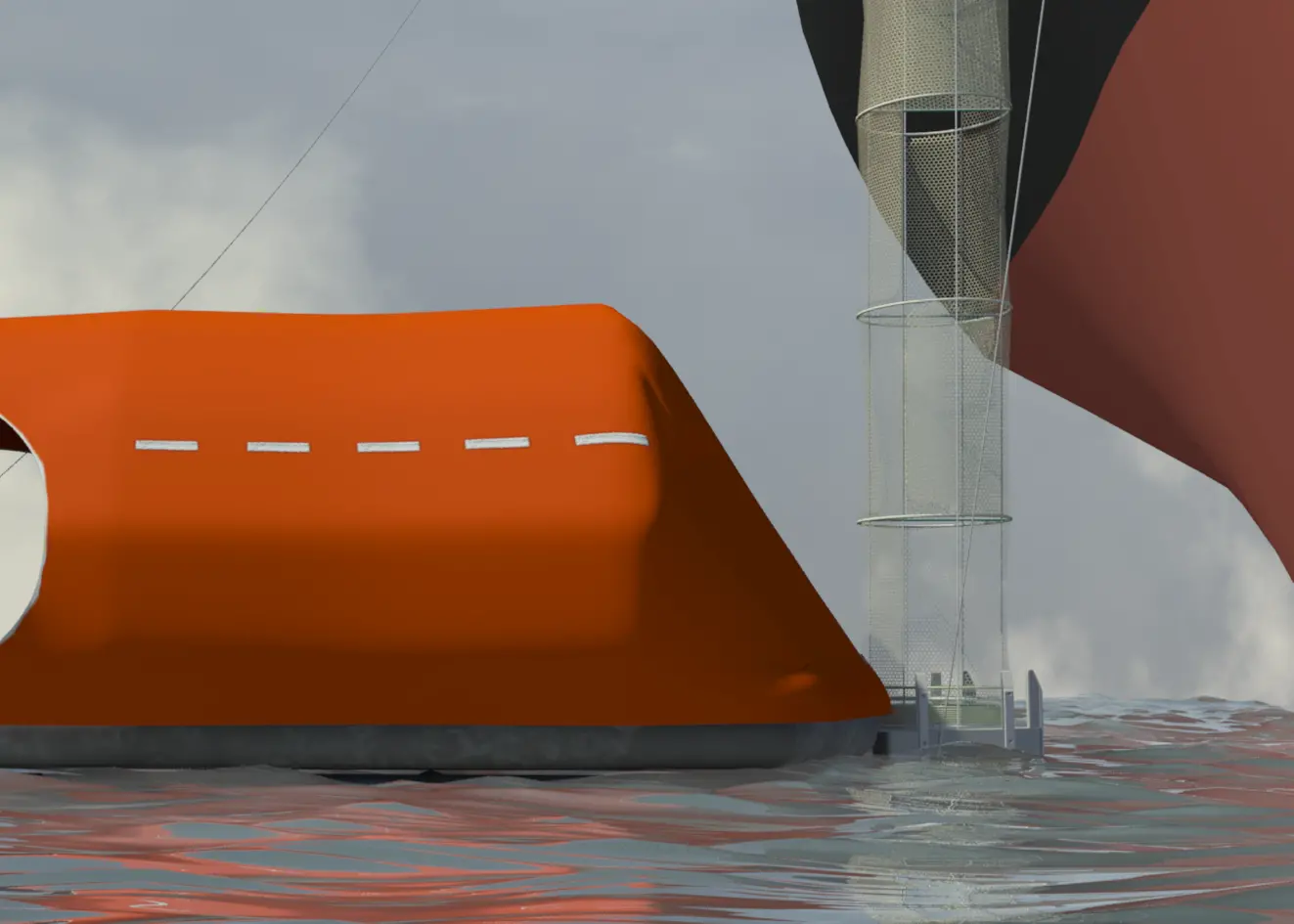
The answer is a Kevlar netting chute; at the top the container, and which is bolted to the deck, acting as the structural interface. It’s got a single handle release that opens the lock on an internal hydraulic winch which allows the chute to go into a controlled drop.
At the other end a stabilising weight lies 10m-15m below the waterline keeping the chute taut and reducing the sideways motion from wind and sea current. At the sea’ surface is a floating boarding platform and/or an automatically deploying liferaft which travels up and down the mooring.
The chute itself is made of fire retardant Kevlar net, fashioned into a column divided into individual cells. These have speed retarding slides running at opposite angles in a zigzag effect. What’s important is that these cells remain independent of each other and don’t concertina, trapping those inside. It simply folds up from the bottom with the openings on each cell allowing for an easy entry and exit at any point.
Further, the design of the chute enables evacuees to wear lifejackets, survival suits, and emergency escape breathing devices, “although they have to be careful that screwdrivers and the like are not going to snag the material, trapping them or ruining the chute” says Mr Carlsen.
The boarding platform inflates automatically and acts as the sea reference point where evacuees can await dry-shod transfer to system liferafts or fast rescue crafts. On one of the systems it can be used as an ordinary liferaft by cutting the chute guidance ropes.
Related Articles
 PROPULSION
 GENERAL NEWS
 HYDROGEN