



Ferries for the future
There is no shortage of second hand ferries on the market, particularly as routes have been abandoned or curtailed in the financial crisis. While second-hand vessels often do not meet today’s requirements or tomorrow’s regulations and expectations, new tonnage can be difficult to finance.
According to Oskar Levander, Rolls-Royce vice-president innovation and head of the company’s Blue Ocean team Esa Jokioinen, what is needed in a new ferry varies from route to route and operator to operator. The list typically includes compliance with stricter standards of damage stability and the ability to safely return to port. More importantly still, vessels must be economical to operate, attractive to passengers and road haulage companies, and cause the minimum of environmental impact. All vessel owners today target low fuel consumption, but a fully performance optimised high end vessel with all the energy saving gadgets is difficult to justify from an investment cost point of view.
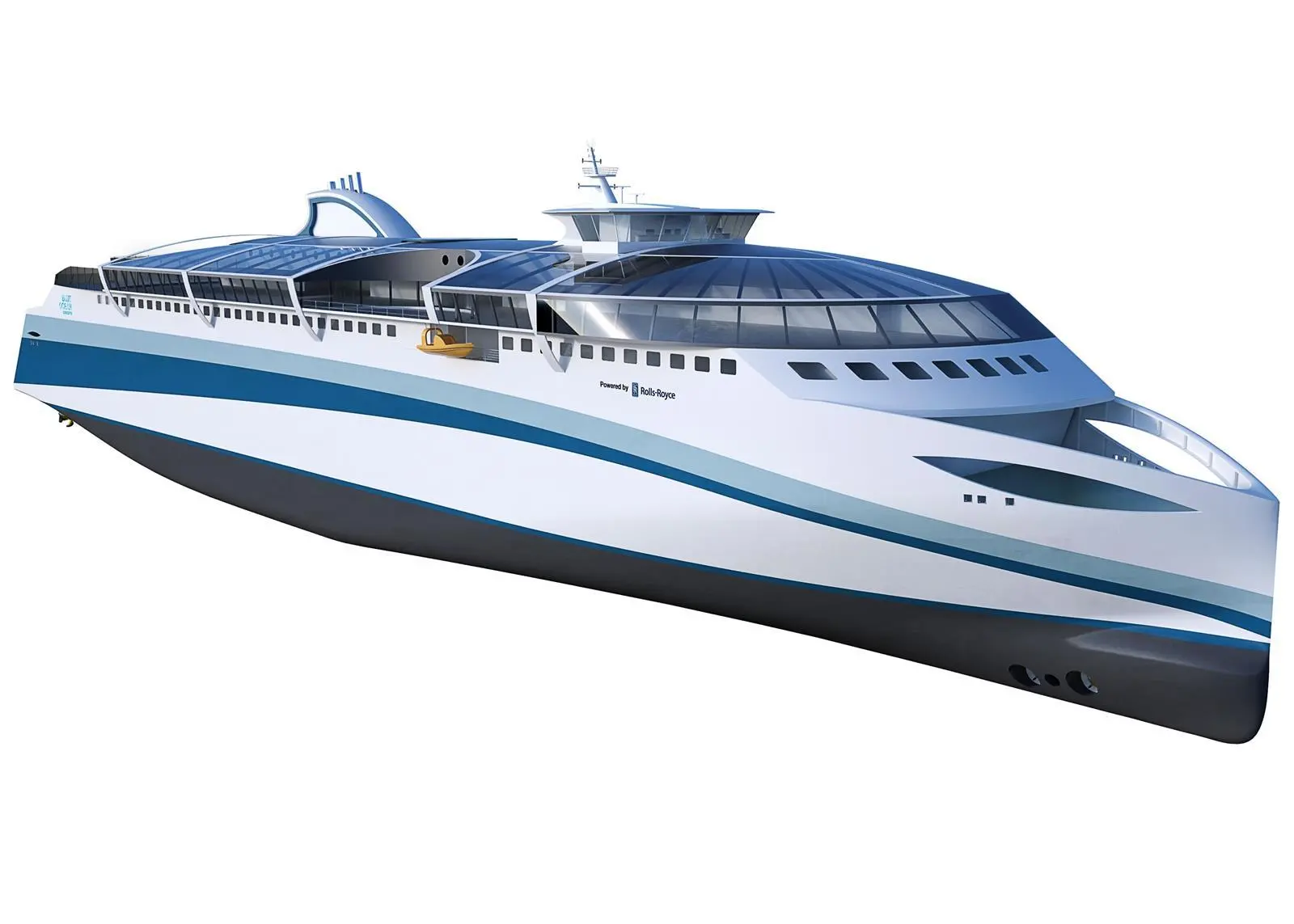
Rolls-Royce’s marine engineering and technology division has established the Blue Ocean team to develop new ship- and propulsion machinery concepts, technologies and solutions to support future business growth. The team has developed two concept studies aimed at a typical ferry route. One is based on a minimalistic design approach where elegant simplicity leads to a low first cost, and at the same time providing clearly reduced fuel consumption compared to conventional vessels of today. The other concept minimises operational cost by using high end technology, aiming at the top of the range, with a novel layout offering a good travel experience.
The team analysed existing ferry routes and operating profiles. Speeds have tended to decrease as fuel prices increase, since speed at sea always has a cost, so the concept designs are optimised for a service speed of about 19 knots.
Emissions also play an important role. With more ECAs in force and proposed, Rolls-Royce believes that LNG is the best alternative fuel to be considered for short sea shipping, in terms of reduced greenhouse gas and NOx emissions, and near-elimination of sulphur, particulates and smoke, important for vessels operating near population centres.
Taking the minimalistic solution, named Clear Blue, first, the aim is to reduce capital costs as far as practicable while providing what is needed to give provide good passenger amenity and fuel economy.
”Investment cost is reduced by removing what is not essential and simplifying the rest,” says Mr Jokioinen
With a length overall of 152m and a relatively broad beam of 31m, it is possible to include additional vehicle lanes, and allow space for U-turns on the vehicle decks, enabling all vehicle movements to take place over the stern, with no moving ramps or structure for cargo operations. Two main vehicle decks total 1,950 lane metres, with space on the open upper aft deck aft for a further 35 cars.
The superstructure offers passenger cabins on two decks, arranged in blocks on each side with space between blocks, each block accessed from a central alleyway, so all cabins have windows. For the shipbuilder, because the self-standing cabins blocks are on, rather than in, the hull and can be installed as large pre-outfitted modules including HVAC and auxiliary services, there is a potential cost saving. Passenger facilities such as restaurant, bar and shop are forward of the cabin blocks, with a single galley and service area, with stores in refrigerated containers between the accommodation blocks, eliminating unloading and on-board stores.
Below the vehicle decks, the compact engine room is protected from collision damage, with the remaining below-deck space divided into watertight compartments providing damage stability.
With three engines, the propulsion arrangement is compliant with Safe Return to Port requirements. Main propulsion is a Bergen B35:40V16PG lean burn gas engine of 7,600kW driving a single CP propeller through a reduction gear equipped with hybrid shaft generator (HSG). Two 6-cylinder Bergen gensets each provide 3,700kW.
Aft of the propeller is an electrically driven Azipull thruster. In transit this acts in a similar way to contra-rotating propellers for increased efficiency, with a power split 70/30. For steering at sea, a rudder is located aft of the Azipull, while for manoeuvring at low speed the Azipull provides vectored thrust at the stern, assisted by two tunnel thrusters at the bow.
Instead of on-board gas tanks, the LNG fuel is carried in trailers on the open aft deck. Typically, two of the three gas containers would be replaced daily and locked to the hull during the sea voyage.
The philosophy behind this whole concept is to install and carry on board no more equipment than is strictly needed, leading to lower construction cost and less complexity.
While the first concept is focused on minimising capital cost, the second, known as Dynamic Blue, aims for minimum fuel costs. This design offers a high-end vessel for markets demanding higher passenger service standards.
”Here our goal is to minimise operation cost using high end technology,” says Mr Levander. ”We have also designed the interior layout to maximise passenger revenue generation.”
The upper decks adopt a non-symmetrical layout, with casings, services, deck-to-deck access and the shop concentrated on the port side, leaving the starboard part of the ship for passenger facilities including restaurants, bars and lounges. This enhances spaciousness and light, this area being cantilevered out over the lower decks, with a glazed roof area. The crew accommodation the deck above is narrow and arranged to port. 166 passenger cabins are sited below the public deck. The focus on eating and shopping provides activity for the passengers and, with a 1,000 capacity, maximises revenue streams for the owner.
This version offers a drive-through loading arrangement to its two-level of vehicle decks of 1,800 lane-metres in total, with bow and stern doors and simultaneous loading from twin level linkspans. Hoistable decks boost car capacity.
The 170m long and 25.9m wide hull, of around 27,500gt, is based on the Rolls-Royce Environship form for low resistance and sea-kindliness.
A hybrid propulsion layout is used, with gas engines, and LNG bunkered from quay or barge into two fixed tanks, located below the vehicle deck and each holding about 145m3.
A single centreline CP shaftline carries a Promas arrangement with propeller hubcap, rudder bulb and twisted leading edge rudder for increased efficiency. The main propeller is flanked by two electrically driven Azipull thrusters which can be used both in transit and for manoeuvring. A 7,600kW Bergen B35:40V16PG engine drives the centre propeller, though a gearbox with electric PTO/PTI. Three Bergen gensets each rated at 3,700kW supply the switchboard. This configuration allows selection of mechanic, electric or hybrid mode for optimal performance in all operation conditions.
A waste heat recovery system further increases efficiency, with exhaust gas economisers supplying steam to a co-generation system capable of delivering about 750kW of electric power to the switchboard. The cold LNG fuel is utilised to provide cooling for ships services.
According to Rolls-Royce, taking as a reference case a typical 2005-built conventional ferry of similar capacity, running on HFO/MGO, on a 110 naut mile route with a four-month peak season offering three crossings per day, and two crossings for the remainder, both concept designs offer cost savings. Clear Blue would show an annual energy consumption reduction of 15% and Dynamic Blue up to 25%
“Our study concludes that new vessels can offer the lowest operating cost. Despite the low investment cost of second hand vessels, Clear Blue will have lower annual costs from the beginning. An owner can get a brand new vessel tailored for his needed at a more attractive cost,” says Mr Jokioinen. “Dynamic Blue shows clearly the lowest operating costs and is a good choice for owners with a long commitment who want to capitalise on the higher revenue potential.”
Related Articles
 PROPULSION
 GENERAL NEWS
 HYDROGEN