



Big ship, but a delicate balance
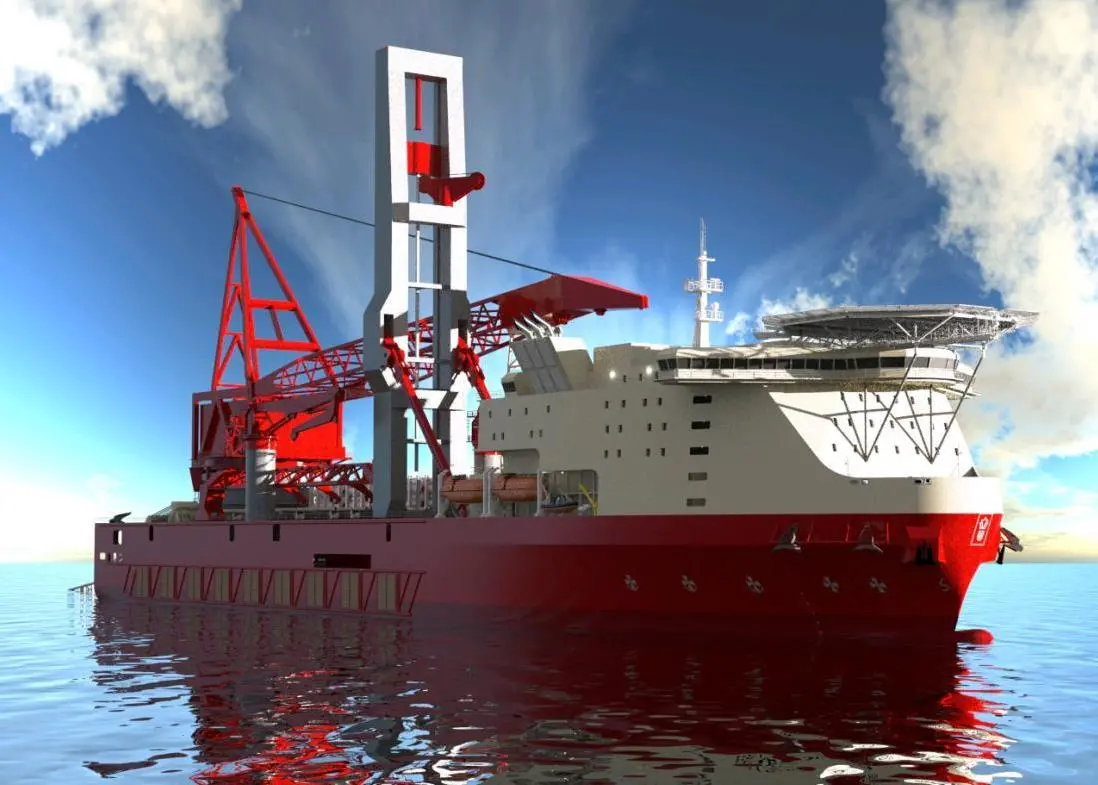
Bob Rietveldt of Dutch design company Ulstein Sea of Solutions (USOS) explains that deeper water means more capability being tied into each ship, as logistics makes a greater demand and there’s no easy passage backward and forward to port, a major consideration for the USOS – Petrofac project teams.
“But this involves a delicate balance,” he explains. “The aft of the vessel, which is after all where a lot of the action takes place, has to be carefully designed to accommodate all the equipment, much of which is supersized to deal with up to 3,500m of water.”
He is certainly not kidding about ‘action’: this Petrofac vessel has a main crane with a fully revolving lift capacity of 5,000 tonnes and also does double duty on pipe laying, having both a 600 tonne capacity S-lay and 2,000 tonne J-lay system, a huge moonpool measuring around 25m by 10m and a pair of AHC, 750 tonne winches. Moreover, there has to be space for the main crane and the J-lay tower to be lowered into a bridge-passing position, bringing the ship’s airdraft down from 83m to 57.8m.
Despite all this, he says the trick is to make sure that each operation is effective: “What you can’t have is one extreme governing the entire design, even though this one element may seem to be the most challenging part of the ship board operation. You have to be certain other functions don’t get overridden.” He adds: “It is so easy to get carried away and overdesign one area while under-designing another. What you have to remember is that it’s always the weakest link that causes the issues.”
So, the vessel has to tie each operation into the overall execution “and still be able to earn money even if you place it in competition with three separate, smaller vessels with simpler tasks”.
The issue is that S-lay and J-lay pipe laying capabilities are rather different: one needs a physically low-lying manufacturing area linked to a 95m stinger trailing out the back – this helps the pipes to bend gently into an ‘S’ before falling into position onto the sea bed. On the other hand, the more upright, J-lay deployment which deals with the deeper water pipes and infield lines is via a 68m high tower: in the case of the Petrofac JSD 6000, the pipes are finally deployed through a moonpool.
Getting this all on one vessel puts an awful lot of pressure on available space, but of course the anomaly is that one pipe facility will usually be idle while the other is working at full tilt.
USOS’s design features a below main-deck pipe fabrication shop; work with the Petrofac project team led to the idea of using this space not only for assembling the double joints of the horizontal S-lay, but also using it for the greater proportion of the quad joints for J-lay operations. It saves time by bringing these stiffer pipes together into longer 48m lengths before they are elevated to the main deck’s buffer station, waiting for an arm to swing them up and slide them into the tall deployment tower – which now only has to deal with one joint in four.
There are other interesting customizations of the Ulstein SOC 5000 foundation: the vessel has been widened by 2.8m, bringing the vessel up to 49m across. This is not just to make room for the scaled up equipment, but because it’s revolving lift capacity is actually at the 5,000 tonne mark. This gives the vessel a stunning 40m of outreach but also demands extra breadth for stability’s sake.
Further, the huge tower and moonpool isn’t located where you’d expect it to be; it’s not in the middle, but over to starboard of the ship’s centerline, so the main deck benefits from a broad, unobstructed and fully strengthened work area.
Lastly, it’s not all about the machinery: because the operations require a crew working 24/7 with long periods spent away from shore, the ship has to accommodate nearly 400 people in comfort.
The Petrofac JSD 6000 vessel, which is to be constructed at the ZPMC yard in China with a view to getting into service early in 2017, is looking toward the emerging market economies for employment. Further, Mr Rietveldt expects a few more of this type of vessel to find its way to the order books. He explains that places like Brazil are ramping up toward huge building campaigns: “These markets are looking at a large amount of deep water infrastructure, and ships like this will be the centre pieces.”
By Stevie Knight
Related Articles
 PROPULSION
 GENERAL NEWS
 HYDROGEN