



Keeping it all moving
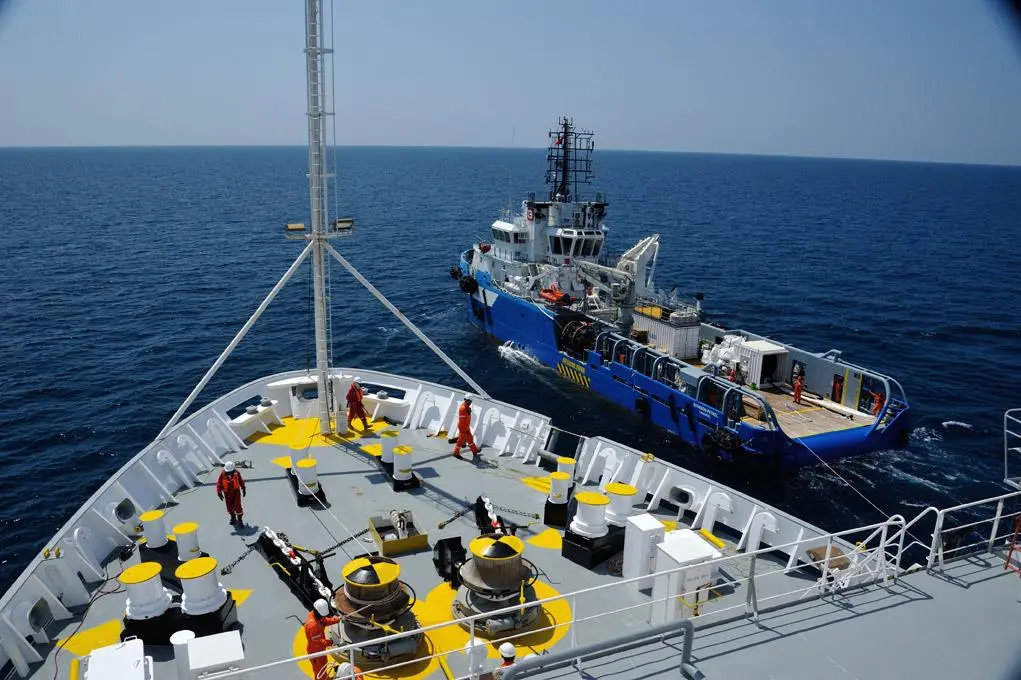
Seismic support is a relatively new area of marine activity, says Geoff Dean of OSD-IMT, but despite their recent arrival on the scene, he expects these vessels to remain a constant presence.
One of the first dedicated vessels from OSD was the Bourbon Petrel: an IMT 952 design it was built by Dubai’s Grandweld Shipyards, entering into service during the middle of last year.
Mr Dean explains the need for this kind of support vessel has evolved along with the increased scope of, and methods of surveying. A few years ago seismic survey ships simply used to be general purpose vessels with survey gear bolted to the deck, but of course, he says, “everything was a lot smaller back then”. Now, although there are still a few of these vessels being converted to work in restricted areas, survey work, like much else, is edging into much deeper water, prompting the development of larger ships like the Ramform Titan.
Mr Dean explains that these big ships simply can’t come to a stop without causing issues for the 10 or more streamers that are being towed behind, reaching as far as 8km astern of the vessel. “If the seismic ship loses speed, the streamers could start to drift forward and sink, tangling with each other, the paravanes and even the mother ship with very expensive consequences.”
Therefore, one of the pivotal support roles of the Bourbon Petrel, beyond supply operations, involves emergency towing in the event of a propulsion breakdown: “The IMT 952 can move into position ahead of the mother ship, pick up a wire and get the big ship under tow at 5 knots all within four or five minutes, preventing damage to the streamers.” This, says Mr Dean, is the main reason for the 50 tonne bollard pull on the 53.8m ship.
The power is an important element: there are two main 1,193kW engines feeding the twin CP propellers. These engines are sized for the bollard pull and 12 knot guard and chase operations which involve clearing a path well ahead of the mother ship and making sure that there aren’t any vessels cutting in too close to the streamers astern. This is a critical function in itself, the support vessels are responsible for monitoring the mother ship’s entire operating area and avoiding fishing fleets which might be in the area.
However, the vessel also has to be suitable for cruising at low speeds with protracted periods of running at around 5 knots whilst refuelling or on escort duty.
To manage the very diverse loading a hybrid propulsion system has been fitted: mechanical propulsion is used in transit and during operations but diesel-electric power from three 550kW gensets are used for escort duties with the power running through the PTI functions of two reduction gearboxes. One interesting innovation is that the maximum bollard pull of the main engines is supported, via the PTI, by a pair of 350kW electric motors. Finally, any slow speed manoeuvring is assisted by a pair of 300kW bow thrusters.
Another operating requirement of the Bourbon Petrel is to replenish oil, water and provisions on the mother ship, but it’s a different pattern from the more common role of platform supply vessels, explains Mr Dean. “Firstly, there is no requirement to transport mud, brine, drill chemicals or the usual dry bulk materials like cement.”
There is however, a need for high volumes of fuel on such large seismic ships, a thirst exacerbated by their prolonged work patterns. So, the Petrel can deliver 895m³ or about 800t of HFO in one go, plus 75m³ of marine diesel and 120m³ of potable water.
Mr Dean explains that in moderate seas the support vessel can deploy Yokahama fenders in order to allow refuelling to be accomplished from alongside, also allowing the mother ship to lift off other supplies from the deck via its own onboard crane. If the seas are too rough for alongside refuelling, the support vessel can steam ahead of the mother ship, passing the hose up a line to the bow of survey vessel and pump up the fuel from a safer distance.
The long runs of the survey ships also have an impact on other elements of the design. The Bourbon Petrel also deals with personnel transfer for crew rotations; this is achieved using the 10t davit which can recover the mother ship’s workboat.
The design differs in other ways from a standard PSV. There is no need for a large working area and so the Petrel has only 240m² of deck aft (strengthened to 5t/m²) unlike many PSVs which claim three times this amount or more.
However enough space is required to locate two 20ft containers, a spare seismic streamer reel with capacity for 8,800m of 52mm streamer and a refuelling hose reel. It also has room for a 9m workboat plus an electro-hydraulic deck crane which can lift 3.0t at 12.0m outreach.
Lastly, accommodation onboard is for a maximum of 24 people, with a layout of two single cabins, five double cabins and three four-berth cabins.
The Bourbon Petrel has been supporting the CGG Symphony in the Black Sea with two sister ships of the same design, Bourbon Fulmar and Bourbon Gannet joining the Petrel since its start of service last summer: “The feedback has been very, very positive” says Mr Dean.
Certainly it seems to be springing interest in other, similar designs: there have been stirrings from both Russian and Chinese owners who are looking toward the next step in the evolution of these seismic support vessels, presently taking form as the IMT 965. There are two vessels of the IMT 965 design currently on order with China Oilfield Services Ltd which are due to start construction this year: the vessel has many of the same characteristics as the IMT 952 but adds another few metres in all directions, bringing its length up to 64.95m, the beam to 16m across and the depth to 7.5m, making it suitable for extended operations.
Despite the constant evolution of seismic surveying techniques, Mr Dean thinks that some things will remain constant: “As long as there are large seismic ships operating offshore, vessels such as these will continue to provide an essential means of support.”
Bourbon Petrel: Principal particulars
Length oa: 53.8m
Beam: 13m
Depth: 6.30m
Loaded draught: 4.80m
Deadweight: 1,290dwt
Related Articles
 PROPULSION
 GENERAL NEWS
 HYDROGEN