



Sigmund Borgundvaag: four decades of designing the future
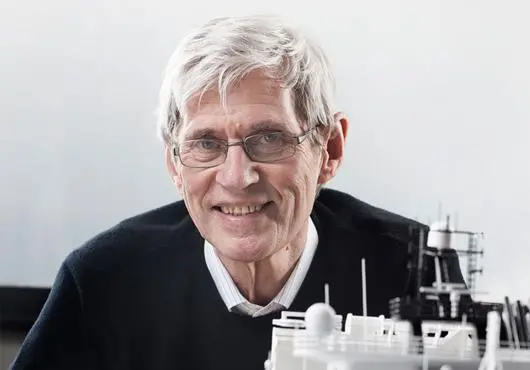
Naval architect Sigmund Borgundvaag of Rolls-Royce makes an intriguing point. While “a lot of good things” have come about from the way vessels are developed today, an 18 year-old UT746 offshore support craft is, according to the operator “better than more modern designs for the job”.
It’s a very interesting statement from someone often called ‘the grandfather’ of offshore support: he’s the man behind the influential UT series which now spans four decades and over 800 vessels.
It may also just be that this craft, like so many others from Mr Borgundvaag’s drawing board, is both very long lived and almost elegant in its match of vessel and application.
Mr Borgundvaag himself says with characteristic understatement that while generally more modern designs have benefitted from elements such as improved aerodynamics as well as hydrodynamics, occasionally there is “just a good fit” between a vessel and its sphere of operation: “Sometimes the simplest way to do it turns out to be the optimal.”
Sounds easy enough, but to understand the context of UT series’ development you have to look back to 1973. Mr Borgundvaag was working for Ulstein in Norway when he saw that the new North Sea oilfield supply boats were in difficulty; they had come from the Gulf of Mexico and simply weren’t up to the relentless hammering. “Even the windows were getting pushed in by the force of the sea” he explains.
His answer was the very first UT704: the Stad Scotsman, launched in 1975, was a fast, robust design that took a lot from the fishing boats that had been negotiating the area for years: “It had a much higher speed than other supply vessels along with better seakeeping and motion” he says. In fact he adds although people may not believe it, the hull form proved so efficient “even modern vessels have a similar fuel consumption”.
A run of orders followed: the solid foundation with its characteristically high freeboard also made itself available for further development – excellent anchor handling and towing capabilities for the AHTS plus a high deck load capacity in the PSVs. The next decade or so saw new classes of PSV and AHTS, maintenance and other support vessels coming thick and fast: the UT 722, a multifunctional tug supply vessel design also formed the basis for emergency towing and pollution prevention vessels while the UT 730 met the need for scaled up deck equipment.
Occasionally the UT designs sprang into another field, for example the UT 500 series. Interestingly, these have taken the ideas developed from offshore service and put them into other applications, for example the two French UT 507 coast guard vessels which were in service from the late 1970s to 2005 when two UT 515s, a specially developed new design, took their place.
It’s not always been straightforward. Mr Borgundvaag explains that the reaction to the first boat, the 80m 704 was, ‘it’s too large, we can’t use it’. However the operators were eventually convinced by market performance, after which the call kept coming for “a little bigger, and a little bigger”.
Size isn’t everything though: “The UT 755s are handy. If you are starting out and want to invest, with these vessels you know you can get some business, whereas a drill or well vessel needs a special contract behind it.” Since its introduction in 1994 it’s had periodic revisions that have kept it abreast of changes and there are now 160 examples either in service or on order.
Despite the popularity of the UT 746 and 755s, Mr Borgundvaag believes that the sector doesn’t always understand the pull of future requirements: “While the industry looks to see what existing vessels can do, occasionally they have difficulty seeing the potential in new designs.”
This might also be true of the more recent design, a UT 776 for Island Offshore which matched a pair of LNG engines with a pair of diesel units instead of going for DF engines: the investment is, he admits, around a quarter higher, but because the LNG engines are used almost all the time, “the running costs save the operators around £2,000 per day” when compared to its diesel-driven twin. However Mr Borgundvaag concludes: “The market has been much slower than we originally thought,” adding “this kind of LNG design will have to make financial sense” by which he means legislation and possibly governmental infrastructure support will be needed before the market moves ahead.
Despite this, the UT designs just keep evolving, and interestingly the latest in the series – the UT 777, a very new class of well intervention vessel – has been designed by none other than Mr Borgundvaag’s son.
Mr Borgundvaag, who has just been awarded a Lifetime Achievement Award at the age of 75, admits that the UT704 still holds a special place in his heart “as it was the design that opened up the market”. The series, as well as the individual designs, have proven themselves remarkably resilient.
Even so, it’s a surprise that the very first 704, the Stad Scotsman, is still working today off the coast of Nigeria under the name Reliance Star 1.
Related Articles
 ALTERNATIVE FUELS & LUBRICANTS
 ALTERNATIVE FUELS & LUBRICANTS
 OPINION