



Hebridean ferry puts down a new marker for hybrid technology
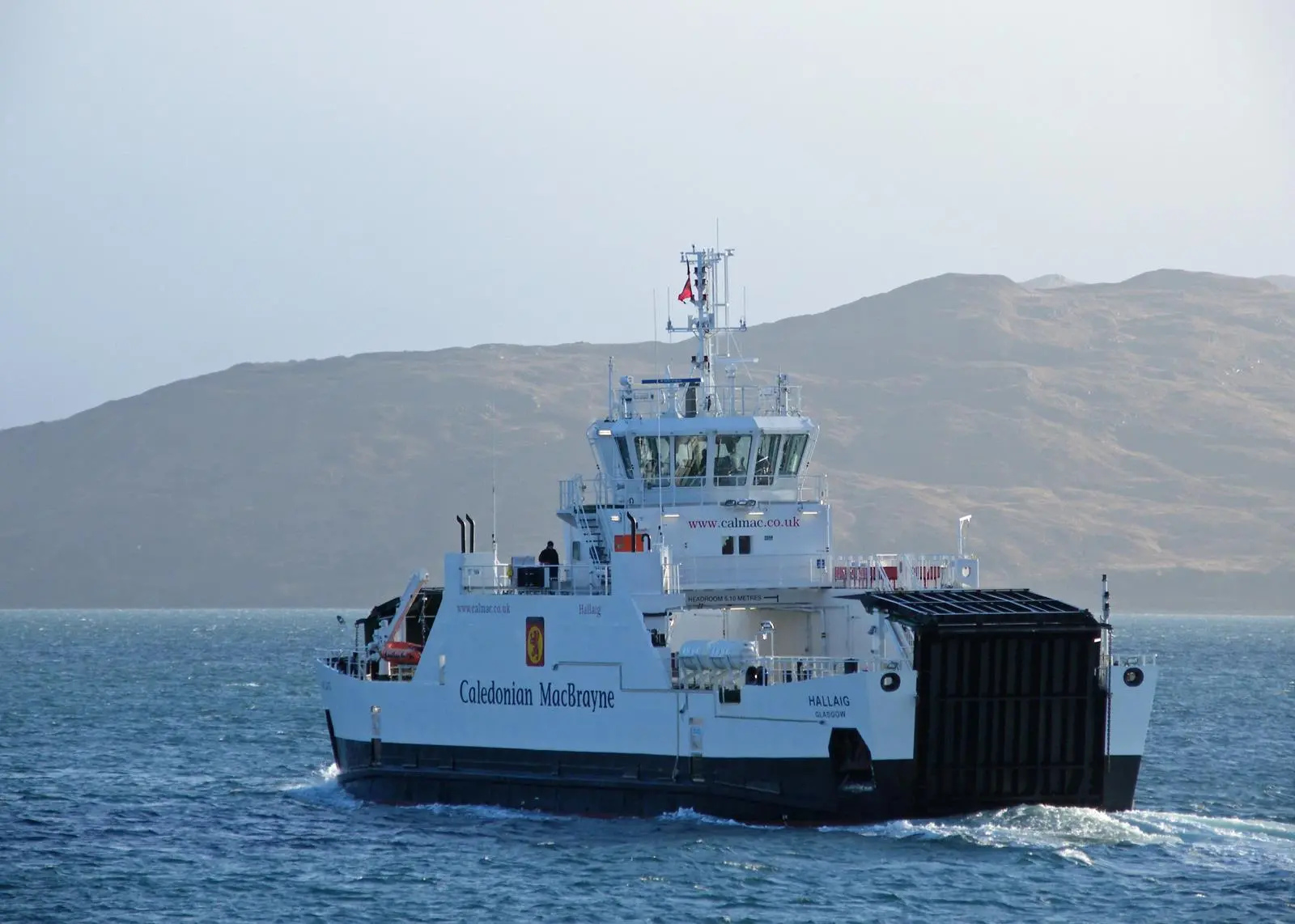
Designed for the tough environs of the Hebrides and outer Clyde estuary, the 43.5m long design employs an electric propulsion system in which diesel generators are complemented and augmented by banks of batteries. The arrangements afford a high degree of operating flexibility, substantial energy savings and a reduced environmental footprint.
Sisters Hallaig and Lochinvar are each capable of carrying 150 passengers and 23 cars or two fully-laden heavy goods vehicles (HGVs), and have been tailored to suit operating profiles on short crossings within the extensive Caledonian MacBrayne (CalMac) route network, where vessels lie alongside at night.
Claimed to be the world’s first sea-going hybrid ferry, Hallaig was phased into duty last winter on the route linking the Isle of Skye with the smaller island of Raasay. Sistership Lochinvar has recently been brought into commission on the Tarbert/Portavadie connection across the mouth of Loch Fyne, in Argyll. Both ships have been assigned to operation with the David MacBrayne subsidiary CalMac Ferries by owner Caledonian Maritime Assets (CMAL), an agency of the Scottish government.
Against the backcloth of governmental and corporate strategic objectives of drastically cutting carbon dioxide (CO2) emissions through reduced energy usage and fuel consumption, the hybrid powering solution supplied by Imtech Marine permits the ferries to run in diesel generator, diesel generator plus battery, or battery-only mode. This allows power sourcing and delivery to be matched to operating policy and precise, overall energy needs at any point, whether sailing, manoeuvring or alongside.
Recent results from measurements taken on board have shown fuel savings well in excess of the circa 20% anticipated relative to a conventional diesel mechanical configuration. Apart from the economic benefits, the hybrid propulsion system leads to a reduction in mechanical stress and noise, particularly when berthing and unberthing.
CMAL entrusted construction to Ferguson Shipbuilders at Port Glasgow. The scheme has thereby given a boost to industrial production, through the resumption of commercial shipbuilding on the Clyde after a gap of several years, as well as putting Scotland in the vanguard of pioneering, low-carbon maritime technology. The Scottish government provided CMAL with a loan of £20million ($33million) for the procurement of the two ferries. CMAL had fed results from an EU-funded collaborative research undertaking, known as the Small Ferries Project, into its plans for new ships.
This latest stage of development of the CalMac fleet has entailed close cooperation between the Ferguson yard and Glasgow ship design firm SeaTec, electrical specialist Tec-Source, and the local office of Imtech Marine. In addition to supplying the propulsion motors, converters and batteries, Imtech designed and produced the main switchboards, the power management system and also the energy management system (EMS) and platform automation. Servicing has been entrusted to Imtech’s Glasgow branch.
In normal operation, Hallaig maintains the Sconser/Raasay service schedule using a single diesel genset out of the three installed, and draws on the batteries for peak shaving under the aegis of the optimal load controller. Extra power is supplied instantly by the batteries, obviating the time delay associated with bringing another genny on-line. Peak shaving by this means not only yields savings in fuel, but also reduces wear and tear on the generators. The practice on a Sunday, when just two sailings in each direction are timetabled, is to run solely on battery power if conditions allow.
Since the ferries are engaged in services which only operate during the day, battery charging from the national grid can take place overnight at the berth. Owner CMAL’s ultimate goal is to tap renewable energy sources for battery charge replenishment.
Fed with electrical energy from the three small diesel gensets, the 400V split main switchboard supplies power to the variable speed drives and electric propulsion motors, ship’s services and the emergency board. The drives each have a direct current (DC) link with the respective, adjacent 350kVA banks of batteries. Inverters ensure that the DC provided by the batteries can be transformed into 400V alternating current (AC). The main board also has a connection for shore electrical power supply, creating a conduit for overnight charging of the batteries from the landside grid. The main gensets are rated at 368kVA and comprise Volvo Penta D13 diesel engines and Stamford alternators.
The two permanent magnet-type propulsion motors each have a rated power of 375kW and a speed range of 0-615rpm, and drive Voith Schneider Propellers (VSPs). The ferries dock without being moored tightly. Accurate control and positioning as well as high manoeuvrability are essential for docking in inclement conditions at relatively exposed ramped berths. To ensure that the type 16R5 EC/90-1 propulsors are well protected during docking manoeuvres, the cycloidal propeller units are located diagonally in recesses towards each end of the hull, rather than in the usual centreline position. Model tank tests were conducted at HSVA’s Hamburg establishment.
The installation provides for a service speed of some eight to nine knots, and the vessel can hold station in wind speeds up to 37 knots. Full propulsion power of 750kW is required in especially adverse weather conditions.
The forward and aft propulsion rooms each contain one variable speed drive and propulsion motor with a short driveshaft to the Voith unit, plus one battery compartment. Within the vessel’s midbody, the forward engine room houses two of the gensets and the main switchboard, while the aft engine room contains a single genset. While essentially a function of the double-ended design, the overall layout of machinery confers a high degree of redundancy.
The two banks of batteries have a combined capacity of 700kWh. Despite a considerable price premium over conventional lead acid batteries, the lithium ion alternative offers a range of operational advantages translating into cost gains over time. Lithium ion technology promises far longer cycle life, charge efficiency and much higher energy density, and is maintenance free. The life expectancy of the batteries is 10 years, and the fuel savings achieved through meeting the load partially or fully with battery power is said to compensate for the cost of shoreside charging at current price rates.
Imtech recently carried out a measurement campaign aboard the Hallaig, over the course of a two week period on her regular run between Sconser and Raasay. Sailing for several days in diesel-electric mode, without the batteries, fuel and kilowatt-hour consumption data was gathered, providing a baseline measurement. For the remainder of the two weeks, Hallaig operated in hybrid mode using the batteries, with fuel consumption recordings continuing to be made along with the evaluation of various hybrid load-sharing strategies.
While both Imtech and the shipowner had initially thought that a fuel saving of around 20% was a realistic expectation, Imtech’s findings, after comparing the results in diesel-electric and hybrid mode, showed that savings of up to 38% had been achieved. On closer examination, a 28% saving was attributed to the overnight, shore-based charging of the batteries, supplanting energy that would otherwise be generated during the day by the gensets. An additional 10% in savings came from ’smart’ usage of battery power via Imtech’s Energy Management System (EMS).
Reduced maintenance costs should accrue from operating on less diesel generators and running gensets at their ‘sweet point’, and through extended battery lifetime.
Cargotec supplied the MacGregor bow and stern ramps and associated power packs. The ramp design is derived from that used on the 54m double-ender Loch Shira, also built at the Ferguson yard and commissioned in 2007.
Although the ro-ro intake of the ‘Hallaig’ class is modest, the 23-car capacity is based on larger-type, 4×4 vehicles and affording sufficient room to open front and rear doors. Moreover, while the freight capability corresponds to just two fully-loaded 44t HGVs, the ferry can actually accommodate four, non fully-laden trucks. The vessel’s ramps access existing infrastructure, obviating the need to install costly linkspans.
The Hallaig-type could provide the template for further investment in the CMAL fleet, while Imtech Marine has a new string to its bow in offering hybrid solutions to the wider market.
There is another dimension to the latest ferry project. With many community renewable energy schemes struggling to connect in areas where there is currently limited local demand, weak grids and long transmission routes to the wider market, additional regular local demand to charge-up hybrid ferries is a welcome development. The vessels’ use of new battery technology also affords a valuable opportunity to assess the utility of battery storage with a defined daily cycle.
Imtech Marine language:
ENERGY MANAGEMENT: “Continuous search for an optimum with respect to energy generation and consumption, given an operational goal.”
POWER MANAGEMENT: “Ensure availability of demanded power.”
PRINCIPAL PARTICULARS–HALLAIG/LOCHINVAR
Length overall 43.5m
Length bp 39.99m
Breadth, moulded 12.20m
Draught, design 1.73m
Vehicle capacity 23 cars / 2 trucks
Ro-ro lane-metres 112.5m
Vehicle deck area 306m²2
Passenger capacity 150
Crew complement 3
Gross tonnage 499gt
Deadweight 135dwt
Displacement 560t
Power and propulsion system Battery/Diesel electric
Battery banks 2 x 350kVA
Main Diesel genets 3 x 330kW/368kVA
Propulsion motors 2 x 375kW
Speed 8-9 knots
Maximum speed 11 knots
Class Lloyd’s Register of Shipping
Related Articles
 PROPULSION
 GENERAL NEWS
 HYDROGEN