



Voith propulsion provides key to specialised construction vessel
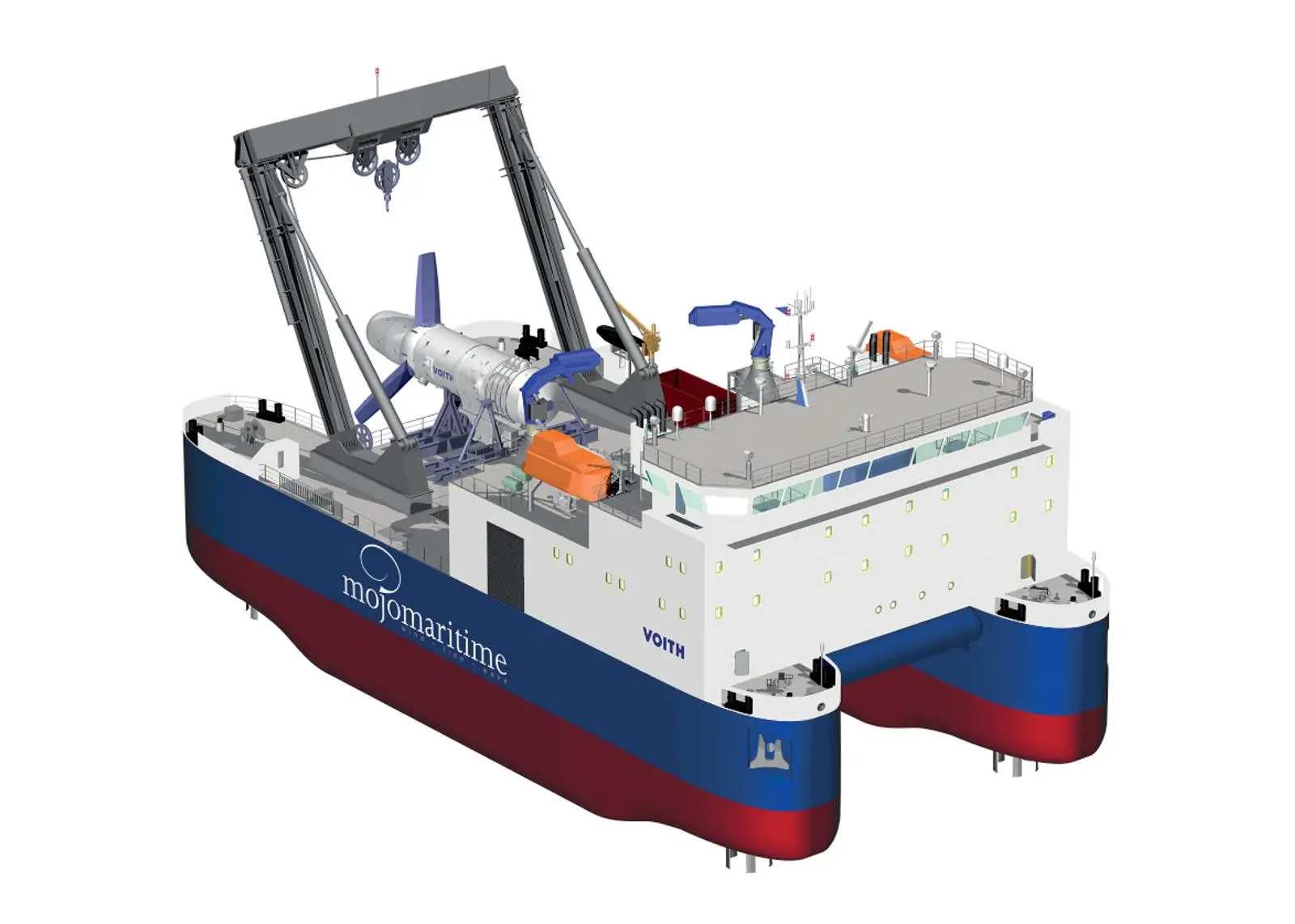
Mojo Maritime, a British marine renewable energy specialist, and Hamburg-based shipowner Hammonia Reederei, signed a Memorandum of Understanding in early 2014 to finance and build the ship, named ‘High Flow Installation Vessel’, or HF 4 in short. The HF 4 has a twin hull configuration designed by Voith and is powered by four Voith Schneider Propeller (VSP) units, which confer it with the ability to operate in currents up to 10 knots using dynamic positioning. , Voith claims that this special vessel is set to transform the offshore construction market.
Engineered by Voith naval architects, the design is based on Mojo Maritime’s outline scheme for a ship suitable for installation of tidal energy turbines in high energy tidal streams. With a length of 59.5m and a beam of 28.6m, the HF 4 boasts an open deck space of about 1,000m², accommodates 44 people and has a maximum A-frame crane lift capacity of 250t. Voith says that this specification will allow it to handle all stages of tidal energy work– from the installation of the turbine support structure to the mounting of the turbine and the long-term maintenance of the unit – but has wider potential, including in the offshore wind sector and in the general subsea construction market.
The twin hull design provides the stability required. “The centre position of the moon pool allows operations to be carried out at the point of the least vessel motion during swells”, said Stefan Moyé, engineering manager, Voith Turbo Schneider Propulsion. “In addition, the extremely short response times of the Voith Schneider Propellers allow precise dynamic positioning, even under the most adverse tidal conditions.”
HF 4 seeks to minimise the installation risks of offshore construction projects while at the same time providing a significant reduction in installation costs.
“As an offshore service provider, we were able to draw up a detailed set of requirements for the ideal construction vessel. But we entered uncharted waters when it came to the actual development”, said Richard Parkinson, Mojo Maritime MD. “Voith has been a competent and reliable partner to us throughout the entire process, and they managed to turn our vision into a ground-breaking, economically unique concept.”
Voith’s development of the basic design included calculation of damage and intact stability, design of the steel structure as well as of the vessel outfitting and machinery systems. Following the Memorandum of Understanding, Mojo Maritime and Hammonia are working together to appoint a shipyard to build the vessel and to secure its first charter.
The project is receiving support from UK’s innovation agency Technology Strategy Board, whose goal is to accelerate economic growth by stimulating and supporting business-led innovation.
Related Articles
 PROPULSION
 GENERAL NEWS
 HYDROGEN