



North Sea toolbox
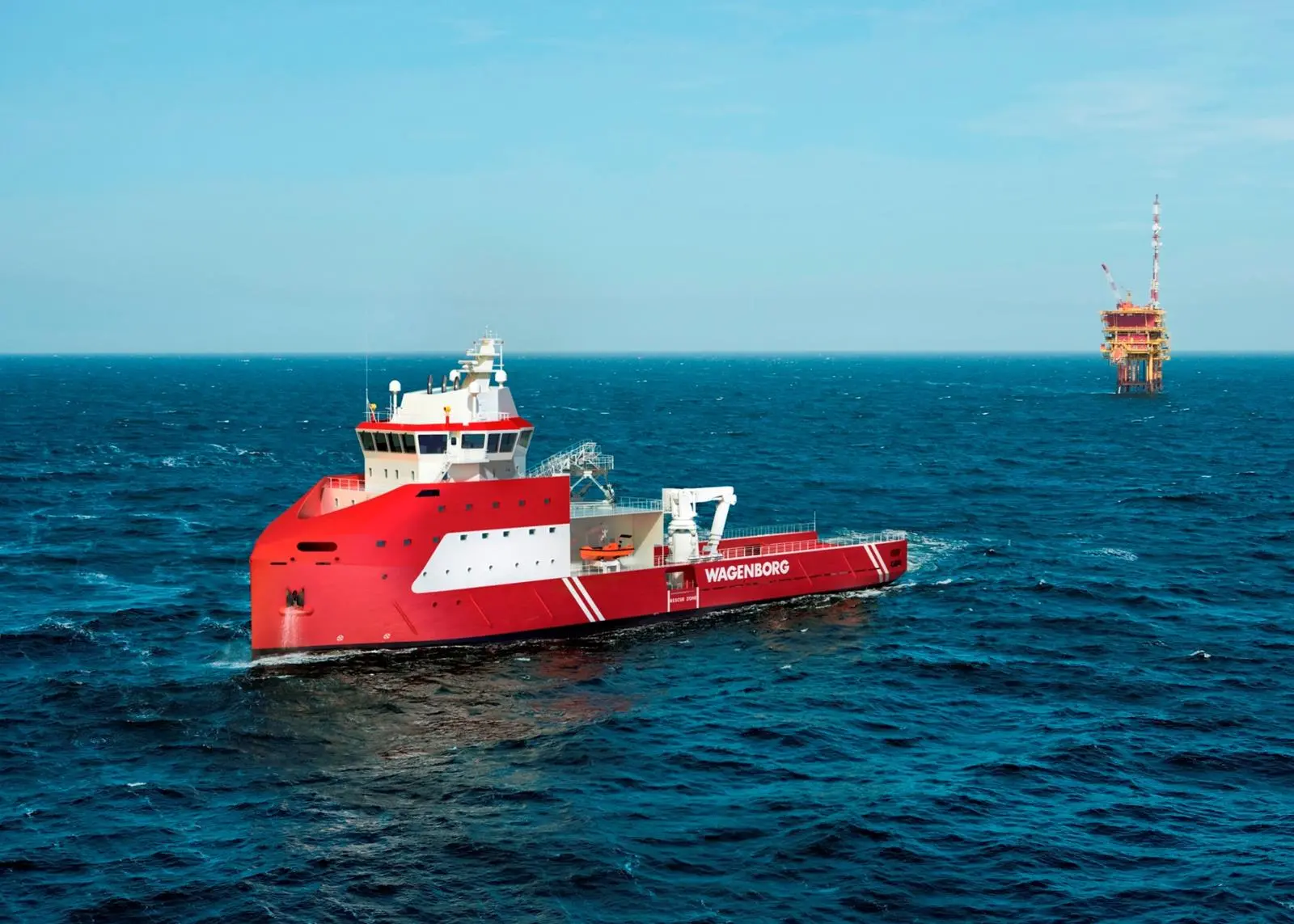
But it doesn’t mean that there’s just a trickle left explains Niels de Goffau of Wagenborg Offshore “it just means that people are being forced to think innovatively about more cost effective ways of maintaining North Sea production”.
Mr de Goffau says that with the North Sea gas platforms age also came an increased need for maintenance, and while the operators have taken to avoiding the big expense of flying technicians in by helicopter in favour of using a motion compensated access gangway, it’s usually been a bolt on installation on a PSV’s supply deck.
Mr de Goffau explains that this kind of ‘bolt on’ approach has its limitations – one of them being that any additional equipment comes at a cost to the other operations plus, as PSVs are the basic workhorse, they often don’t have either chemical bunkering facilities or motion compensation cranes.
He says given all this Wagenborg Offshore got around to asking: “Can we integrate some of these different needs through a ‘toolbox’ that can fulfil a wide range of platform maintenance activities? Needs that don’t, at the moment, get answered by the typical PSV setup?”
The answer is the quirkily-named ‘Walk to Work’ vessel which rethinks a number of typical solutions. For example the conventional chemical bunkering method uses the platform crane to carry the hoses – something that can stress them. The new procedure involves using floating hoses and a dry breakaway coupling: the vessel’s crane achieves the link after which the hoses are disconnected from the crane itself.
The vessel can also be used for emergency well stimulation along with bunkering of other chemicals, as it can help inject methanol into the well at high pressure. It is heated on the vessel “and there’s been some clever engineering calculations involved to make sure the methanol will be at the necessary temperature on reaching the well” says Mr de Goffau.
But all this needs to happen with the engineering capability in situ, so one of the big points raised was the comfort of the well maintenance engineers who aren’t, after all, seamen. Because the vessel was developed from scratch, there was special attention paid to the vessel’s sea behaviour; it meant going with vibration-reducing bow thrusters and Voith Schneider propellers working together to minimise roll as well as adding to good station keeping.
And central to the operation, in more ways than one, is the motion compensated gangway which has been placed in the centre of the vessel: Mr de Goffau explains that this position behind the bridge gives the most stable location, and he reasons that this gives a better all round solution than putting it on one side as the 22m gangway still has enough footfall to reach both sides of the platform, and will still be operable at 2.5m significant wave height.
He adds that in terms of weather conditions, the southern part of the North Sea is a somewhat easier, less extreme environment to work in than other North Sea areas, lending itself to a greater degree of vessel optimisation.
Still, even here the weather can’t be depended on and so this is where the Octopus forecast system comes into its own. It shows up safe working windows for the various operations and highlights the vessel’s ability to maintain its DP position ahead of time. Further, it also lets the captain know under which heading any particular activity should be executed including loading, offloading and technician transfers.
By Stevie Knight
Related Articles
 PROPULSION
 GENERAL NEWS
 HYDROGEN