



Adept breed of pipelayer shaped by Brazilian needs
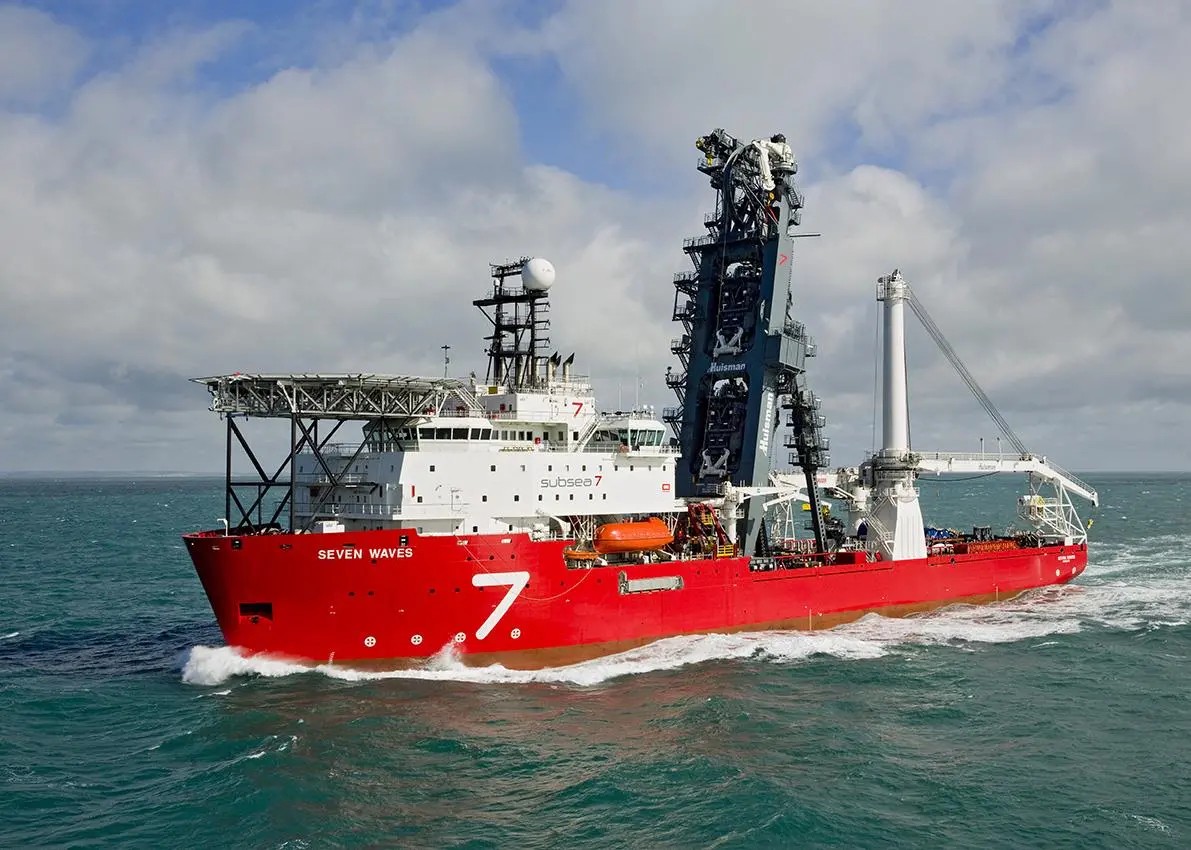
As the first of a new generation of high-tension pipelaying vessels contracted to Petrobras, the 17,300gt Seven Waves signals the deepening involvement of specialist operator Subsea 7 in the Brazilian offshore market.
Luxembourg-registered but operationally-headquartered in London, Subsea 7 has pursued a fleet expansion strategy over recent years in anticipation of demand driven by the increasing scale and complexity of subsea projects globally. Designated a pipelay support vessel (PLSV), Seven Waves is the first of four sisters ordered by the company from IHC Merwede in the Netherlands. This entire new stage of investment is underpinned by long-term employment commitments from Brazilian energy major Petrobras.
Offering a DP2 standard of dynamic-positioning, Seven Waves has been developed to transport and install flexible flowlines and umbilicals in water depths up to 3,000m. The 550-tonne top tension capacity of the lay system tower confers one of the highest performing flexi pipelay capabilities worldwide, reflecting the evolving requirements of Brazilian deepwater and ultra-deepwater operations.
The outline specification was prepared by Subsea 7’s Technology and Asset Development Team. Moulded to the needs for fulfilling the five-year charter contract with Petrobras, the final design was the outcome of close cooperation between the owner and IHC Offshore & Marine. The shipbuilder contends that the adoption of an integrated design approach has had a fundamental influence in differentiating IHC Merwede from the competition worldwide.
Following construction at IHC’s Krimpen aan den IJssel yard near Rotterdam, Seven Waves transferred downstream to Huisman’s Schiedam quay for the fitting of the 550-tonne pipelay system and 400-tonne capacity offshore mast crane.
The tiltable lay system incorporates two 275t tensioners to handle flexi products of 100mm-630mm outer diameter. Both tensioners can be retracted clear of the firing line (the pipe joint assembly line), facilitating safe and efficient, pipe and cable A&R (abandonment and recovery) and PLET (pipeline-end-termination) procedures. The system has been equipped for accurate control of ’squeeze’ loads, an important attribute for handling umbilicals.
The lay tower can tilt during operations to an angle of up to 10°, so as to assist with recovery of rigid pipe from the seabed, and can also be tilted to 50° from the vertical so as to ensure clearance of overhead obstructions. The power cables at the entrance to Vitoria harbour in Brazil were a particular consideration.
Other design elements tailored for Brazilian ultra-deepwater work are the two underdeck storage carousels of open-top ‘basket’ design, with respective capacities of 2,500t and 1,500t for flexible flowlines, and high-pressure flushing systems, plus underwater demountable main thrusters, enabling removal and replacement while the vessel is afloat. The outfit incorporated to meet Petrobras’ requirements includes two work-class remote-operated vehicles (ROVs).
The deepwater crane is equipped with an active heave compensation system to counteract the vessel’s vertical motions when landing a load on the seabed, potentially to depths as great as 3,000m. This capability is especially apposite to the heavy loads entailed with deepwater subsea production system installations. The ship is also fitted with a 25-tonne capacity Cargotec auxiliary knuckle boom crane.
Seven Waves employs a diesel-electric propulsion and manoeuvring system delivered by Wärtsilä, and based on six medium-speed diesels and multiple thrusters. The prime movers in the six main gensets are eight-cylinder models of the Wärtsilä 32-series engine, each producing 3,840kW. Three 2,950kW stern azimuthing thrusters provide main propulsion, augmented in manoeuvring and position-keeping mode by two 2,400kW retractable bow azimuthing units and a pair of 2,200kW bow tunnel thrusters.
The aggregate thruster power concentration is 18,050kW, and the factors that led to the nomination of Wärtsilä equipment included the ease and speed of changeover offered by the three steerable thrusters of underwater demountable design. With a conventional thruster, in the event of a failure, a vessel would usually have to sail to drydock for repairs. Levels of equipment reliability as a whole have a fundamental bearing on customers’ ability to fulfil contractual obligations and hence on profitability and reputation.
As a popular choice of machinery that is well known for achieving high levels of efficiency, the Wärtsilä 32 engine is also highly regarded for its reliability, uncomplicated maintenance routines and long maintenance intervals. Dependable technology, although a requisite across the market, is critically important in the offshore industry. For pipelayer operations, high engine loads have to be continuously sustained to ensure that the pipe is deployed safely and accurately.
Kongsberg Maritime DP technology is employed in the form of a K-POS DP22 dual-redundancy system, using Veripos DGPS, Seapath DGPS and HiPAP reference systems. The Norwegian company was also responsible for the thruster control and vessel management systems.
IHC Merwede engaged Combinatie Croon Bakker, the joint undertaking of Croon Elektrotechniek and Bakker Sliedrecht, as subcontractor for the design engineering, integration and installation of the electrical system, including energy generation, switchgear, distribution, high and low voltage networks, electric drives, automation and power management.
The sophistication of modern pipelay and offshore construction vessels is emphasised by one of the ship’s most impressive statistics, wherein over 300km of electrical cable has been installed, ranging from heavy-duty power lines to small signal cables. Since the vessel is some 146m long, she thereby carries over 2km of cabling for every metre of her length.
Combinatie Croon Bakker in turn commissioned Alphatron Marine to provide the complete internal communications solution. This comprises a Cisco Voip telephone system, which is the Subsea 7 standard worldwide, supplemented by Alphatron’s own heavy duty, DNV-certified telephones, public address and general alarm system. The Dutch firm also supplied its proprietary Alphatainment system.
Seven Waves transited for Brazil in March 2014, to commence operations ahead of schedule. Her long-term engagement by Petrobras has consolidated a business relationship that has seen Subsea 7 provide support over many years to the Brazilian national energy corporation in flexi-pipe installation projects.
Seven Waves is the fifth vessel in the Subsea 7 fleet to have been constructed by IHC Merwede. With the opening up and development of deepwater, pre-salt Brazilian fields, the Petrobras requirement for new-generation, high top-tension flexible pipelay vessels has continued to increase. As a consequence, a further agreement was signed with Subsea 7 last year, encompassing the construction and operation of three more ships based on the Seven Waves design. Each has been secured for a five-year period.
The building of the follow-on trio has also been entrusted to IHC Merwede, and deliveries are due in the third and fourth quarters of 2016 and second quarter of 2017, respectively. The total cost of the three newbuilds, including inventories, commissioning and mobilisation to Brazil, is approximately US$950m.
A total of five further pipe layers to be employed by Petrobras has been contracted from the Dutch shipbuilder by Seabras Sapura, the partnership between SapuraKencana of Malaysia and London-headquartered Seadrill.
PRINCIPAL PARTICULARS–SEVEN WAVES
Length overall: 145.9m
Breadth, moulded: 29.9m
Depth, to main deck: 13.0m
Draught, maximum: 8.3m
Corresp. deadweight: 11,312dwt
Draught, operational: 7.2m
Corresp. deadweight: 7,025dwt
Gross tonnage: 17,283gt
Main offshore crane capacity: 400t
Operating depth, maximum: 3,000m
Propulsion system: Diesel electric
Service speed: 13 knots
Main generator engines: 6 x 3,840kW
Main propulsion thrusters: 3 x 2,950kW
Manoeuvring thrusters: 2 x 2,400kW; 2 x 2,200kW
Total thruster power: 18,050kW
Cabin berths: 120
Class: Lloyd’s Register
Class notations: +100A1, +LMC, UMS, DP(AA), CAC(3), EP, ICC, IBS, *IWS, NAV-1, UD strengthened for load of 5t/m², Helicopter landing area
Flag: Isle of Man
Related Articles
 PROPULSION
 GENERAL NEWS
 HYDROGEN