



Purpose-built for long-endurance seismic survey anywhere
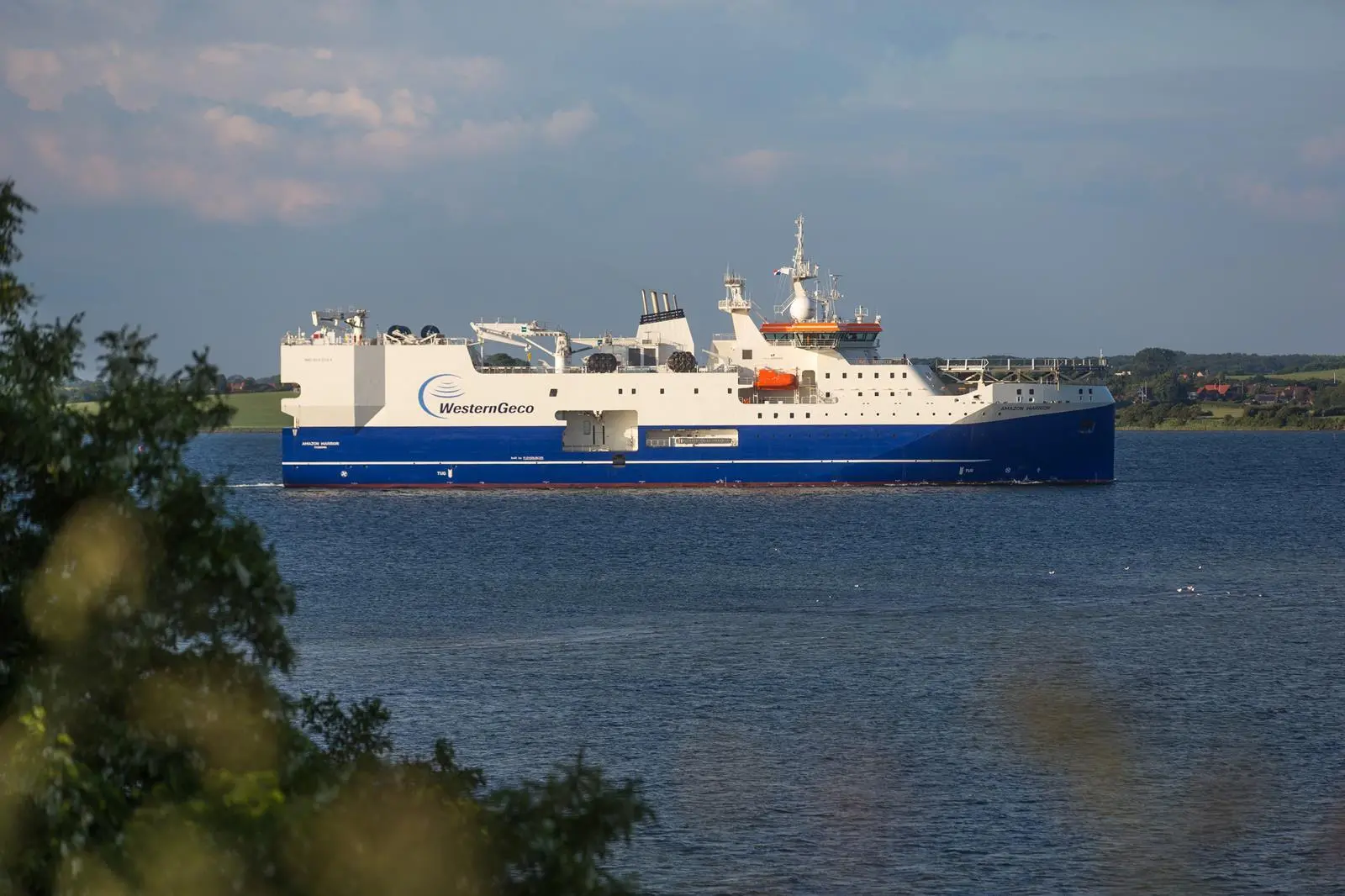
This impressive new entrant into the expanding global fleet of deepsea seismographic research ships embodies a bespoke design to support WesternGeco’s leading-edge survey and data gathering systems, enhance overall performance in adverse weather conditions, and provide an optimum operating platform in terms of overall cost and fuel efficiency.
The requirement for purpose-built tonnage incorporating the most sophisticated seismic survey systems arises from the offshore oil and gas industry’s resurgence and drive into deeper waters and new, environmentally hostile frontiers. A principal driver is hydrocarbon exploration and production (E&P) in geologically-complex areas such as the offshore regions of Brazil and West Africa, and the Gulf of Mexico, as well as new endeavours in Arctic and sub-Arctic latitudes. Furthermore, the capability to efficiently obtain high-fidelity data in testing conditions is apposite to the industry’s bid to maximise resource exploitation in mature basins, such as the North Sea.
Worldwide capital expenditure on oil and gas E&P has risen substantially over the past 10 years, with growth of about 5% in 2014 and there are indications that activity will continue to increase in 2015 and beyond. According to industry sources, marine seismic survey represents around 1.5% of the global E&P spend.
The 21,195gt Amazon Warrior, the largest in the fleet controlled by WesternGeco, has been conceived to work anywhere worldwide, including Arctic waters. She is the first of two sisters contracted for the UK-headquartered company from German shipbuilder Flensburger Schiffbau-Gesellschaft, where second-of-class Amazon Conqueror is at an advanced stage of outfitting.
Following delivery in June 2014, Amazon Warrior was mobilised for a 1,700km² survey in the Douala Basin off Equatorial Guinea, on behalf of Noble Energy. Wherewithal carried by the ship to enable her to fulfil the high-resolution 3D survey includes proprietary Q-Marine solid streamer technology and the ObliQ sliding-notch, broadband acquisition and imaging technique.
At 126m in length and 28m-31m in width, the vessel has been developed as a large, powerful, manoeuvrable and stable platform that can maintain her data gathering role in inclement sea and weather conditions. Flensburger carried out seakeeping analyses and tank testing, undertaken at Force Technology’s premises in Denmark. One of the main outcomes of the closest attention to motion characteristics is the knife-shaped bow to reduce slamming, so as to enhance streamer control and minimise associated noise issues, a vital factor in obtaining ’clean’ seismic data.
The wide back deck is laid out for the deployment of 18 seismic streamers, with a total streamer capacity equivalent to more than 200km, and the means of simultaneously deploying or recovering four streamers. Ample working space facilitates reconfiguration of streamer layouts while under way.
The ship design process involved the use of advanced 3D visualisation tools to create ‘virtual’ versions of key working areas, with experienced maritime and seismic crews providing feedback to help ensure the practicality, safety and efficiency of final arrangements.
Seismic and engineering workshops, stores, and supply handling are all on the same level and located as close as possible to the relevant equipment or machinery. The main deck is located at a height and protected to minimise the potential for wave ingress. Crew cabins have been designed and located for optimal rest. In addition to the forward mounted helicopter deck for offshore crew changes, a built-in offshore gangway is available for at-sea transfers of personnel, obviating the need for use of small craft. Workboats for replacement of streamer sections and other tasks are located in both the port and starboard sides of the hull.
In the context of the vessel’s worldwide operational scope, the array of DNV GL class notations denotes strengthening to PC-7 standard, the Polar Class level comparable to Finnish-Swedish ice class 1A, for navigation in ice thickness to 0.8m, corresponding to first-year summer or autumn ice.
Full redundancy in the propulsion and steering systems reduces safety risks and ensures production continuity in the event of a breakdown, and also enables maintenance to be conducted during ‘live‘ operations. Machinery is distributed between two independent engine rooms, port and starboard. The remarkable design has been conceived for a production endurance of 120 days, in the interests of project efficiency and market competitiveness and operational practicalities in remote exploration areas.
Amazon Warrior employs a diesel-mechanical main propulsion drive with the facility for propulsive power to be augmented through a hybrid PTO/PTI (power take-off/power take-in) shaft motor arrangement. In an all-Wärtsilä propulsion system, 9L32 diesels drive two 4E1415-type controllable pitch propellers in nozzles through SCH116 reduction gears, allowing the ship to make around 17.5 knots. In its 580kW per cylinder version, the Wärtsilä 9L32 has a nominal power rating of 5,220kW, while the 500kW/cyl model yields 4,500kW.
The electrical power arrangements are extensive, encompassing two shaft generators plus four diesel generator sets, two of which are based on Wärtsilä 7L32 engines, each of 3,500kW, with the two others using 6L20 units, of 1,200kW apiece. The emergency generator is driven by a D2842 series diesel from MAN’s Nuremberg stable.
The Wärtsilä outfit also embraces the two forward, electrically-driven manoeuvring devices, in the form of an FS1510 retractable azimuth thruster and FT200 tunnel thruster.
The powering and propulsion system as a whole has been engineered for optimum vessel performance and economy during both seismic mode, the predominant at-sea operating period when a low speed is maintained, typically at around five knots, towing large seismic arrays. During transit mode, passages from port to port or project to project are made at up to 17 knots. The ship operates on marine gas oil, and it is claimed that, in seismic mode, the design offers the lowest fuel consumption in relation to the towed footprint.
Through the WesternGeco contract, the German shipbuilder has broken new ground, moving into the promising offshore sector after more than 15 years’ orientation towards the ro-ro and ro-pax markets, in which it has recently also secured fresh business.
The medium-scale yard’s retention of a large in-house design department and unerring commitment to R&D, coupled with its reputation for quality, design added-value and on-time construction, stood it in good stead in landing the latest and boldest stage of fleet investment by WesternGeco, the world’s largest seismic company, part of the Schlumberger group. WesternGeco’s previous generation of high-capacity seismographic research ships was distinguished by the embodiment of the Ulstein X-Bow hull form.
The bridgehead gained by Flensburger in a capital-intensive and technology-intensive segment of the offshore market was consolidated earlier this year when it landed a deal from Siem of Norway for two 158m well intervention vessels. Immediately after delivery in 2016, these ships will take up charters with Helix Energy Solutions for operations in Brazilian offshore waters.
PRINCIPAL PARTICULARS — AMAZON WARRIOR
Length overall: 126m
Lengh bp: 119.6m
Breadth, moulded: 28.0m
Breadth, maximum: 31.0m
Depth: 9.5m
Draught, design: 7.0m
Draught, maximum: 7.15m
Gross tonnage: 21,195gt
Deadweight: 6,866dwt
Capacity, streamer tow points: 18
Main engines: 2 x Wartsila 9L32
Speed: 17.5 knots
Accommodation, single berths: 76
Class: DNV GL
Notation: DNV 1A1, PC-7 Winterized Basic, SPS, SF, COMF-V(2)C(3), HELDK, RPS, E0, NAUT-OSV(A), CLEAN DESIGN, BIS, TMON
Flag: Panama
Related Articles
 PROPULSION
 GENERAL NEWS
 HYDROGEN