



Jones Act Aframax gives new dimension to US shipbuilding
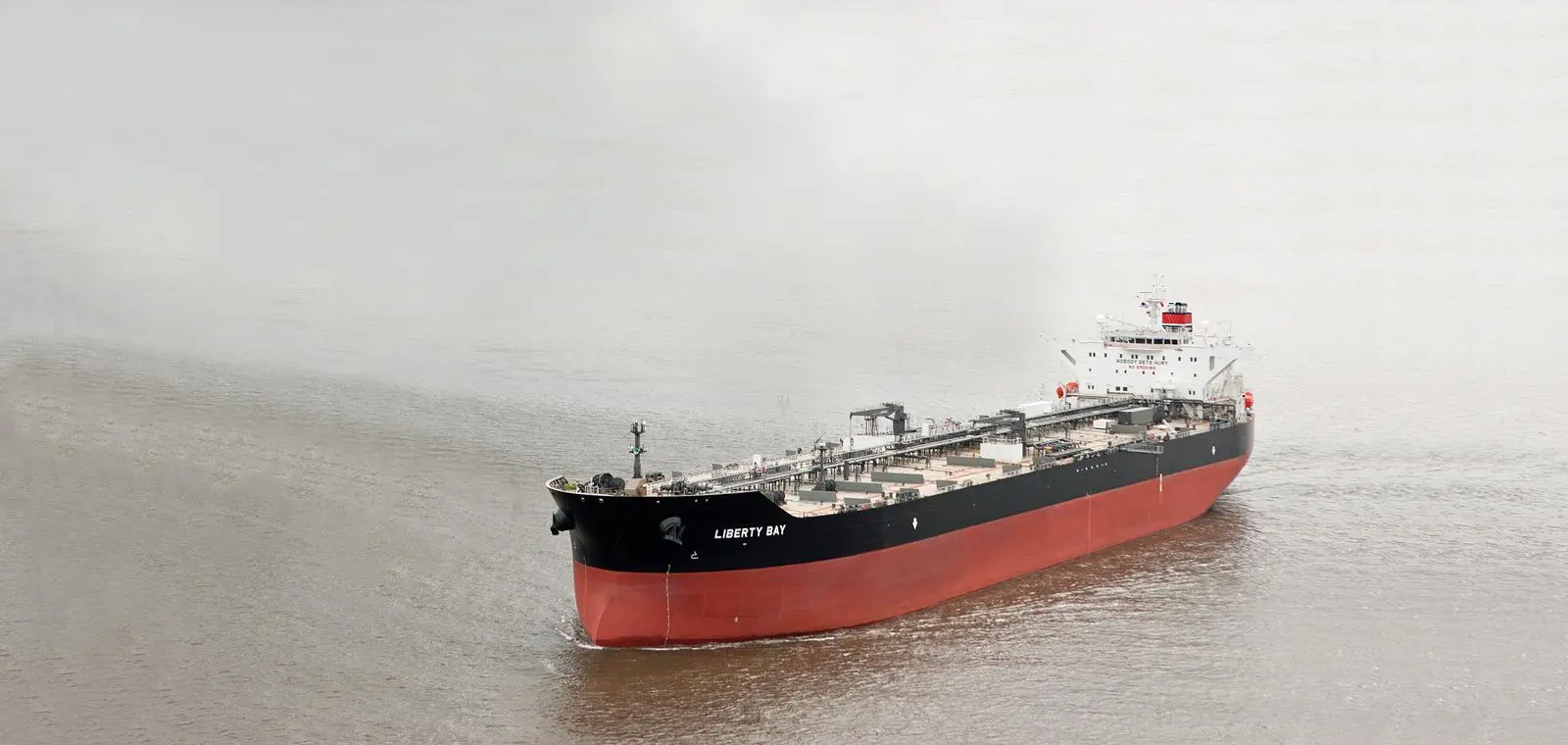
The 115,000dwt Aframax tanker Liberty Bay was contracted by Exxon Mobil Corporation’s marine affiliate, SeaRiver Maritime, and is the first of two sisters designed to transport Alaskan North Slope crude oil from Prince William Sound, Alaska, to refineries along the US west coast in California and Washington state.
SeaRiver’s US$400m deal for the South Korean-designed tanker duo has delivered a significant economic boost to the greater Philadelphia region, and the commissioning of the lead ship denotes a new milestone for the shipbuilding enterprise formed in 1997 under the name Kvaerner Philadelphia Shipyard.
Located on the site of the former naval shipyard, which closed in 1995, the new production complex was completed in 2000, utilising European shipbuilding technology. Focused on the domestic or ’Jones Act’ market, the yard’s output to date has primarily entailed containership and product carrier capacity. The Liberty Bay class gives wider dimension to Aker Philadelphia’s portfolio, and the latest advances embodied in the new ships, destined to replace two 1978/79-built double-hulled tankers, the Kodiak and Sierra, will allow SeaRiver to realise operational efficiency gains in the coastwise traffic.
While the US yard has made substantial recourse to Hyundai Mipo Dockyard (HMD) design know-how in its production of multiple product carriers, the Aframax newbuilds embody the design input of Samsung Heavy Industries. Redundancy in key systems, energy efficiency and heightened performance levels were key goals. To this end, SeaRiver consulted with independent specialists to complete an extensive evaluation of the vessel’s design using failure mode and effects analysis (FMEA). The methodology was applied to the analysis of key operating systems under a variety of scenarios at sea.
Liberty Bay is powered by a single MAN two-stroke engine, a six-cylinder model of the S60MC-C8.2 type, yielding 13,560kW at maximum continuous rating (MCR) with 12,200kW at normal continuous rating (NCR), and providing direct drive to a fixed pitch propeller. The arrangements confer a service speed of 15 knots. The three main gensets are driven by 925kW Yanmar diesels.
While the main engine, and the auxiliaries, ensure an IMO Tier II level of compliance for air emissions, the vessel uses low-sulphur diesel oil for all near- and in-port operations. Energy efficiency features include the main engine auto-tune and Alpha lube systems and the combination waste heat boiler.
The new tanker has the capacity for 1,698m³ of heavy fuel oil plus 1,256m³ of diesel, and the entire 800,000-barrel (130,000m³) cargo section plus fuel tanks is bounded by a double hull. The segregated water ballast spaces afford a total volume of 39,900m³. Cargo handling is effected using three steam turbine-driven pumps, in an integrated control system with radar tank level monitoring.
The type-approved BalPure ballast water treatment system from Severn Trent De Nora was selected for SeaRiver’s new Aframax class. Installed as a sub-assembly, the BP3000 system utilises electrolytic disinfection technology and is capable of treating ballast water flow rates of up to 3,230m³/h. BalPure employs proprietary self-cleaning electrodes that are claimed to eliminate the need for time-consuming chemical and mechanical maintenance.
The bridge outfit includes Furuno X-band and S-band radars, Yokogawa autopilot and steering stand, and Transas ECDIS with radar overlay, plus a ship movement information display system(SMIDS) from AMI Marine. Highly sensitive and accurate to 0.01 knots, SMIDS detects and displays vessel movement instantly, often before this is visibly apparent, assisting bridge personnel to ensure precise control and take corrective action at the earliest opportunity, especially in confined waters or difficult conditions.
SeaRiver Maritime’s second-of-class Aframax, Eagle Bay, is expected in service towards the end of 2014, to be followed through 2015 and 2016 by four 50,000dwt product tankers for a joint venture comprising Crowley Maritime Corporation, Aker Philadelphia and various affiliates. The quartet has a total contract value of approximately US$490 million. The orderbook otherwise comprises two 3,600teu containerships, due to be commissioned by Matson Navigation Company in 2018. These vessels, commanding a total US$418m, will be the largest boxships ever built for the Jones Act market, and will be employed in Matson’s trade between the US west coast and Hawaii.
The yard is set to add two 50,000dwt product tankers to its forward construction programme, thereby taking on delivery commitments in the fourth quarter of 2016 and opening quarter of 2017, respectively. Worth some US$250 million, the order will be to the account of the newly-formed Philly Tankers, a Norwegian limited liability company with a wholly-owned subsidiary of the same name in Delaware. The deal will carry options on third and fourth newbuilds for completion in 2017.
Aker Philadelphia will have a 54.5% stake in Philly Tankers, which will deploy and charter the vessels in the Jones Act market, employing a shipmanagement specialist for maintenance and crewing and to ensure full regulatory compliance. Options will also be considered as regards commercial management of the tankers.
The vessels will be based on a proven Hyundai Mipo Dockyard design, identical to that of the four tankers currently in hand at Aker Philadelphia to the account of the joint venture between the shipbuilder and Crowley, and similar to the 14 product carriers delivered by the yard between 2007 and 2013. As with the preceding quartet of 330,000-barrel capacity newbuilds, Philly Tankers’ tonnage will be prepared and configured to allow for LNG-fuelled main propulsion at some future stage.
Aker Philadelphia is listed on the Oslo Stock Exchange and is 71.2%-owned by Converto Capital Fund, which in turn is majority-controlled by Norwegian industrial investment firm Aker ASA.
PRINCIPAL PARTICULARS —
LIBERTY BAY
Length overall: 251.0m
Breadth, moulded: 43.8m
Draught, summer: 15.0m
Deadweight: 115,000dwt
Cargo capacity: 130,000m³
Main engine power, MCR: 13,560kW
Main engine power, NCR: 12,200kW
Service speed: 15 knots
Auxiliary engines: 3 x 925kW
Staterooms (cabins): 28
Class: ABS
Notations: +A1(E), Oil Carrier, CSR, AB-CM, ESP +AMS, +ACCU, CPS, TCM, SPM, UWILD, VEC, GM, Enviro
Flag: USA
Related Articles
 PROPULSION
 GENERAL NEWS
 HYDROGEN