



Island Performer: inventive inheritance
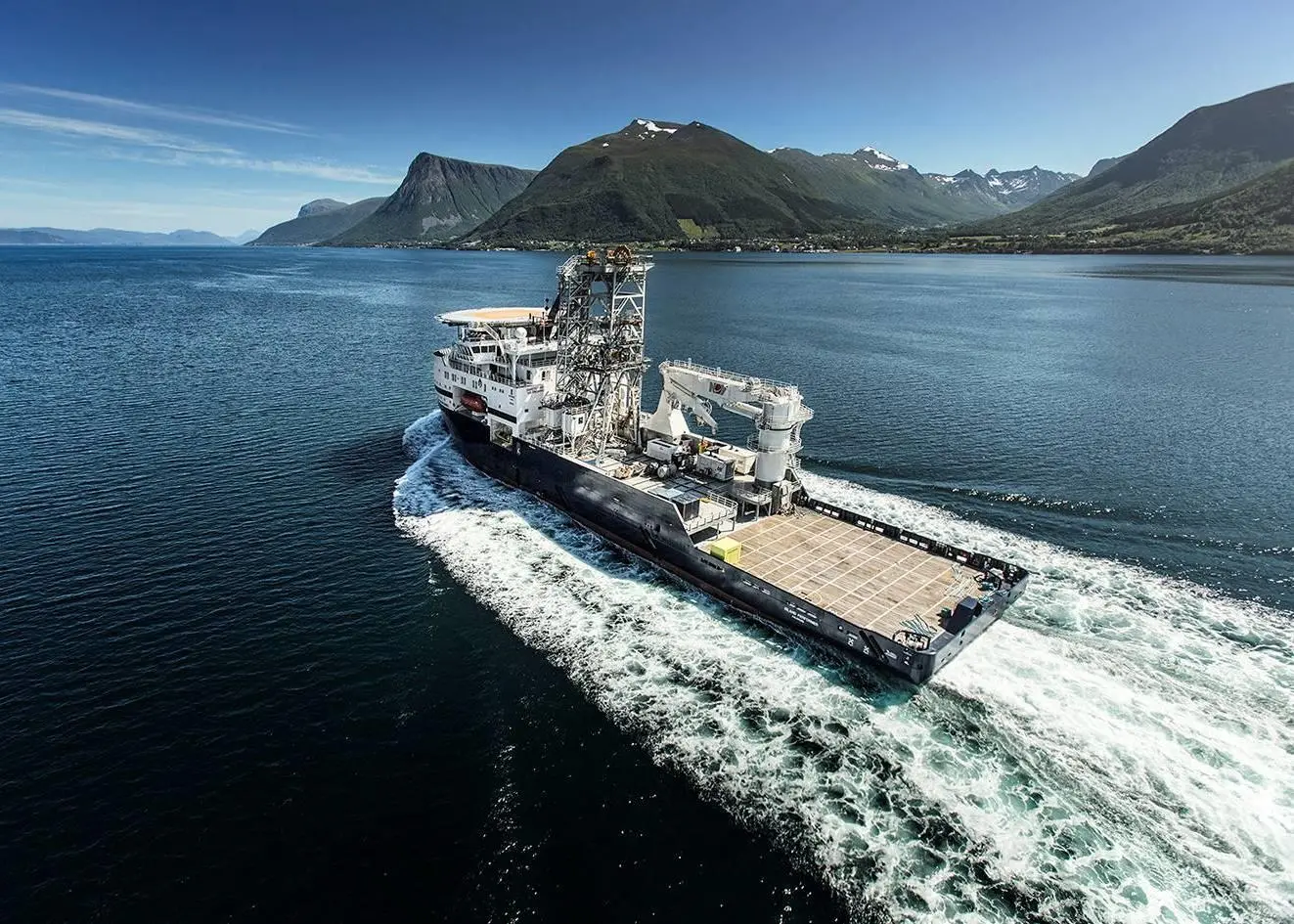
As there’s no holding back the tide or the market, the challenge centred not simply on innovation but also timing. But the only way to get a large and complex crossover vessel into the water quickly is to have a “technology backbone” already in place, says Håvard Stave of Ulstein Verft; in this case it was provided by the previous delivery, Polar Onyx.
In fact the 130m Island Performer has inherited more than design from one of its forebears, it has gained a whole module handling tower. This came from the SX121 Island Intervention, originally Karianne, one of a pair of vessels orphaned by the financial troubles hitting Marine Subsea (its sister Sarah being picked up by DOF Subsea to become Skandi Constructor).
When after a few years of RLWI/IMR work the Island Intervention was turned over to IMR/subsea duties and gained larger 250 tonne crane, the switch left its module handling tower looking for a new home.
Far too nice a piece of kit to let go, this same module tower has now been subject to an upgrade “to reflect the latest developments” says Mr Stave, and placed on Island Performer to sit over its capacious 8m by 8m moonpool. The 31m tower is rated for a safe working load of 150 tonnes, with both active heave and constant tension modes, operable down to 2,500m water depths.
Obviously this helped the lead time enormously, as a new tower takes a significant time to build.
Mr Stave’s colleague, naval architect Bjørnar Hatløy of Ulstein Design & Solutions, describes how Island Performer has been ‘sculpted’ to suit its focus on RLWI work. A shelter deck increases the operational window for moonpool work and offers a shielded space for deck operations: in fact this shelter stretches all the way past the main moonpool and aft to the main crane, allowing a multi-skidding system that can handle 100-tonne pallets to be more easily used in harsh conditions.
The design includes a reinforced, heavy-load cargo deck, both for handling exceptionally heavy equipment and construction work, for operations down to around 3,000m. Supporting this is the kit: an active heave compensated offshore crane with a below-deck winch: this gives a capability of 250 tonnes at 14m extension or 83 tonnes at the full 36m outreach. Alongside this are two deep-sea, tooled up work ROVs: one of these is to be launched through a 5m square dedicated ROV pool and the other from the starboard side.
In the centre, the helideck has been expanded to the new 26m rules, and moved from its usual forward position, now placed closer to the midsection of the vessel, “sliding it around 14m further aft” says Mr Hatløy. This reduces the ‘see-saw’ effect and increases the weather window for crew changes.
Propulsion has been designed to give an all-round optimum, and the trademark Ulstein X-bow has been combined with three huge nozzled 3.2m diameter fixed-pitch azimuthing thrusters that can be controlled, via a frequency converter, to give zero to 3,000kW output or up to 1,200 rpm. One retractable-swing-up 2,000kW, controllable pitch azimuth thruster and two, forward positioned side thrusters giving 2,140kw each complete the set and give the vessel its crucial station keeping capabilities. “The thrusters are super silent and allowed us the DNV1 noise notation; actually they are more in line with a cruise ship than an offshore vessel,” says Mr Hatløy.
All of this is fed by six main 2,880kW generators: “The six-engine configuration was an upgrade, giving us more resolution for the machinery, better loading and redundancy,” he adds. All in all, “the Performer is safer, greener and smarter”, says Mr Stave, “We’ve got fuel consumption down and emission figures down, along with a lower risk of oil spills.”
Further, its DP3 configuration allows the vessel to stay in place for longer even if there’s a fault, he explains: “It means even if there’s some issue, the vessel can round off an operation in a proper manner rather than cause serious delays by suddenly needing to break off work.”
However, the relatively newness of this particular market creates its own challenges. Particularly germane is the fact that Island Performer, like Polar Onyx, has grown its accommodation from 90 to 130 people, and this by itself means that the original design’s SPS requirement layout had to be quite a sophisticated balancing act. But, given that the Performer is to have some drilling operability, the ship’s need to additionally be prepared for compliance with IMO MODU (2009) code presents a less than easy job; one that has meant going through the vessel with a fine-toothed comb.
Even with the yard, vessel owner and class society working together to close any gaps in criteria it remains a challenge to keep an eye on everything. “You need to retain that overview on exactly what is relevant to each code at every step of the process,” explains Mr Hatløy. A system-by-system statement of compliance that covered both was made all the more difficult because of a difference in the way the codes are resolved. “For example SPS stability parameters are probabilistic whereas the MODU code compliance is deterministic – so we had to do some detailed sums, finally calculating we needed to maintain the integrity to 1.5m all the way across the vessel,” he explains.
One important point underscored by Mr Stave was the parameters are less fixed than for the more ordinary, much smaller classes of OSVs which can come ready-designed with few changes or challenges.
He explains that collaboration is the bedrock of Ulstein’s design process: “Even after signing the contract, it’s a spiral of evolution every day.” Part of this means readying the ship for upgrades or later conversion. In the case of the Performer, this meant preparing the ship for installation of a 2,500 tonne below deck carousel should a contract require it.
“We sell the ship in just one day, but the owners have to sell it every day of its life,” concludes Mr Stave.
MAIN PARTICULARS – ISLAND PERFORMER
Length oa: approx 130.0m
Length bpp: 122.1m
Breadth, moulded: 25.0m
Depth to main deck: 10.0m
Freeboard to main deck: 2.4m
Freeboard to shelter deck (moon pools): 5.35m
Scantling draught: 7.6m
Design draught: 7.0m
Related Articles
 PROPULSION
 GENERAL NEWS
 HYDROGEN