



From submarines to support vessels
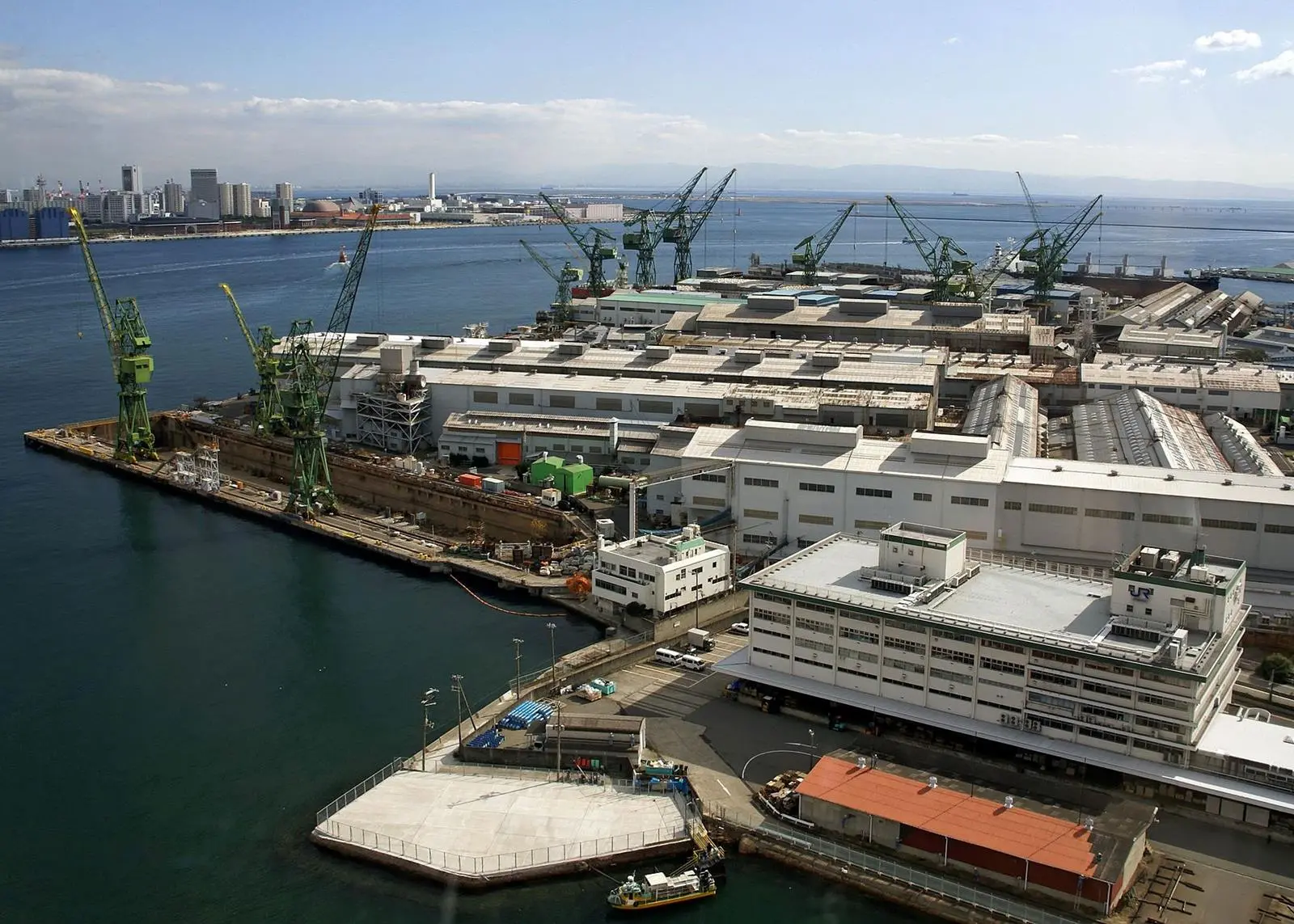
But this would not be doing justice to the yard’s history. Though Kawasaki is better known in some circles for motorcycles, Kawasaki Heavy Industries (KHI) began at the end of the 19th century in shipbuilding, with a yard at Kobe, branching out to a bigger space in Sakaide. Despite years of diversification and the long winter of recession that swallowed almost two decades of Japan’s development, the yards kept going, scraping through with some downsizing.
KHI endured and, with Chinese interest springing not one but two shipbuilding facilities – Nantong (NACKS) and the Dalian (DACKS) – into being in the early part of this century, it even thrived. Just three years ago Brazil also reached out to KHI, putting the company in an enviable position.
While these larger yards went chasing big contracts, the smaller facility at Kobe kept quietly ticking over. One of the main elements of Kobe’s survival during the hard years was its military contracts, building a reputation for sophisticated and dense craft which include the Kairei research ship and a deep submergence rescue vehicle (DSRV). Importantly, it included Japan’s first submarine back in 1906, a strand that has developed since with delivery of more than 80 subs, up to the latest Soryu class at the Kobe yard.
The details are relevant. Packed into an 84m length and tiny 9.1m beam, the sub’s engines are optimised for endurance, controls are graphically supported, loud components are acoustically isolated and needless to say, the whole diesel electric design incorporates a number of highly automated systems.
Sounds familiar? It hasn’t escaped KHI that this ability to bring automation together within a tight space is an overriding value-added factor in offshore support builds. KHI’s belief it can hold its own in the competitive offshore arena rests on several factors: Hodaka Shimizu, senior manager of KHI’s offshore units design department says: “My impression is that Europe, especially Northern Europe, is very, very good at innovation, in other words at knowing what needs to be developed… on the other hand we, as a Japanese company, are good at knowing how to put the design into a product.”
Further, while cost considerations have resulted in European facilities commonly outsourcing their hulls to Eastern Europe, “these vessels still need a lot of equipment installed after being towed into the home yard, resulting in holes being cut in the hull or deck,” he explains.
By contrast, KHI was forced to plot a different course in order to survive Japan’s economic squeeze. The strategy that proved successful was exactly the reverse of Europe’s: keeping it at home. Even with a presence in Nantong and Dalian, KHI still doesn’t outsource hull construction to China.
Mr Shimizu explains that KHI’s survival instead rested on tying the build down to one spot, tightening the construction processes. “What this meant for us was developing our pre-outfitting capability. So, we don’t do a lot of the work on the slipway or in the dock, but actually on the flat, in the nearby assembly shop.”
For example pipework can often be near-completed by the time it is introduced to the vessel. While cabling is a little harder, all lengths are measured, cut and identified with start, end and descriptions before being spooled onto a drum.
However, a reality check is necessary at this point: the 3-D model for one of those sophisticated submarines looks more like a multi-coloured ball of wool than a vessel, so how is it carried out?
Although KHI is involved in extremely advanced aerospace and automation technology, surprisingly Kobe doesn’t rely on clever laser welding machines. Despite the nature of the products the tools themselves are “fairly standard and nothing special” says Mr Shimizu. He adds that while high-tech machinery is useful in its place, the largest element is understanding the processes “and the yard has had more than 100 years of submarine construction” to perfect its methodology.
He explains that exact sequencing and timing underpin extremely dense builds such as the UT777: “Our construction department starts to collaborate at the very beginning of the design stage. For example, even the size of the steel plate and type of metal has an effect on the build strategy and the schedule is again tied very closely into procurement. What we have is a very effective interface between all the departments.”
The flow round the workshop has been developed so that there are no unnecessary moves between stations. And if the customer wants a change or two? At the last moment? The answer is simple: “Yes, it’s possible, but it will put the overall cost of the build up.” However, rather than stagger into unknown territory, KHI can forsee the increase in terms of not just alternative equipment but also execution. This approach allows the yard to offer a series of options to keep down extended costs.
So, says Mr Shimizu: “We don’t intend to replace Northern Europe when it comes to technical innovation, but we think we can offer something different when it comes to the build process of a large offshore vessel”. Bringing the two sides together should equal a whole that’s greater than the sum of its separate parts.
Related Articles
 PROPULSION
 GENERAL NEWS
 HYDROGEN