



The UT story: 40 years of vessel success
In 1974 The Motor Ship published an article on a new offshore supply ship design from a little known shipyard on the west coast of Norway. The yard was Ulstein Hatlo and the vessel the first UT 704. Now, 40 years later the UT designation has become synonymous with a huge family of designs serving a variety of offshore functions but all with the UT prefix.
Today the family is Rolls-Royce owned following the UK group’s acquisition of the rights to use UT with its purchase of the Ulstein Group from Vickers which had bought the various divisions of Ulstein except the shipbuilding operation a few months earlier in 1999. Now 40 years on there are close to 800 examples of UT vessels either in service or under construction.
FIRST OF THE FAMILY
The UT 704 was designed by Sigmund Borgundvåg as a multi-purpose anchor handling, tug, supply (AHTS) vessel with good sea keeping qualities and a large cargo capacity, particularly on deck,. The first of 91 examples of the 65m long, 7,040bhp vessel to be built in Norway, and in yards around the world, was the Stad Scotsman for Stad Shipping of Alesund. This vessel is still operational, with many modifications and updates over the years, as the Seabulk Condor of Seacor Marine. The last UT 704 was delivered in 1993.
Following the initial success of the UT 704 further designs were developed in the mid-1970s such as the UT 705 (the first of 31 built being the Tender Carrier) and UT 706 platform supply vessels (PSVs). Meanwhile development of new propulsion arrangements were taking place – the UT 709 design of 1979 was the first to adopt diesel electric propulsion, and in 1982 the UT 705 Stad Ulstein incorporated azimuth thrusters for the first time,
In 1984 The Motor Ship featured the Ulstein-built AHTS Star Polaris, the first Mk. III version of the UT 704, for Aberdeen-based Star Offshore Services. The many improved features of the vessel include larger and slower turning propellers than earlier UT 704s, Becker rudder, 800bhp bow thruster, 250 tonne triple-drum winch, Ulstein’s passive stabilising system, and joystick manoeuvring control.
In 1996 the UT 755 PSV design was introduced which has gone on to be built in large numbers; to date more than 200 are in service or on order.
WAVE PIERCING
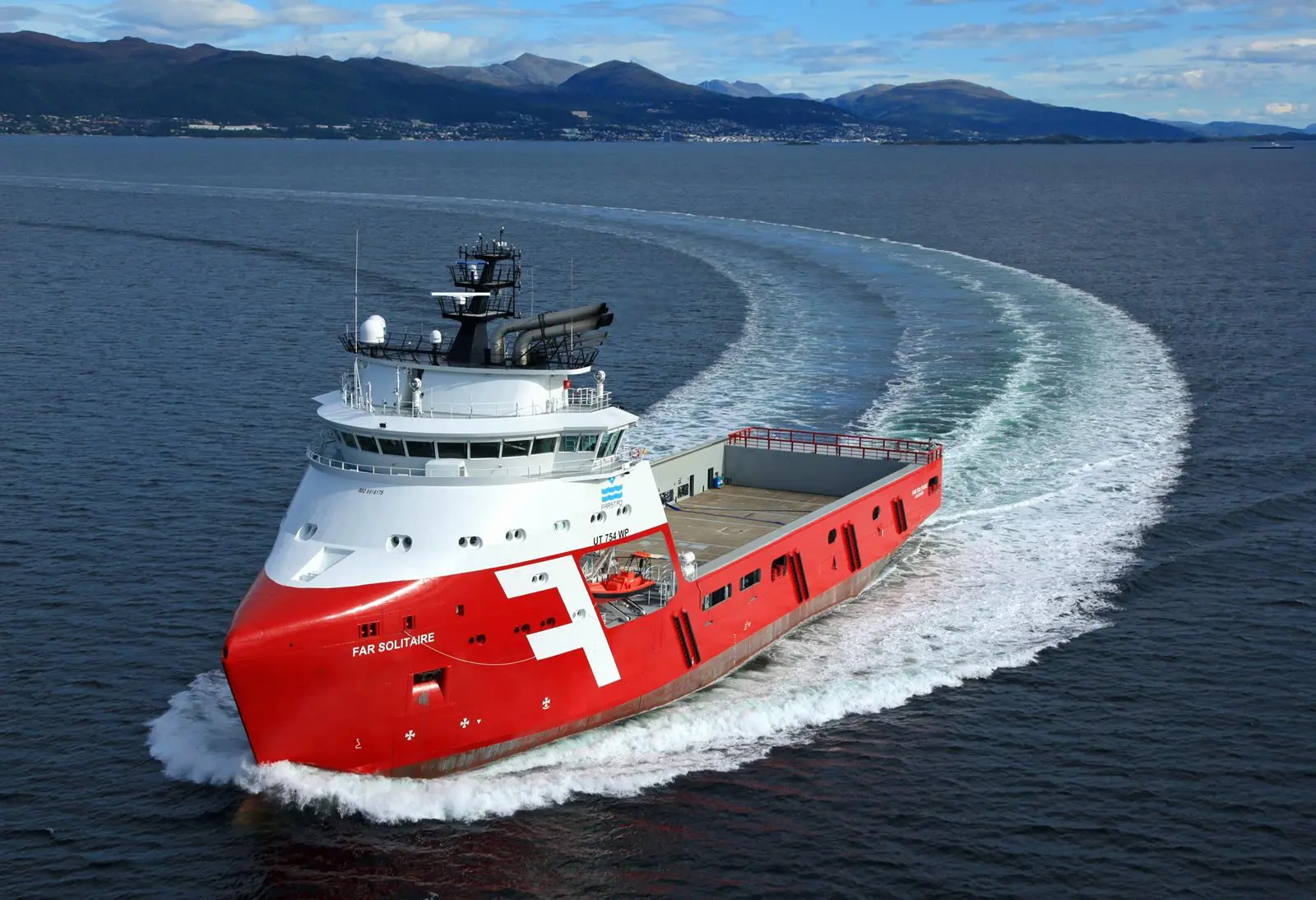
In 2013, an advanced supply vessel of Rolls-Royce design owned and operated by Farstad Shipping entered service. Named Far Solitaire and given the type name UT 754 WP, it has been developed by Rolls-Royce and Farstad working closely together, with good support from the classification society DNV.
Far Solitaire’s most striking visual feature is its wave piercing bow developed by Rolls-Royce for optimum sea keeping qualities, improved crew comfort and reduced fuel consumption. It was the first vessel to enter service with the new bow design, but equally important is its very large capacity for carrying hazardous and noxious liquid cargo, without prejudicing its other supply functions. The UT 754 WP can carry much more than the usual 800m³ limit of hazardous and noxious liquid cargo, as defined by IMO Res. A.673(16), IBC code Chap 2. The reason is the newly revised wording of the resolution, which in practice now classes drilling mud and brine as hazardous and noxious liquids, because they contain chemicals that are so listed. The amounts mixed in may be small, but the whole volume of mud or brine then comes under the same category.
Since a North Sea supply boat load of mud and brine would typically be in the 1,000 to 1,200m³ range, this means that either loads would have to be cut to less than the 800m³ limit, or a new solution found to allow the desirable amount to be carried per trip, while still complying with the rules. The UT 754 WP solves this. While not a chemical tanker, it meets the damage stability rules and ventilation requirements for chemical tankers, together with other design features, and is approved for carrying more than 1,600m³ of noxious liquids. Slop and backload tanks are equipped with hydrogen sulphide (H2S) detection and alarm systems.
The vessel, built by STX Offshore Norway, was the first to be equipped with the new Rolls-Royce Dual Draglink cargo rail crane. Installed on the starboard cargo rail, it features increased lifting height, with efficient vertical and horizontal load handling. A new shore connector system allows shore power of any voltage and frequency to be used independently, or in parallel with the ship’s generator to cut emissions in port.
MULTIPLE USES
Over the years UT vessels have been designed for a wide range of applications including subsea construction, anchor handling, seismic work and top hole drilling.
Subsea construction calls for vessels with offshore cranes and other equipment that enables them to accurately position heavy modules on the seabed. Many of the vessels built to date are basically large platform supply vessels fitted with a crane and systems for deploying ROVs. Now Rolls-Royce has developed a family of subsea construction vessels under the designation UT XXX SCV. Vessels differ in size, mainly based on the capacity of the offshore crane which can range from 150 to 600 tonnes. Beams offered are 21m, 23m, 25m, 28m and 30m. The hull is optimised as a working platform with low motions in a seaway and has the ability to meet DP3 dynamic positioning rules.
The design with its large open deck area can be configured for different tasks. In addition to construction, it is prepared for a tower, top hole drilling and well intervention, and with its ROV hangar and handling systems can carry out subsea inspection, maintenance and repairs.
A length of 123m overall has been chosen for the 23m beam member of the SCV family, providing a deck area, excluding the moonpool, of 1,400m². An offshore crane rated at 250 tonnes is mounted on the starboard side and the ROV hangar has space for three ROVs with the option of an ROV moonpool. There is accommodation for a total of 120 under the SPS2008 rules. The UT XXX SCV has a flexible diesel-electric propulsion system with two main azimuth thrusters at the stern, and tunnel and retractable thrusters forward. It will meet ERN 99,99,99,99 standard for propulsion redundancy.
The 92m long UT 790 WP anchor handler design integrates efficient and safe deep water anchor handling, easily driven and sea-kindly hull lines with reduced emissions and enhanced crew safety and comfort in a single package.
Shifting moorings in waters up to 2,000m deep requires a high bollard pull, which in turn demands stability. The UT 790 WP has a bollard pull of 250 tonnes, and a top speed of 17.5 knots but can cruise economically at 12 knots. The design is scalable, allowing owners to go for higher or lower bollard pulls. The design has a hybrid propulsion system – two Bergen main engines totalling 12,000kW drive CP propellers via reduction gears with shaft generators. Four Bergen gensets, each rated at 1,843kWe, supply electrical power when required. In some operating modes the shaft generators supply all electrical loads, in others the main engines can be shut down and the shaft generators act as motors, turning the main propellers, which are supplemented for DP and manoeuvring by two tunnel thrusters and a retractable azimuth thruster forward and two tunnel thrusters aft.
Rolls-Royce is no stranger to seismic vessel design, and since the acquisition of Odim it can provide a range of seismic handling equipment as well as designs and systems for the ship. For example the UT833 WP is an advanced seismic survey vessel design for present and future needs with specification options to suit individual owners’ requirements. It can deploy 18 streamers each 10km long plus the air gun array. The design has a bollard pull of up to 180 tonnes and a claimed highly competitive fuel cost per square kilometre surveyed.
The 110m long ship has a hybrid propulsion system that includes a Promas/InnoDuct. In normal seismic mode the UT 833 WP has a range of about 10,000 nautical miles, or 30,000 naut mile at a 14 knot cruising speed and an endurance of up to 80 days with 72 people on board. As surveying work is increasingly carried out in the Arctic, the design can be delivered with de-icing and Ice class.
LATEST DESIGN
The UT 777 CD is a new offshore vessel design that can undertake a variety of subsea tasks, including top-hole drilling, subsea construction and inspection, and maintenance and repair work in deep waters. It can also be adapted to undertake light well intervention. It has been developed in close cooperation with the Norwegian owner Island Offshore, to be used in offshore drilling operations during harsh weather conditions. The vessel (classed as a mobile offshore unit, or MOU) will be built in Japan by Kawasaki Heavy Industries and is scheduled for delivery in 2017.
The new design is based on many years of operating experience, especially from the Island Wellserver, which was designed in 2005. InterestinglyStig Ole Borgundvåg, the son of UT 704 designer Sigmund Borgundvåg, is responsible for the design.The Ice-class vessel will have DP3 dynamic positioning and comfortable accommodation for 91 people. It will be 168m long with a beam of 28m and will incorporate an enclosed module handling tower to ensure a safe and comfortable working environment for the crew while operating in harsh and cold conditions. The high operability extends the number of days it can continue to work in the North Sea (said to be up to 90% of weather conditions) and at the new frontiers in the north.
Rolls-Royce is to supply the design and engineering package together with the main ship systems, including the six main diesel generator sets powered by Bergen B32:40 series engines, the propulsion and positioning system of three azimuth thrusters at the stern and two retractable azimuth thrusters, plus two tunnel bow thrusters. The supply includes the control, automation and low voltage systems, a full outfit of anchoring and mooring winches plus a cargo rail crane and a bulk cargo handling module.
Related Articles
 PROPULSION
 GENERAL NEWS
 HYDROGEN