



Offshore crew transport gets larger and faster
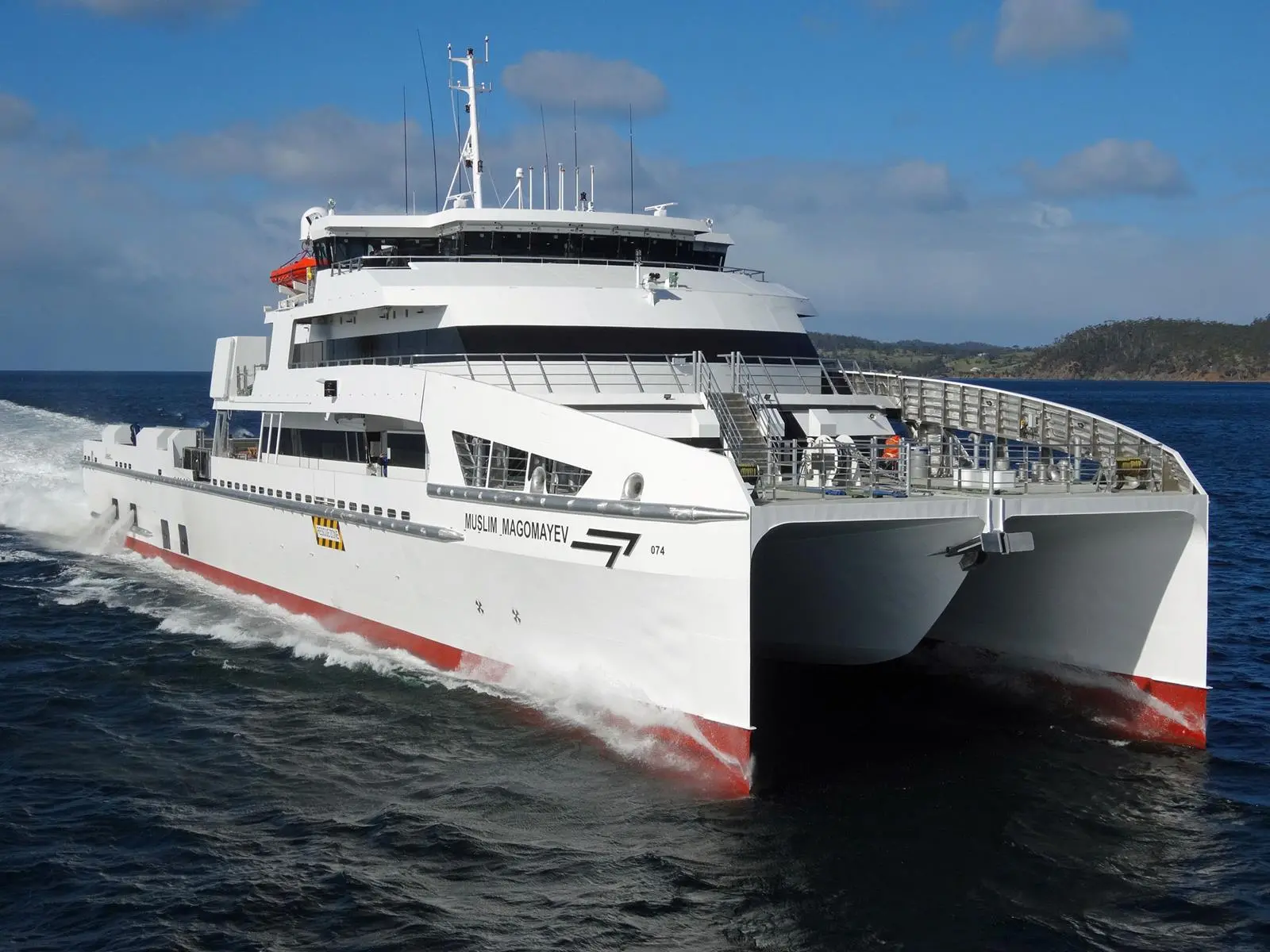
Crew boats for offshore oil and gas installations have traditionally been rather on the small side for The Motorship – more workboats than ships. But in common with other classes of offshore support ship, crew boats have been growing in size, and many now offer a decent cargo capacity as well as seating for personnel being transferred to and from offshore installations. As befits its builder’s main area of expertise, Incat’s new vessel – a 70m catamaran named Muslim Magomayev owes more to high speed ferry practice than crew boat design.
The ship was undergoing sea trials in September, and was due to be delivered to Baku, Azerbaijan, by the end of the month.
This is the first vessel that Incat Tasmania has purpose built for the oil and gas industry. During construction over the past year the fast crew boat was referred to simply as Incat hull 074 but is now bearing the name Muslim Magomayev in honour of a popular Azerbaijan singer Muslim Magomayev who died in 2008, and said to be the former Soviet states’ equivalent to Frank Sinatra.
The vessel will be used by Caspian Marine Services to operate fast crew transfers for up to 150 offshore workers to multiple installations in the Caspian Sea. The high speed of the ship is claimed to offer more efficient transport for passengers and cargo than helicopters or standard crew boats. Incat has opted for a semi-Swath (small waterplane area twin hull) design, along with active ride control, to reduce stress on passengers so they arrive at the oil platform relaxed and fit to work.
Muslim Magomayev is of about 200 dwt capacity, and is able to carry 150 passengers and 14 crew, along with 130 tonnes of deck cargo, in up to 40 knot wind and seas of 3m significant wave height. With a 275m² cargo deck equipped with a Palfinger knuckle boom crane, the ship can perform platform supply tasks over a range of 400 naut mile, and at speeds of up to 35 knots, while in common with conventional platform supply vessels, she is DP2 equipped.
The propulsion system follows normal crew boat practice with waterjets driven by high speed diesel engines, in this case four 2,880kW MTU 16V4000 M73L engines each turning a Hamilton HT 900 waterjet, through ZF gearboxes. Four Thrustmaster 300hp retractable azimuting bow thrusters are fitted. Auxiliary power comes from four Caterpillar C18 550kWe gensets. The design speed was set at 36 knots maximum, to give a 30 knot service speed at full load and 90% MCR. The yard noted that on the first day of sea trials, a lightship speed of 38.7 knots was achieved, and felt that there was potential for more to come.
Like Incat’s fast ferries, the crew transfer ship is constructed of lightweight marine grade aluminium. Concept design and production engineering were carried out buy Incat’s associate companies Incat Crowther of Sydney and Revolution Design, respectively. Building was undertaken over a one-year period at Incat’s Derwent Park shipyard, in Hobart, Tasmania. It is the first craft Incat has built to the DNV Clean Design notation, giving it a ‘Green Passport’. The main cabin and machinery are resiliently mounted to cut noise and vibration.
Incat says that the vessel’s 16m beam is somewhat narrower than is usual for its catamaran vessels, the limiting factor in this case being the width of the Volga-Don Canal that it must transit between the open sea and Baku.
Passengers are accommodated on two decks, with the main deck housing two VIP rooms, storage areas and a workshop, while nine en-suite crew cabins and the galley are on the mid-deck. The wheelhouse has been made large, to accommodate the extensive electronic installations associated with the Kongsberg dynamic positioning system.
According to Incat, crew transfer is achieved primarily by the Amplemann system, which is based around a stabilised access platform to provide a stable deck and gangway to safely transfer between the offshore platform and the vessel. The access platform compensates for the vessel’s motion by using six hydraulic cylinders. Station keeping is controlled from four control stations, each equipped with Hamilton Jet’s MECS control system integrated with a DNV DYNPOS-AUTR DP2 system. This system is intended to provide safe crew transfers in conditions up to sea state 4.
Caspian Marine Services MD Zamig Ismayilov said “We had heard a lot about the quality of the Incat ships before we came to Tasmania, and now that we have seen the finished ship we are very pleased that we decided on Incat, the Muslim Magomayev they have built for us will be the best vessel of its type in the Caspian Sea.”
Incat told us that the customer was very happy about the fact that the ship was delivered on time, and that it performed according to specification. The ride comfort and lack of noise and vibration were also noted.
Incat chairman Robert Clifford said “we believe this fast crew boat will generate a great deal of interest in the global oil and gas industry. It will pave the way for future orders for similar vessels as operators can take up an alternate to the very expensive option of helo transfers.”
Related Articles
 PROPULSION
 GENERAL NEWS
 HYDROGEN