



LNG and the cost effective slice and splice
He adds: “The difference in price between MGO and HFO could increase a cruise ship’s operational expenses by up to 40%.”
Despite this, when it comes to a large cruise LNG retrofit the financial arguments aren’t that straightforward. Installing both LNG tanks and fuel handling systems in the existing hull involves a dizzying number of technical complications, not least because the extra space required by the LNG structure outstrips the space made available from ditching the original HFO or MGO tanks. Further, as the new system would probably mean removing a number of cabins, it’s also not good for revenue. And last but not least, the out-of-service time also needs to be factored in.
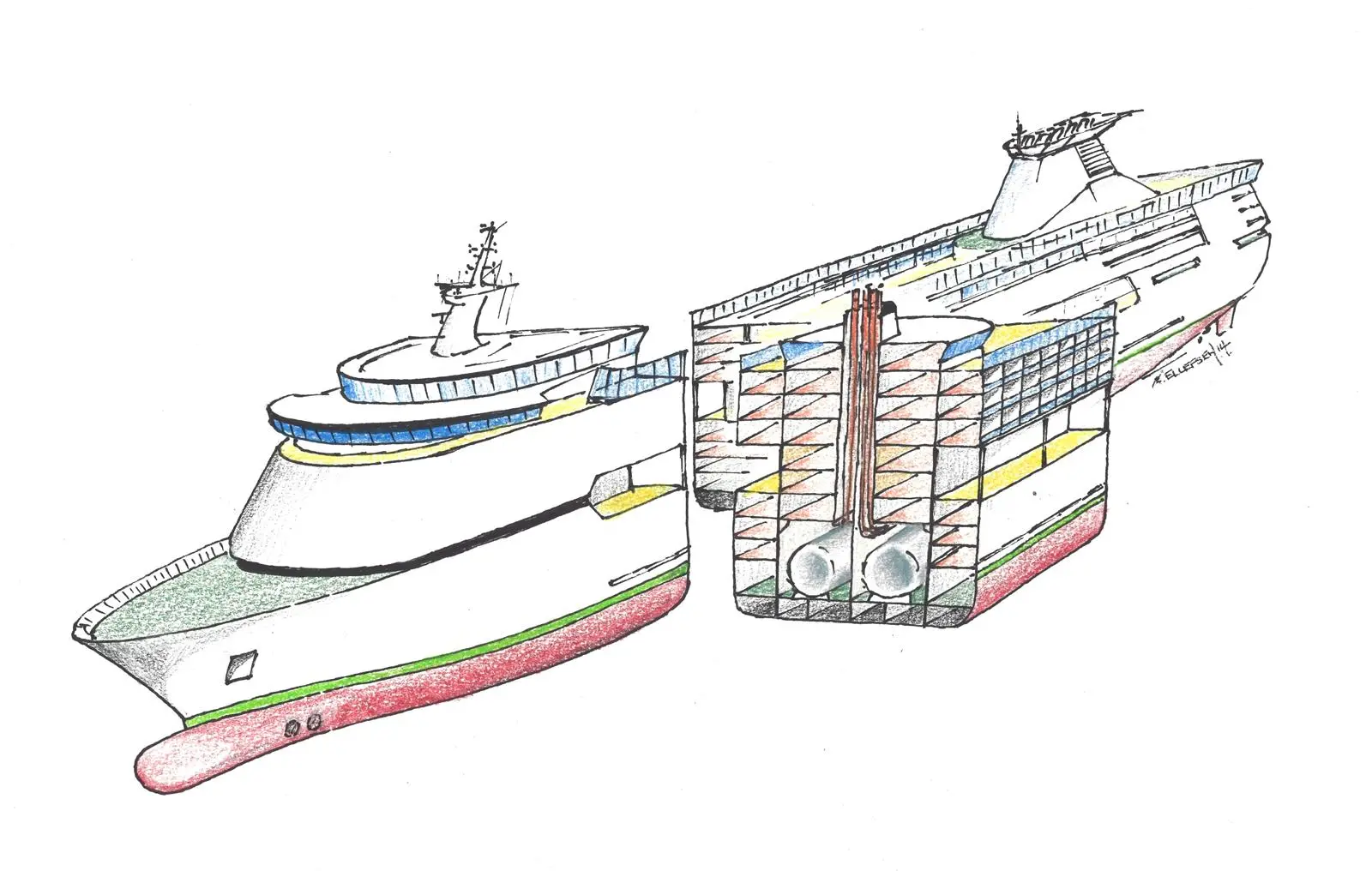
However, there’s one potential answer that may tip the balance-sheet: inserting a new prefabricated mid-body section containing all the LNG systems plus a number of additional cabins and public spaces. Passenger capacity, rather than diminishing, could grow by another 10%: on a 75,000 tonne vessel this might introduce another 120 cabins “so the new section helps pays for itself with new passengers” says Mr Chiotopoulos. Plus, there’s no need for the ship to be taken out of service for more than a few weeks.
This idea is not without its precursors, Mr Chiotopoulos hastens to add. Enchantment of the Seas was lengthened in 2005 by adding a 22m mid-body section although in this case the reason for the month-long conversion was simply in order to increase the number of cabins.
He points out the potential market is huge despite practicality considerations virtually eliminating either very large or very small cruise ships. This still leaves a good sized swathe. “The strongest candidates for conversion are the eight to 19-year-old ships between 40,000gt and 143,000gt. This represents almost 55% of the fleet,” he explains.
The size of the insert varies according to ship, the main determinant being an increase in longitudinal bending moment – this could become a showstopper if the hull is already designed to its optimum and cannot sustain any additional length. For most ships the maximum may be a complete fire zone, around 43m, while the practical minimum is half a fire zone.
However, even a 22m insert should allow enough space to house 1,500m³ of LNG in a cylindrical type C tank. While a prismatic, low-pressure type B tank is an alternative – increasing the LNG capacity by about 30% – it does make the build more complicated as a worst-case scenario of a ‘controllable fatigue crack’ has to be factored in for safety reasons.
Following the simpler solution, the DNV GL team calculated that having 1,500m³ of LNG onboard meant approximately 70% to 80% of all existing cruise itineraries could still be catered for while the remaining, longer routes could be supported by a second bunkering or dual fuel MGO/HFO capacity.
There are still some issues to resolve. A damage stability study is needed and the location of the bunker station could be problematic: Mr Chiotopoulos explained balconies, openings and lifeboats have to be outside a safety zone. Further, there are limits on the size of the tanks: over 7m or 8m diameter and they will interrupt the deck, plus the maximum tank length is under discussion now at IMO, with indications that this dimension could be limited to between 9% and 12% of the total vessel length. However, he says, this still should allow for bunkering of 1,500m³ of LNG.
Cutting the ship in half involves severing and splicing all the coordination systems, including cables, pipes and ducts – a job not to be underestimated. On an operational level the slow speed manoeuvring capability of the extended ship during port calls needs to be evaluated and this may require an increased thruster capacity. Also to be taken into account is the likely increase in potable, black and grey water capacity to cope with the extra passengers.
Mr Chiotopoulos adds that since there have recently been a lot of retrofit package developments, the possibility of converting the main engines to dual fuel could be investigated, but he admits the only option may be removing the ship’s entire HFO capability, including fuel treatment systems and tanks. This would free up space in the engine rooms for new LNG systems but it does leave the ship with MGO as its second fuel, resultings in a slight potential impact on the running bill.
On the plus-side, exploiting the properties of LNG such as cold recovery and a higher waste heat return makes the engine room more energy efficient, and this may balance out the need for additional hotel power.
Even given all this, it seems the option may be financially attractive and the DNV GL study concluded that it compares favourably to MGO and scrubber options when taking the four to nine year mark for payback. The full study is available online at http://www.dnv.com/binaries/LNG_RetrofitCruise_2014-03-L03_tcm4-596302.pdf.
Related Articles
 ALTERNATIVE FUELS & LUBRICANTS
 FUELS & LUBRICANTS