



Rising performance, widening options in LNG containment
A common thread in the LNG containment system evolutionary process is the improvement in system performance. Recent and impending fleet additions embodying advances in containment design are claimed to be capable of achieving a cargo boil-off rate (BOR) of just 0.08%/day. This may be compared with the 0.10%-0.12% attained by some of the latest tonnage, which had put down a new marker for the industry after the 0.15% level reached with ships constructed in the 1980s.
The small percentage gains belie the considerable absolute savings that stand to be accrued. To give added perspective to this progress, 1970s-built LNG tankers typically had a BOR of 0.25%.
Membrane systems from Gaz Transport & Technigaz (GTT) and Moss Maritime’s spherical tanks remain the pre-eminent technologies at sea today in the LNG carrier fleet, reflecting outstanding service track records dating from the 1970s. But commercial ambitions and vibrant technical endeavours have led to a situation where the LNG tanker and floating LNG (FLNG) markets are now presented with a considerably wider range of options in cryogenic cargo containment than ever before. Moreover, the engineering specialists have added another string to their bow in adapting existing technologies and developing new proposals for LNG bunker tanks, given the rising population of ships using LNG as fuel.
South Korea’s long-mooted KC-1 membrane containment system is set to make its seagoing debut within the next few years as part of the next stage of LNG carrier fleet development initiated by natural gas utility Korea Gas Corporation (KOGAS).
During August, KOGAS launched a tender for six 174,000m³ LNG carriers to transport shale gas from the Sabine Pass terminal in the US to Korean reception terminals over a 20-year period. The project stands to boost the domestic maritime industrial sector as a whole, since the tender is confined to South Korean shipping companies and requires construction in South Korean yards. Furthermore, the KOGAS stipulation that two of the planned newbuilds should incorporate the KC-1 tank system provides a platform for home-grown technology in a field dominated by overseas licensors.
The KC-1 solution was devised by KOGAS in collaboration with Daewoo Shipbuilding & Marine Engineering, Hyundai Heavy Industries and Samsung Heavy Industries, and drew on know-how from Korean subcontractors and universities. The motivation, at both corporate and national levels, has been to reduce reliance on foreign technology and the associated financial outgoings. Although Korean shipbuilders are the commanding global force in LNG carrier construction, the industry says that royalties equivalent to around 4-5% of newbuild prices are having to be paid to foreign licensors of the core technology of cargo containment.
The five-year development project, backed by the Korean Ministry of Knowledge Economy, saw the formulation of the KC-1 system in 2010, subsequently certified by major classification societies and the subject of more than 50 patent applications filed both at home and abroad. It is claimed that the structure is simpler and accordingly less costly to fabricate than existing membrane designs, and that the nature of the primary and secondary barrier arrangements offers the highest integrity in terms of leakage and thermal shock prevention.
The importance attached by Korean yards to reducing dependence on foreign containment technology, a move which could ultimately have a significant influence on the shipbuilding bottom line, has been underscored by the companion development of a raft of new system design proposals by individual builders. Thus, the hitherto narrow choice of options available to the client market has been widened not only by KC-1 but also by solutions from the ‘heavyweights’ in LNG carrier production.
Samsung unveiled its own technology in 2011 in the form of the Smart Containment-System Advanced (SCA) solution, and has recently presented a new version known as SCA-WS, claimed to offer a boil-off rate of 0.088% per day. Daewoo has now formulated a membrane-type system known as Solidus, complementing its earlier- developed Aluminium Cargo Tank Independent-type ‘B‘ (ACT-1B) containment design for LNG-FPSOs and LNGCs. Solidus features double stainless steel barriers and reinforced polyurethane insulation form. The secondary barrier is secured to the hull with load bearing mastic, and a mechanical fastening is used to ensure insulation panels stay in place in the event of any bonding detachment.
Hyundai is also ready to provide customers with an alternative to the established containment designs by way of its 2013-floated HMCCS membrane system for LNG carriers and LNG-FPSOs. The home-grown solution features STS304L and Invar-alloy barriers and new insulation panels of low-density polyurethane foam and glass fibre composite material, to achieve an indicated BOR of 0.09% per day.
Up till now, an absence of market uptake of indigenous Korean systems has meant that there is no service record by which necessarily conservative shipowners or charterers can judge new offerings against tried-and-tested cryogenic cargo containment designs. However, the operational introduction of KC-1 could kick-start a step change in the industry, and may open the way for the other Korean solutions.
In the meantime, and notwithstanding renewed investment of late in Moss spherical tank systems, membrane-type containment from French cryogenic engineering specialist Gaztransport & Technigaz (GTT) continues to predominate. Far from being complacent about its leading market position, GTT has augmented its offering with a succession of design enhancements and extensions, and is building a presence with its technology in the rapidly evolving fields of LNG bunkering and liquefied ethane transportation.
At the 2014 Gastech conference and exhibition in Seoul, GTT announced the strengthening of its portfolio through the Mark V and NO 96 MAX systems for LNG carriers. Both offer reductions in cargo evaporation, at a guaranteed BOR of 0.09% of cargo volume per day combined with an optimisation of the construction process and cost.
The Mark V design, a variant of the Mark III system, features a new, metallic secondary barrier, and has been made available for installation in LNGCs under construction from 2016 onwards. For release at the same time, the NO 96 Max arrangement is an upgrade of the NO 96 GW design, and incorporates an innovative pillar-type insulation box arrangement. In the NO 96 GW solution, glass wool replaced the perlite thermal insulation material of the NO 96 system.
Having provided membrane solutions in ethylene and LPG carriers since the 1960s, GTT is now promoting the technology for multi-gas vessels and very large ethane carriers (VLECs), demand for the latter having arisen by virtue of the US shale gas revolution. GTT contends that membrane containment maximises a given hull envelope’s cargo carrying potential and lends itself to ethane’s higher density in its liquid state.
Ethane is the second most important constituent of natural gas, after methane. Historically, ethane has been transported in small, liquefied ethane/ethylene/LPG carriers using Type ‘C’ containment systems. A Lloyd’s Register report estimates that the largest feasible size of ships with Type ‘C’ tanks is currently around 40,000m³, and it is felt that for ethane carriers of 80,000m³-plus, the adoption of either prismatic Type ‘B’ tanks or membrane systems would provide the likely best technical pathways, based on ships with three or four tanks.
In fact, an innovative tank design developed by the German company Hartmann Reederei has been nominated in a breakthrough VLEC deal announced in September. The Star-Trilobe containment system will be employed for a planned series of five 85,000m³ liquefied ethane tankers to the account of United Ethane Carriers, a joint venture of Jaccar Holdings of Luxembourg and the Hartmann Group. The Star-Trilobe configuration combines three cylinders into a single unit, achieving better utilisation of the cargo section, to the extent of a claimed 30% increase in cargo capacity relative to vessels of equivalent dimensions.
10-year time charters to Oriental Energy(Nanjing) have been secured for the VLECs, which will be further technically distinguished by dual-fuel two-stroke propulsion machinery suited to operation on ethane.
Another fleet project in which the design has been developed specifically in mind of the emerging demand for ethane transportation entails a series of four 35,000m³ liquefied ethane/ethylene carriers at Jiangnan Shipyard in China. Ordered by Navigator Gas, each vessel has been specified with cargo systems from TGE Marine of Bonn. The three-tank layout involves a maximum individual tank size of more than 12,000m³, rating the semi-refrigerated ships as the world’s largest with Type ‘C’ tanks.
It is anticipated that large-scale exports of ethane will become available from surplus US shale gas production and that international petrochemical companies will increasingly aim to diversify feedstock supplies through purchases of low-cost US ethane. TGE Marine is currently developing conceptual designs for ethane carriers larger than the 35,000dwt class due to be delivered to Navigator Gas through 2016.
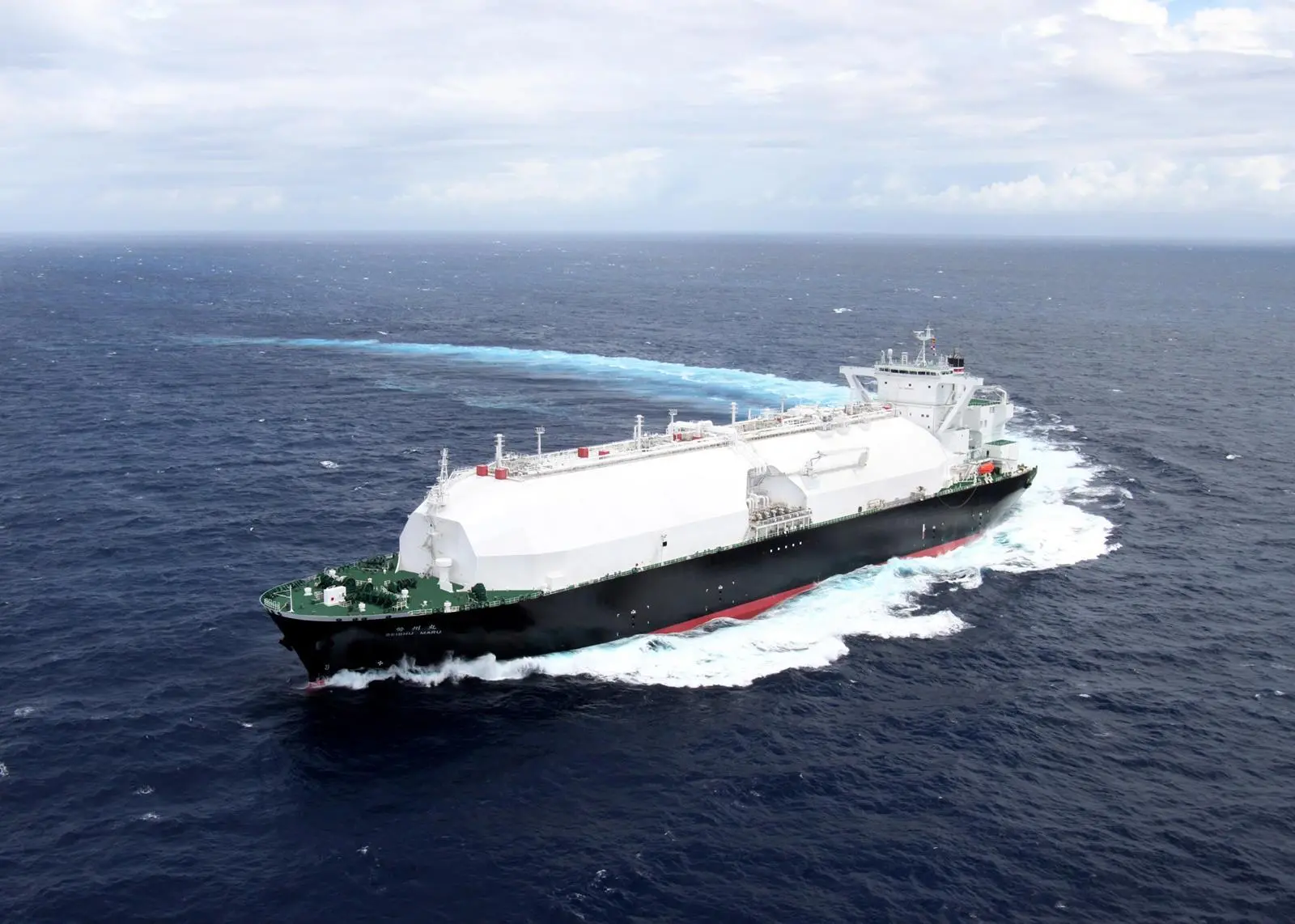
The Moss spherical cargo tank system is central to the innovative Sayaendo concept developed and built by Mitsubishi Heavy Industries. The unique design features four Moss tanks protected by a continuous cover integrated with the ship’s hull, and made its seagoing debut in the 155,000m³ LNG carrier Seishu Maru, delivered from MHI’s Nagasaki complex in September. Wilhemsen Technical Solutions, whose subsidiary TI Group supplied the cargo tank insulation, reported that the vessel completed her gas trial at the stipulated boil-off rate of just 0.08%.
The Sayaendo design transports 8,000m³ more than a typical 147,000m³ Moss-type LNG carrier without any increase in beam by using vertically stretched tanks that maintain the same tank diameter. It also offers a major advance in fuel efficiency through the adoption of MHI’s new ultra-steam turbine (UST) propulsion plant. Seishu Maru was built to the account of a Japanese consortium including NYK Line and Chubu Electric, and MHI has logged eight orders to date for Sayaendo LNGCs from various owners.
The design draws on the integrated hull structure (IHS) concept, used under licence from Aker Arctic Technology of Finland. As well as protecting the tanks, IHS provides enhanced longitudinal strength, while facilitating reduced overall steel weight and accommodating a greater tank size.
Aker Arctic has also licensed IHS to Hyundai Heavy Industries, which has been contracted by Petronas to build four 150,200m³-capacity LNG carriers, each incorporating four Moss spheres of about 42m diameter and the continuous tank cover structure. This type of cargo containment can accept any filling level and associated sloshing pressures.
After a gap of many years, the SPB prismatic independent type tank system was nominated for a Japanese LNG carrier deal announced in early 2014. Originally developed by Ishikawajima-Harima Heavy Industries (IHI), the IHI-SPB containment system was initially employed in two LNG tankers delivered in 1993 to serve a long-term contract with Philips/Marathon transporting Alaskan LNG to Japanese buyer Tokyo Gas. The exemplary service record of the Polar Eagle and Arctic Sun in maintaining 20 years’ uninterrupted operation across the rigorous waters of the north Pacific has provided Japan Marine United (JMU), the shipbuilding successor to IHI, with a solid basis for renewed marketing endeavours.
In the current newbuild project signed by JMU, the SPB system will be used for two tri-fuel diesel-electric, 165,000m³ ships booked by a consortium of Japanese owners on the strength of long-term contracts with Tokyo Gas.
The refinement of the concept in the intervening period is such that it is claimed that the new LNGCs will reach the ultra-low BOR of 0.08%/day. The SPB system is said to offer a proven immunity to sloshing problems and to facilitate hull optimisation. The flush weatherdeck is a potentially attractive feature for floating terminal and production vessel applications.
Type ‘C’ pressure vessels have been the preferred means of storing bunkers in ships other than gas carriers powered by machinery that uses LNG as fuel. But Type ‘B’ tank technology has been selected for LNG fuel storage in the new generation of 14,400TEU and 18,800TEU containerships ordered from Hyundai by United Arab Shipping Company(UASC) and pre-configured for dual-fuel operation. The nominated system is the IHI-SPB self-supporting prismatic design.
An important milestone was also denoted this year by the selection of GTT membrane technology for the fuel tanks in the Pegasis (power efficient gas innovative ship) newbuild ordered by Brittany Ferries from STX France. The ro-pax ferry was originally to be handed over by the end of 2016, while in addition, GTT was contracted to design the bunker tanks for three other vessels of Brittany Ferries’ fleet planned to be converted to LNG-fuelled propulsion. These plans have, however, been put on hold because the owner has failed to win a hoped-for temporary relaxation of sulphur emissions regulations in the English Channel and is going for exhaust gas scrubbers instead of gas fuel.
GTT is capitalising on its long experience in LNG containment by developing solutions along the whole supply chain dedicated to bunkering with LNG. After receiving recent approvals in principle (AIPs) for its 2,200m³ bunker barge design for the US market from major classification societies, the company has obtained an AIP from Bureau Veritas for a proposed 4,000m³ LNG bunker vessel employing the MkIII Flex membrane tank design.
An important new strategic move by GTT was denoted by the recent signing of a technical and licence agreement that made the Spanish company Gabadi its first licensed outfitter. The way is now clear for Gabadi to propose solutions to non-licensed shipyards for the integration and construction of GTT membrane containment systems, especially in small LNG carriers and LNG bunkering projects. The French licensor intends to create a network of such outfitters to facilitate access by all yards to GTT technology.
Related Articles
 PROPULSION
 GENERAL NEWS
 HYDROGEN