



2014 Support Sector Review: A changing game
A few of the earlier shifts have spurred on development: for example diminishing returns from the North Sea have triggered some interesting activities. David Bull of OSC says: “The oil is still there but this last 40% takes advanced technology and is much more capital intensive. The oil majors are stepping back a little to concentrate on bigger projects, making room for the smaller drilling companies who have expertise in getting the last drop out.”
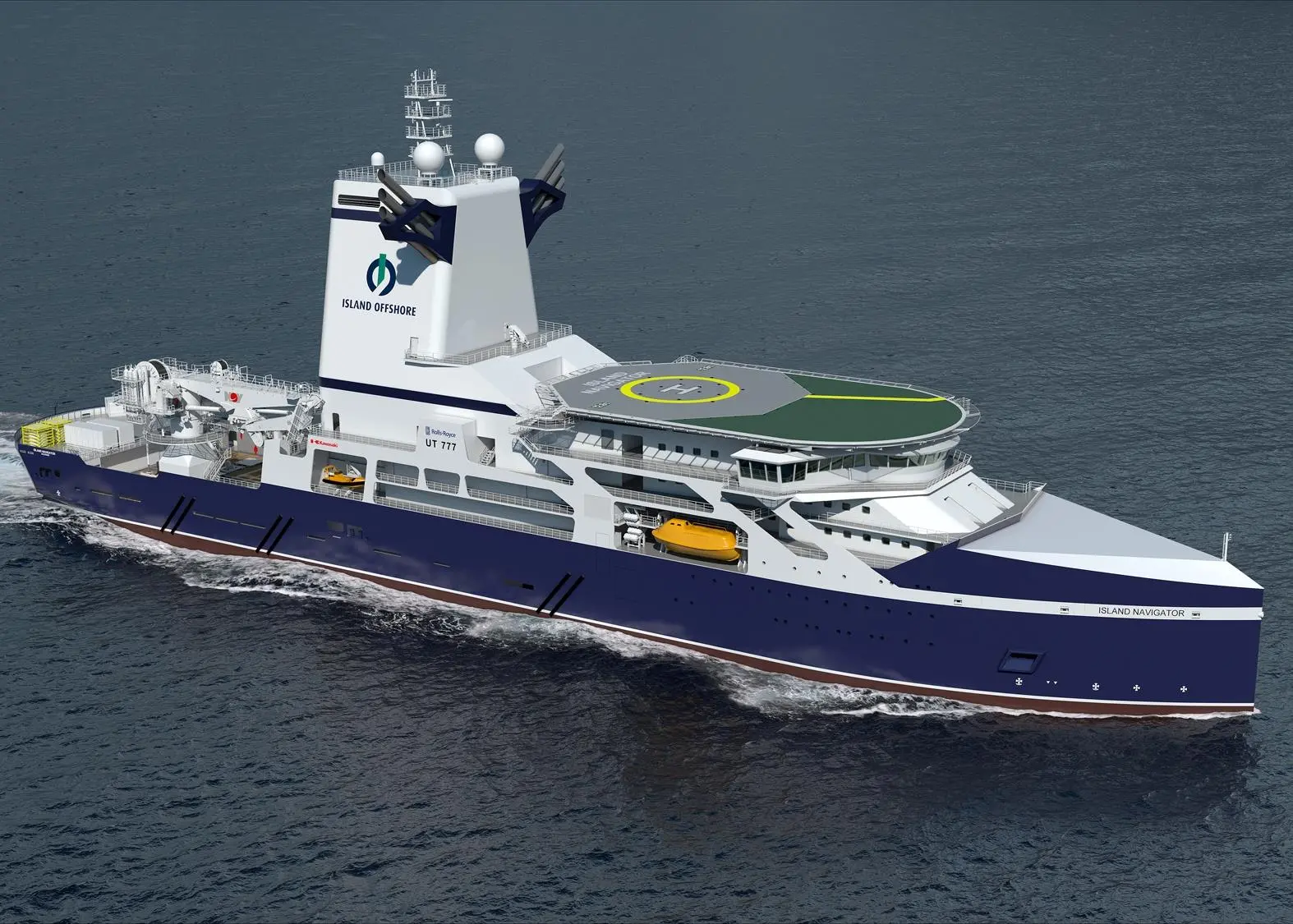
He adds: “It’s resulted in more specialist designs, and that’s why there’s been a sudden spike in new orders and recent deliveries for new kinds of well intervention vessels.” Most of these are positioning themselves to give a lift to the overall bottom line despite requiring huge investment: Island Performer showed off a relocated helideck and extended sheltering to open up riserless light well intervention windows while the UT777 design from Rolls-Royce for Island Offshore has been designed not just to take on all weathers but will also take over some top hole drilling from the rigs.
These are big orders, and not without risk. A February request from Siem Offshore for two, €140m well-intervention vessels from the German Flensburger Schiffbau-Gesellschaft (FSG) ended up with parent company Siem Industries taking over the FSG shipyard entirely following some speculation about the yard’s liquidity, following the bankruptcy of a main supplier.
Despite this, doing more with less remains the main theme and this has made room for new crossover designs. These seek to settle in the overlap between the new thriftiness of the oil and gas fields and the increasing scale of the renewable energy market, with rising safety consciousness being common to both. Walk-to-work designs from Royal Wagenborg, Vroon, Damen and others have been developed for serial visits of unmanned rigs and windfarms, with Damen being so certain of the future that 2014 saw it announcing that it was building its first vessel on spec.
But… a lot of these are very niche vessels with a limited market, and beyond this there’s the plunge of the oil price below that magic $100 per barrel, the point at which people say R&D begins to fall away. Where the ‘threshold’ level really lies is debatable says Mr Bull, but oil and gas field developments are already being pulled back hard in certain areas, with signs of the effect spreading.
Looking at the bigger picture Clarksons notes, after a stable run for three or four years “2014 has seen a significant fall in the overall number of offshore units ordered and their value”. It points out that worldwide fewer than 300 vessels of all types had been ordered by 30 September 2014, and while there’s a backlog on the orderbooks, there’s a question mark over what happens after these have been delivered. China, however, may be more resilient “as there’s growth in the domestic market” says Mr Bull, plus Japan’s entry into the upper end of the offshore sector has been clearly signalled by KHI’s build of the UT777 for Rolls Royce.
Still, this year has seen orders and deliveries of a handful of interesting European PSV developments, especially for those looking at extreme environments and tightening eco-legislation. For example, Havyard got the contract for a new 833WE ICE vessel that also incorporates a hybrid battery and diesel-electric propulsion to take the edge off both the peaks in the power demand and low loading. Further, there’s been a look into seeing whether batteries can take over some of the necessary DP redundancy with Viking Lady trialling the idea. It’s a development that may need lithium ion tech to back it up and whether the price and the power management has been sorted out enough to convince a largely conservative industry remains to be seen.
Wärtsilä on the other hand has been steadily increasing its share of the ship design market, with the recently delivered VS 4412 Rem Eir being its eighth LNG PSV: this has gone for a larger design to accommodate the dual fuel element. Wärtsilä’s also displaying a pragmatic approach to its VS 485 PSV MkIII ice design; since in reality the Arctic isn’t going to be open for business just yet the vessel is being built for ice class IB, then equipped for a lower spec with the idea that, for example, the propeller blades could be changed over for ice running when required.
Innovation rises in importance when things get tight as everyone hunts for a few percent efficiency, but this is balanced against greater risk aversion. So, the new Hull Vane from Van Oossanen Naval Architects, a hydrofoil that uses the energy for propulsion rather than purely lift, may be on the way to proving itself just in time: it has been fitted to one of a series of 55m OSVs, MS Karina, built at shipyard De Hoop and comparative sea trials showed a reduction in shaft power of 10% at 12 knots rising to 15% at 21 knots.
Unfortunately at the same time the rug maybe pulled out from underneath some of the most innovative stars of the show so far: Norwegian yards are faced with a stepping down in NOx fund support, an incentive that has successfully incubated a lot of very neat, green technology. It’s complicated – Kristian Døvik of the Business Sector`s NOx fund explains: “We have downscaled our support per kilo NOx reduced, for instance – and maybe most important – new buildings or retrofitting to gas propulsion …. may receive up to 80% support, maximum up to NOK200/kg NOx,” which is a big drop from NOK350. He goes on to explain that the rates “are dynamic and can be both scaled up or down” plus the whole agreement needs to be renegotiated in a couple of years.
However, he adds, the idea behind the fund is to taper off: “As the technology matures and prices go down, the share of the costs covered by the NOx fund can be kept stable even though support rates are reduced.”
Although his point is clear, needless to say the designers and yards may not quite see it that way – and with that fall in oil price there’s a ‘perfect storm’ on the horizon. Firstly, there are still a lot of prototypes which are heavy on investment, so that while some technology has indeed matured, a lot is still on that ‘rising curve’ as the fund and high oil prices have together allowed the oil majors to get pretty demanding. So Norway’s industry, which has by necessity focused on innovation rather than trying to compete on price, may not yet have wide enough margins to simply absorb a drop like this: one industry source admitting that the fund’s lower support rates will probably impact the overall demand for green tech and LNG propelled supply vessels if overall baseline investment costs can’t be reduced.
On the other hand, it looks as if the desire for LNG powered OSVs may pick up in the US. In fact Mr Bull believes that the next growth spurt will be driven by the US rather than Europe or Norway; this is partly down to tightening marine legislation and partly because the US may well have enough cheap gas to be able to make the market case for revolutionising its offshore support fleet, making a rather effective stick and carrot.
At the moment it’s being led by Harvey Gulf: this year saw the entry into service of Harvey Energy, the first of a series of six dual fuel PSVs being built by TY Offshore. Harvey meanwhile has said it may order as many as 10 of these STX SV310DF design vessels, which rely on Wärtsilä 34DF engines and LPac units with a 67,600 gallon LNG fuel tank. Alongside this, three new orders for a total of $540m are underway for a pair of STXCV heavy lift construction vessels from Eastern Shipbuilding.
The heavy lift ships, Harvey Sub-Sea and Harvey Blue-Sea, will soon join the operator’s 92.05m long, diesel-electric Harvey Deep-Sea (again an STXCV design) which came out in 2013. The two new vessels will each be 103.6m long with a beam of 22.3m and draught of 9m, having a capacious 1114.8m² of working deck, serviced by a 250 tonne active heave compensated crane which will give the ships the ability to deploy loads of 135 tonnes in water depths of 3,500m. All this will mean Harvey Gulf will (eventually) have the world’s largest fleet of LNG-powered OSVs and to match it, it has started construction of a $25m bunkering facility at its Port Fourchon, LA terminal.
Further, this run of activity prompted Jensen Maritime and LNG America to get together earlier in the year to develop a bunker barge solution: this will both distribute the fuel from LNG America’s Louisiana supply source to coastal terminals and to take on direct bunkering itself from tanks around 3,000m³. The most notable point is that they’ve gone for the simplest design solution in order to be ready to meet expected demand.
But the America’s support development isn’t all about LNG; Harvey Gulf has also purchased 11 of Gulf Offshore Logistics’ DP2 offshore supply and fast supply vessels, and it is broadening its horizons by starting work off the Mexican coast through a new subsidiary. This is based at Ciudad del Carmen in Campeche, close to the Mexican oil projects which are just now opening up to foreign interests as the Mexican government seeks to boost its diminishing oil returns.
Despite Mexico’s lead, Brazil, so far, remains stubbornly protectionist, and this year saw it having to scale back its offshore ambitions a little despite the riches that exist under the infamous ‘presalt’ layer: further there are still a number of gaps in capability. Vard Promar in Brazil in particular has pulled back the group’s profitability in the third quarter of 2014 to “marginally negative” said Vard. On the whole, whether Brazil will manage to bring the necessary skill sets on-board by cementing partnerships between local and foreign companies “remains to be seen” says Mr Bull.
While a lot of work, both in Brazil and worldwide, is going deeper because it makes sense to put the processing equipment down onto the seabed and out of the reach of the waves, it has given rise to challenges that aren’t purely about depth. Subsea installation costs have inexorably risen and Statoil recently pointed out that these have more than doubled in the last decade instead of falling. Getting away from individually tailored solutions is probably the biggest issue and Statoil, for example, is looking to establish a number of industrial standards to pin down costs.
Although this kind of initiative is focused primarily on the subsea interface modules and may have difficulty reaching up into the (as yet) relatively small fleet of subsea construction vessels, in the longer term numbers are predicted to rise and with it, the potential of gaining some economies of scale.
One last point: 2014 also held out the promise of a nascent support industry: KT Maritime Services Australia – a joint venture between Kotug and Teekay – was contracted to supply three 42m, 100-tonne bollard pull Rotortugs to act as Infield Support Vessels (ISVs) for Shell’s big Prelude FLNG project: although very new, with the demand for these offshore liquefaction plants rising it’s definitely a sector in the making. Although sadly it won’t offer more than a glimmer in what promises to be a tumultuous 2015.
Related Articles
 ALTERNATIVE FUELS & LUBRICANTS
 ALTERNATIVE FUELS & LUBRICANTS
 OPINION